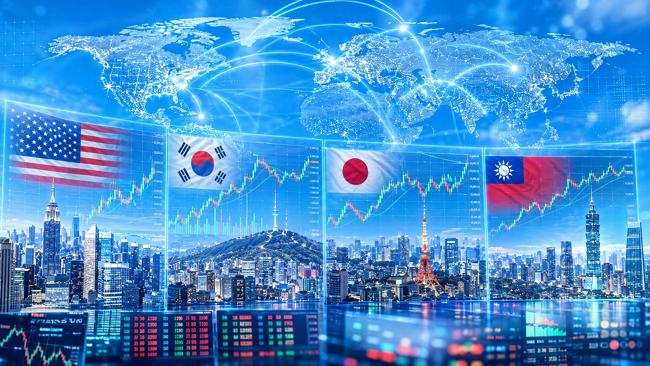
Global capital did not reduce risky assets across the board this week. Despite the risk in Hormuz and the burden of rising oil prices, the market did not sell all assets in the same direction. Instead, capital moved more finely by country, sector, and stock.
The key question for capital flows this week was simple.
Who can bear the costs, and who can grow profits?
In the US market, earnings dictated the direction of capital. The reason the US stock market did not collapse significantly despite increased Middle East risk is that corporate earnings supported the market's floor. As earnings announcements from major S&P 500 companies continued, the market more directly weighed revenue, margins, capital expenditures, and the impact of AI investments over war news.
However, capital moved selectively even within the US.
While capital flowed into AI infrastructure, power semiconductors, and some industrial goods, some software and cloud companies faltered due to concerns about slowing growth. The market is no longer moving solely based on the word "AI." It has begun to differentiate between companies where AI translates into actual revenue, profits, and productivity improvements, and those where it does not.
The capital flow in the Korean market should be read through the lens of semiconductors.
This is also why it is difficult to view the KOSPI's entry into record high territory as merely overheating. Even though the index has risen, valuation concerns are lower compared to major countries, and if the profit outlook for the semiconductor sector continues to be revised upwards, the market is looking at profits before prices.
The characteristic of capital circulation in Korea is that semiconductors lead the way, followed by some industrial and material sectors.
The structure is such that expanded AI demand and the recovery of the memory market are first reflected in semiconductors, and then expectations spread to cyclical industries such as shipbuilding, machinery, transportation, refining, and chemicals.
Therefore, the current Korean stock market is not simply a semiconductor-driven market, but rather a phase for confirming whether the improved profit expectations originating from semiconductors can spill over to other sectors.
Japan moves with a different logic.
The key to the Japanese stock market is fiscal expansion, yen depreciation, and liquidity.
Capital entering the Japanese market looks not only at corporate earnings but also at policy and monetary conditions. Taiwan's key benefit is direct exposure to the AI semiconductor supply chain centered around TSMC. While the US is the center of AI demand, Taiwan is regarded as the center of AI production.
China shows a relatively weak trend.
Policy expectations remain, but the intensity of stimulus measures, geopolitical burdens, and doubts about the speed of economic recovery are limiting capital inflows. Global capital has not completely abandoned China, but at least in this week's flow, it ranked lower than the US, Japan, Taiwan, and Korea.
If we were to put a name to this week's capital flows, it would be closer to "Selective Risk Appetite."
It was not a market that bought all risky assets, nor was it a market that sold them all. While acknowledging war risks, the market selected areas where profits are resilient, costs can be passed on, and which are linked to AI and productivity improvements.
This is how capital moved this week.
Uncertainty was not avoided, but assets that could withstand uncertainty were chosen.
Next week's checkpoints are threefold.
First, we need to see if the strong US earnings are spreading beyond tech stocks. If capital remains concentrated only in AI infrastructure and some large-cap stocks, the rotation may be limited.
Second, there is the possibility of further upward revision of the profit outlook for Korean semiconductors. The key to further KOSPI increases is the direction of the profit outlook, not the index level.
Third, we need to see if global capital continues to avoid China. If capital returns to China, the intra-Asian rotation structure could change, and conversely, if avoidance continues, the relative strength of Korea, Taiwan, and Japan could be maintained.
※ This article is a market commentary in article format, not investment advice. Actual stock prices and capital flows may vary depending on exchange rates, oil prices, geopolitical variables, corporate earnings, and policy changes.

 Iranian Foreign Ministry: "Continuing Message Exchanges with the U.S. and Activities of Mediating Countries"
Esmaeil Baghaei, Spokesperson for the Iranian Ministry of Foreign Affairs [Xinhua, Yonhap News file photo]Esmaeil Baghaei, spokesperson for the Iranian Ministry of Foreign Affairs, stated on the 26th
Iranian Foreign Ministry: "Continuing Message Exchanges with the U.S. and Activities of Mediating Countries"
Esmaeil Baghaei, Spokesperson for the Iranian Ministry of Foreign Affairs [Xinhua, Yonhap News file photo]Esmaeil Baghaei, spokesperson for the Iranian Ministry of Foreign Affairs, stated on the 26th
 President Yoon: "Do You Think You Are Safe from the Special Counsel?"... Final Statement Video Released
President Yoon Suk Yeol rebuking the special prosecutor on the 24th. [Court video / @birds_justice X account subtitle GIF] A video of President Yoon Suk Yeol's closing statement at his trial rega
President Yoon: "Do You Think You Are Safe from the Special Counsel?"... Final Statement Video Released
President Yoon Suk Yeol rebuking the special prosecutor on the 24th. [Court video / @birds_justice X account subtitle GIF] A video of President Yoon Suk Yeol's closing statement at his trial rega
 President Yoon, regarding the first-instance ruling on the Public Official Election Act: “An excessive political verdict that distorts the facts… We will appeal immediately.”
The first-instance sentencing hearing for President Yoon Suk Yeol regarding violations of the Public Official Election Act is being broadcast live at Seoul Station on the 27th. [Photo=Yonhap News]Pres
President Yoon, regarding the first-instance ruling on the Public Official Election Act: “An excessive political verdict that distorts the facts… We will appeal immediately.”
The first-instance sentencing hearing for President Yoon Suk Yeol regarding violations of the Public Official Election Act is being broadcast live at Seoul Station on the 27th. [Photo=Yonhap News]Pres
 WSJ: "SK Hynix ADR Premium Is a Sign of AI Trading Overheat"
Advertisement for SK Hynix ADR listing in New York's Times Square [Reuters=Yonhap News file photo]The Wall Street Journal (WSJ) has pointed out that the price of SK Hynix’s American Depositary Recei
WSJ: "SK Hynix ADR Premium Is a Sign of AI Trading Overheat"
Advertisement for SK Hynix ADR listing in New York's Times Square [Reuters=Yonhap News file photo]The Wall Street Journal (WSJ) has pointed out that the price of SK Hynix’s American Depositary Recei
 'Godfather of Japanese Mystery Novels' Keigo Higashino Passes Away After Battle with Cancer at 68
Famous Japanese mystery novelist Keigo Higashino [AFP=Yonhap News]It has been belatedly reported that Keigo Higashino, the "godfather of Japanese mystery novels" and author of bestsellers such as "The
'Godfather of Japanese Mystery Novels' Keigo Higashino Passes Away After Battle with Cancer at 68
Famous Japanese mystery novelist Keigo Higashino [AFP=Yonhap News]It has been belatedly reported that Keigo Higashino, the "godfather of Japanese mystery novels" and author of bestsellers such as "The
 [Park Pil-kyu Security Column] To the Ignorant Trying to Clothe a Beast in Sheep's Clothing
Rep. Kim Byung-joo of the Democratic Party of Korea [Photo=Yonhap News]“The Air Force Academy doesn't teach you how to fly a plane!” “The Army, Navy, and Air Force academies are exactly the
[Park Pil-kyu Security Column] To the Ignorant Trying to Clothe a Beast in Sheep's Clothing
Rep. Kim Byung-joo of the Democratic Party of Korea [Photo=Yonhap News]“The Air Force Academy doesn't teach you how to fly a plane!” “The Army, Navy, and Air Force academies are exactly the
 [Issue Diagnosis] Two Effects of the Election Petition Review
 [Photo] Evidence of Election Fraud Flooding U.S. Media… Trump Had 2.7 Million Votes Stolen
 [Video] U.S. Semiquincentennial Air Show... 'Art in the Sky' streaks across New York
 [Editorial Cartoon] A Draconian Law That Undermines Freedom of Expression

 List
List









