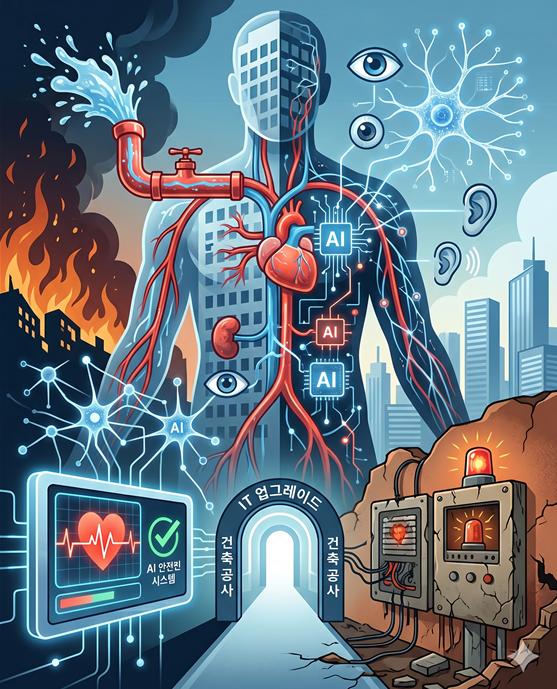
Modern buildings are like giant organisms. Electrical wiring is the nervous system transmitting power, sensors are the eyes and ears guarding the building, and plumbing is the digestive system responsible for circulation. And the red fire pipes flowing through them are the 'ultimate vessels' that spray life-saving water in case of a fire.
We spare no expense, spending hundreds of millions of won on the elaborate facades and interiors of buildings, yet we are remarkably indifferent to the fire safety systems directly connected to our lives. However, tranquility can transform into tragic consequences in mere minutes on the trial of fire. It is time to shift the paradigm from 'designed safety' to 'operational safety.' Building safety costs are not mere expenses; they are the most valuable investment for preserving life.
1. Apartment Options Centered on 'Home Appliances': Whose Responsibility is 'Safety'?
Today's apartment model homes are showcases of lavish interiors and popular home appliances. While there's an abundance of 'paid options' costing tens of millions of won, such as system air conditioners, built-in refrigerators, and imported marble countertops, 'advanced safety products' directly linked to residents' lives are nowhere to be found. Despite the existence of innovative safety technologies like intelligent detectors, fire warning systems, AI fire doors, and acoustic sensors, they are excluded from apartment option lists. This is due to the rigid fire safety standards of the National Fire Agency, the Ministry of Land, Infrastructure and Transport's cautious administration, mindful of potential disputes over rising housing prices and conflicts with appliance manufacturers.
While aesthetic values like interior design are treated with leniency, safety technologies directly related to life are neglected under the pretext of 'lack of standards.' Passive administration that disregards the lives of citizens is, in itself, dereliction of duty. To guarantee residential safety rights, relevant regulations must be immediately revised, and proactive administrative measures, such as introducing an 'Optional Safety System' allowing residents to choose advanced safety systems directly, and providing technological incentives, are urgently needed. The Ministry of Land, Infrastructure and Transport and the National Fire Agency must revise relevant regulations to include advanced safety products in apartment option lists and implement proactive administration that offers incentives for technology adoption.
2. AI Fire Safety That Detects Fire Signs Immediately: It's Time to Ensure It Through Legislation
The Shindorim Hotel fire on April 26th at approximately 7:58 AM proved that the key to saving lives in high-rise buildings is not the scale of the fire but 'rapid detection and evacuation.' Moving beyond past passive detection methods that only activated upon contact with smoke or heat, AI-based prediction systems that autonomously detect subtle fire signs are now gaining attention. In particular, by resolving the chronic problem of false alarms through data analysis, the urgent adoption of advanced safety technologies using AI neural networks beyond passive detection is necessary.
Innovative technologies such as AI-based detectors without false alarms and acoustic sensors have already proven their effectiveness in providing comprehensive, blind-spot-free predictive capabilities in the market. Therefore, the National Fire Agency and the Ministry of Land, Infrastructure and Transport must flexibly reform the national certification system to prevent innovative technologies from being hindered by outdated regulations and strengthen institutional support, such as including them in apartment option lists. Only when advanced fire safety technologies are chosen in the market and established within the institutional framework can the daily lives of all citizens be safely guaranteed from fire.
3. Replacing Aging Automatic Fire Alarm Systems: The Dilemma of Cost, Functional Interruption, and Damage
With four out of every ten buildings in Korea now over 30 years old, the 'replacement of automatic fire alarm systems' installed since 1990 has become an issue. Building owners and managers on-site are unable to replace aging automatic fire alarm systems due to the burdens of replacement cost (Budget), functional and operational interruption during replacement (Block), and damage to interiors (Visual). This is because the practice of 'wired cabling,' which has continued for over 70 years, necessitates extensive work, including tearing open ceilings.
In reality, hotels or nursing homes operating hundreds of rooms often postpone replacements due to concerns about operational downtime and damage to walls, leading to major tragedies in case of fire. It is time to transition to an 'IT upgrade' method that modernizes the system in just a few days with low labor costs, without tearing down walls, through 'wireless mesh network' technology. We must move towards an era that prioritizes safety, protecting human dignity through the harmonious integration of technology and personnel, going beyond simply extinguishing fires.
Check the fire alarm control panel in your building right now. A faint flicker might be the final warning of aging. The essence of safety that we must confront and accelerate is not safety confined to blueprints, but all-weather detectors and fire warning systems that operate immediately when fire signs appear.
◆ Cho Young-jin
CEO of Rose AI

 Iranian Foreign Ministry: "Continuing Message Exchanges with the U.S. and Activities of Mediating Countries"
Esmaeil Baghaei, Spokesperson for the Iranian Ministry of Foreign Affairs [Xinhua, Yonhap News file photo]Esmaeil Baghaei, spokesperson for the Iranian Ministry of Foreign Affairs, stated on the 26th
Iranian Foreign Ministry: "Continuing Message Exchanges with the U.S. and Activities of Mediating Countries"
Esmaeil Baghaei, Spokesperson for the Iranian Ministry of Foreign Affairs [Xinhua, Yonhap News file photo]Esmaeil Baghaei, spokesperson for the Iranian Ministry of Foreign Affairs, stated on the 26th
 President Yoon: "Do You Think You Are Safe from the Special Counsel?"... Final Statement Video Released
President Yoon Suk Yeol rebuking the special prosecutor on the 24th. [Court video / @birds_justice X account subtitle GIF] A video of President Yoon Suk Yeol's closing statement at his trial rega
President Yoon: "Do You Think You Are Safe from the Special Counsel?"... Final Statement Video Released
President Yoon Suk Yeol rebuking the special prosecutor on the 24th. [Court video / @birds_justice X account subtitle GIF] A video of President Yoon Suk Yeol's closing statement at his trial rega
 President Yoon, regarding the first-instance ruling on the Public Official Election Act: “An excessive political verdict that distorts the facts… We will appeal immediately.”
The first-instance sentencing hearing for President Yoon Suk Yeol regarding violations of the Public Official Election Act is being broadcast live at Seoul Station on the 27th. [Photo=Yonhap News]Pres
President Yoon, regarding the first-instance ruling on the Public Official Election Act: “An excessive political verdict that distorts the facts… We will appeal immediately.”
The first-instance sentencing hearing for President Yoon Suk Yeol regarding violations of the Public Official Election Act is being broadcast live at Seoul Station on the 27th. [Photo=Yonhap News]Pres
 WSJ: "SK Hynix ADR Premium Is a Sign of AI Trading Overheat"
Advertisement for SK Hynix ADR listing in New York's Times Square [Reuters=Yonhap News file photo]The Wall Street Journal (WSJ) has pointed out that the price of SK Hynix’s American Depositary Recei
WSJ: "SK Hynix ADR Premium Is a Sign of AI Trading Overheat"
Advertisement for SK Hynix ADR listing in New York's Times Square [Reuters=Yonhap News file photo]The Wall Street Journal (WSJ) has pointed out that the price of SK Hynix’s American Depositary Recei
 'Godfather of Japanese Mystery Novels' Keigo Higashino Passes Away After Battle with Cancer at 68
Famous Japanese mystery novelist Keigo Higashino [AFP=Yonhap News]It has been belatedly reported that Keigo Higashino, the "godfather of Japanese mystery novels" and author of bestsellers such as "The
'Godfather of Japanese Mystery Novels' Keigo Higashino Passes Away After Battle with Cancer at 68
Famous Japanese mystery novelist Keigo Higashino [AFP=Yonhap News]It has been belatedly reported that Keigo Higashino, the "godfather of Japanese mystery novels" and author of bestsellers such as "The
 [Park Pil-kyu Security Column] To the Ignorant Trying to Clothe a Beast in Sheep's Clothing
Rep. Kim Byung-joo of the Democratic Party of Korea [Photo=Yonhap News]“The Air Force Academy doesn't teach you how to fly a plane!” “The Army, Navy, and Air Force academies are exactly the
[Park Pil-kyu Security Column] To the Ignorant Trying to Clothe a Beast in Sheep's Clothing
Rep. Kim Byung-joo of the Democratic Party of Korea [Photo=Yonhap News]“The Air Force Academy doesn't teach you how to fly a plane!” “The Army, Navy, and Air Force academies are exactly the
 [Issue Diagnosis] Two Effects of the Election Petition Review
 [Photo] Evidence of Election Fraud Flooding U.S. Media… Trump Had 2.7 Million Votes Stolen
 [Video] U.S. Semiquincentennial Air Show... 'Art in the Sky' streaks across New York
 [Editorial Cartoon] A Draconian Law That Undermines Freedom of Expression

 List
List










