 From left to right: Kim Jong-tae, Kim Gil-rak, and Lee Moon-gyu, key instigators of the Tonghyokdang incident.
1968 was a year of extreme tension in the security environment of the Korean Peninsula. On January 21, 31 armed operatives from North Korea's Reconnaissance Bureau, Unit 124, infiltrated towards the Blue House via the Segeomjeong area in Jongno-gu, Seoul.
This was the so-called January 21 Incident. Following this, on January 23, the US Navy intelligence gathering ship USS Pueblo was captured by North Korea in international waters off the coast of Wonsan. Its 83 crew members were detained. On October 30 of the same year, approximately 120 armed communist guerrillas landed in the Uljin and Samcheok regions of Gangwon Province. Three major military provocations occurred within a single year.
Concurrently with these external pressures, the Tongil Hyokmyeong Dang (Revolutionary Party for Reunification) incident was uncovered within South Korea. While Tonghyokdang outwardly presented itself as a political organization, it was in reality an underground network linked to North Korea's strategy towards the South. Kim Jong-tae was the central figure. He was identified as an operative who received directives and acted in connection with Heo Bong-hak, the head of the North Korean Workers' Party's General Bureau for South Korean Affairs. According to investigation records, he was confirmed to have received 70,000 US dollars and 22.5 million Korean won in operational funds.
The organizational objective of Tonghyokdang was to escalate political chaos within South Korea and, at a specific juncture, to seize control of the Seoul metropolitan area through armed rebellion. Plans including the assassination of key figures, paralysis of administrative functions, and subversion of the system were revealed during the investigation and trial. This went beyond mere ideological activism or propaganda.
The organizational structure had expanded nationwide. Activities were confirmed in major cities such as Busan, Daegu, and Jeonju, centered around Seoul. Members included students, company employees, religious figures, and cultural professionals. This indicates that the organization targeted a diverse range of social groups, not a specific stratum.
Around August 1968, the Korean Central Intelligence Agency (KCIA) launched a large-scale crackdown. Investigations began primarily in the Jongno-gu and Jung-gu areas of Seoul and expanded to major provincial cities. Consequently, a total of 158 individuals were arrested, and 73 of them were referred to the prosecution. Of these, 23 were released without detention. The figures demonstrate the considerable scale of the organization.
However, the investigation revealed the organization's fragile structure. The communication system was simple, and document management was unsystematic. Tracking a specific individual would lead to the sequential discovery of related individuals. The decentralized structure and security measures that an underground organization should possess were not functioning.
The core issue revealed in this incident was a misjudgment of the reality. Tonghyokdang assessed the South Korean society as being in a state of rapid political transition. They believed that regime change was possible by expanding influence among students and intellectuals. However, South Korean society at the time was in the early stages of industrialization, and the state apparatus maintained strong control. Amidst repeated external provocations, it was difficult for an organization linked to North Korea to secure broad support.
The reliance on external support also acted as a limitation. The organization's strategies and direction were aligned with North Korean directives rather than internal discussions. This widened the gap with the local situation. A strategy relying on external directives with a weak internal foundation is difficult to sustain.
The leadership structure was also weak. Due to its centralized structure centered around Kim Jong-tae, the entire organization was quickly destabilized when its core figure was exposed. The fact that it was a network-centric structure, rather than a decentralized independent cell network, proved to be a critical weakness.
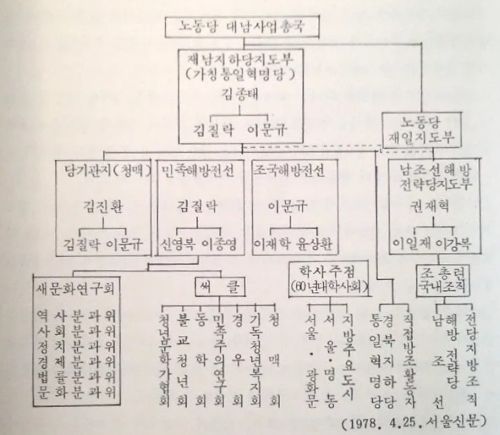 Tonghyokdang Organizational Chart
The judicial consequences were severe. Kim Jong-tae was executed on July 10, 1969. The death penalty was finalized for four key figures, including Lee Moon-gyu, by the Supreme Court on September 23, 1969. Many other related individuals received long prison sentences. The state viewed this incident not as a mere political event but as an attempt to subvert the regime.
The Tonghyokdang incident is distinct from the first Inhyokdang incident in 1964. The Inhyokdang incident later saw significant controversy regarding fabrication during retrial proceedings. In contrast, the Tonghyokdang incident is classified as a case where direct links to North Korea, operational activities, and fund transfers were concretely revealed during the investigation. The nature of the incident itself is different.
Another point worth noting is the record of an attempted reorganization in 1971. Even after the organization's collapse due to the 1968 arrests, there were movements to re-establish similar underground organizations. This indicates that the ideological current had not completely disappeared.
Following this incident, there was a shift in protest methods. As the dangers of a strategy centered on secret organizations became evident, the tendency towards public activism intensified. Student movements in universities, labor movements, and activities of civic organizations were in this direction. Although the approach changed, some ideological continuity was maintained.
The government's response also intensified. Triggered by the series of security incidents in 1968, vigilance increased regarding the potential for a combination of internal organizations and external provocations. Subsequently, the public security investigation system and intelligence gathering capabilities were expanded.
The Tonghyokdang incident was the result of three overlapping weaknesses: a lack of internal foundation, a fragile security structure, and excessive reliance on external support. With these three factors operating simultaneously, the organization could not be sustained long-term. While it existed in terms of scale, it did not achieve the power to mobilize society as a whole.
The figures from 1968 concisely illustrate the situation: 31 individuals who infiltrated near the Blue House, 83 Pueblo crew members detained, over 120 deployed in Uljin and Samcheok, 158 arrested and 73 referred to the prosecution in connection with Tonghyokdang. It was a year where external military pressure and internal organizational operations occurred simultaneously. However, the internal operations collapsed without securing social backing.
The Tonghyokdang incident demonstrates that the existence of an organization and the ability to influence society are entirely different matters. If the gap between strategy and reality is not narrowed, an organization cannot be sustained. This incident remains as a case study illustrating how that gap is revealed.
◆ Songsan
A poet and researcher of history and philosophy. Former director of the Syngman Rhee Institute. Currently serves as a research advisor for the Korean Modern and Contemporary History Research Association and as the representative of the philosophy forum Lyceum. He has published four poetry collections, co-translated 'Heroes of Hooko Archipelago,' and published 'Joseon Become Myth' and 'Humanities on the Tatami.' He is currently actively engaged in research and practice of liberal cultural movements. Songsan is a pen name.

 Iranian Foreign Ministry: "Continuing Message Exchanges with the U.S. and Activities of Mediating Countries"
Esmaeil Baghaei, Spokesperson for the Iranian Ministry of Foreign Affairs [Xinhua, Yonhap News file photo]Esmaeil Baghaei, spokesperson for the Iranian Ministry of Foreign Affairs, stated on the 26th
Iranian Foreign Ministry: "Continuing Message Exchanges with the U.S. and Activities of Mediating Countries"
Esmaeil Baghaei, Spokesperson for the Iranian Ministry of Foreign Affairs [Xinhua, Yonhap News file photo]Esmaeil Baghaei, spokesperson for the Iranian Ministry of Foreign Affairs, stated on the 26th
 President Yoon: "Do You Think You Are Safe from the Special Counsel?"... Final Statement Video Released
President Yoon Suk Yeol rebuking the special prosecutor on the 24th. [Court video / @birds_justice X account subtitle GIF] A video of President Yoon Suk Yeol's closing statement at his trial rega
President Yoon: "Do You Think You Are Safe from the Special Counsel?"... Final Statement Video Released
President Yoon Suk Yeol rebuking the special prosecutor on the 24th. [Court video / @birds_justice X account subtitle GIF] A video of President Yoon Suk Yeol's closing statement at his trial rega
 President Yoon, regarding the first-instance ruling on the Public Official Election Act: “An excessive political verdict that distorts the facts… We will appeal immediately.”
The first-instance sentencing hearing for President Yoon Suk Yeol regarding violations of the Public Official Election Act is being broadcast live at Seoul Station on the 27th. [Photo=Yonhap News]Pres
President Yoon, regarding the first-instance ruling on the Public Official Election Act: “An excessive political verdict that distorts the facts… We will appeal immediately.”
The first-instance sentencing hearing for President Yoon Suk Yeol regarding violations of the Public Official Election Act is being broadcast live at Seoul Station on the 27th. [Photo=Yonhap News]Pres
 WSJ: "SK Hynix ADR Premium Is a Sign of AI Trading Overheat"
Advertisement for SK Hynix ADR listing in New York's Times Square [Reuters=Yonhap News file photo]The Wall Street Journal (WSJ) has pointed out that the price of SK Hynix’s American Depositary Recei
WSJ: "SK Hynix ADR Premium Is a Sign of AI Trading Overheat"
Advertisement for SK Hynix ADR listing in New York's Times Square [Reuters=Yonhap News file photo]The Wall Street Journal (WSJ) has pointed out that the price of SK Hynix’s American Depositary Recei
 'Godfather of Japanese Mystery Novels' Keigo Higashino Passes Away After Battle with Cancer at 68
Famous Japanese mystery novelist Keigo Higashino [AFP=Yonhap News]It has been belatedly reported that Keigo Higashino, the "godfather of Japanese mystery novels" and author of bestsellers such as "The
'Godfather of Japanese Mystery Novels' Keigo Higashino Passes Away After Battle with Cancer at 68
Famous Japanese mystery novelist Keigo Higashino [AFP=Yonhap News]It has been belatedly reported that Keigo Higashino, the "godfather of Japanese mystery novels" and author of bestsellers such as "The
 [Park Pil-kyu Security Column] To the Ignorant Trying to Clothe a Beast in Sheep's Clothing
Rep. Kim Byung-joo of the Democratic Party of Korea [Photo=Yonhap News]“The Air Force Academy doesn't teach you how to fly a plane!” “The Army, Navy, and Air Force academies are exactly the
[Park Pil-kyu Security Column] To the Ignorant Trying to Clothe a Beast in Sheep's Clothing
Rep. Kim Byung-joo of the Democratic Party of Korea [Photo=Yonhap News]“The Air Force Academy doesn't teach you how to fly a plane!” “The Army, Navy, and Air Force academies are exactly the
 [Issue Diagnosis] Two Effects of the Election Petition Review
 [Photo] Evidence of Election Fraud Flooding U.S. Media… Trump Had 2.7 Million Votes Stolen
 [Video] U.S. Semiquincentennial Air Show... 'Art in the Sky' streaks across New York
 [Editorial Cartoon] A Draconian Law That Undermines Freedom of Expression

 List
List










