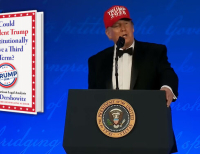
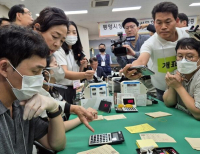
This visualizes the flow of global funds into South Korea's AI supply chain, while simultaneously showing some funds adjusting their positions. [Photo: Hanmi Ilbo Synthesis]
The theme for this week's market movement is "The Clash Between Premium and Position Adjustment."
This week, funds did not leave the market; they strategically repositioned themselves. Early in the week, global capital flowed into AI semiconductors and data center infrastructure.
In the U.S. market, buying interest concentrated on memory, AI chips, network equipment, and data center-related stocks.
In the Korean market, large-cap semiconductor stocks, led by Samsung Electronics and SK Hynix, once again became the benchmark for fund flows.
However, the core of this fund rotation is not simply a bullish trend in semiconductors.
This week, two forces were simultaneously at play in the Korean market.
One is the "premium" logic suggesting that South Korea should be bought more. The other is the "rebalancing" logic that necessitates reducing positions in South Korea, which have risen too quickly. Consequently, this week's fund flows were unstable, even amidst a rising market.
This week's Capital Rotation Radar has one central question: Are the funds entering the Korean market driven by conviction, or are they chasing the rally before further position adjustments?
Three structural observations were confirmed in this week's market.
First, global capital has revisited the AI supply chain.
AI data center investment is not solely about GPUs. As data centers expand, memory, storage devices, network equipment, and power infrastructure become essential. This is why funds this week rapidly shifted towards AI semiconductor sub-sectors such as memory, storage, and server infrastructure-related stocks.
South Korea's connection to this trend provided foreign capital with a reason to look at Korea again.
Second, the expectation of inclusion in the MSCI developed market index has begun to function as a "premium" argument for Korea.
In the past, the Korean market was a large market within emerging economies. However, with the recent growth in the stock market's size and the government's efforts to improve foreign investor accessibility and refine capital market regulations, expectations for developed market index inclusion are re-emerging.
What's important is not just how much passive money flows in. The greater significance lies in the potential for a different pool of capital to invest in Korea.
Long-term funds, pension funds, sovereign wealth funds, and large active funds with limitations on emerging market exposure may begin to view Korea through a different lens.
Third, foreign position adjustments have remained a burden within the uptrend.
If Korean stocks rise faster than other emerging markets, Korea's weighting within emerging market funds automatically increases. In such cases, foreigners may sell not because they view Korea negatively, but to reduce their overweight position relative to the benchmark.
The more Korea performs well, the more selling pressure some foreign investors face. The correction later this week highlighted this risk again.
This week's fund rotation was not a one-way movement.
While money flowed into semiconductors and AI infrastructure, sectors with defensive characteristics like energy, consumer staples, and healthcare also gained attention as oil prices and interest rate burdens increased.
Funds were not reducing risk, but rather beginning to differentiate between risks.
South Korea's market position has also shifted.
Korea is no longer a market bought solely due to undervaluation. It is now a market where the AI supply chain, memory semiconductors, export benefits from a weak won, and MSCI inclusion expectations are all simultaneously at play.
Consequently, the reasons to buy Korea have increased, but so have the reasons to adjust prices that have risen sharply.
Next week's viewing points are threefold:
First, we need to confirm whether foreign investors continue to buy large-cap Korean semiconductor stocks.
Second, we should observe how quickly Korea-related Exchange Traded Funds (ETFs) and KOSPI 200 nighttime futures recover after any adjustments.
Third, we need to examine whether the weak won acts as both a positive for export stocks and a burden for foreign capital simultaneously.
The conclusion from this week's Capital Rotation Radar is as follows: The Korean market has entered a phase where it is being tested as to whether it is a market to buy even if it becomes more expensive, rather than simply a cheap market to buy.
※ This article is for reference and analysis to understand market trends and fund movements, not an investment recommendation for specific stocks or financial products. Actual market and stock prices may vary due to various factors such as interest rates, exchange rates, oil prices, policies, corporate earnings, and supply-demand changes. The final investment decision and responsibility lie with the investor.

 [Statement by the Seobeokka KMA Patriots Association] ㉛ Recount the ballots openly, as the previous recount covered up election fraud
Recount of the Tongyeong mayoral election [Photo=Yonhap News]South Korea's liberal democracy is dying. The National Election Commission (NEC), which has degraded into a criminal organization through t
[Statement by the Seobeokka KMA Patriots Association] ㉛ Recount the ballots openly, as the previous recount covered up election fraud
Recount of the Tongyeong mayoral election [Photo=Yonhap News]South Korea's liberal democracy is dying. The National Election Commission (NEC), which has degraded into a criminal organization through t
 What is the significance of the "Trump 2028" red hat that keeps reappearing?
It is noteworthy that while it is "highly likely" that President Donald Trump is "seriously considering" a run for the presidency in 2028, he is also "deliberately" fueling speculation regarding wheth
What is the significance of the "Trump 2028" red hat that keeps reappearing?
It is noteworthy that while it is "highly likely" that President Donald Trump is "seriously considering" a run for the presidency in 2028, he is also "deliberately" fueling speculation regarding wheth
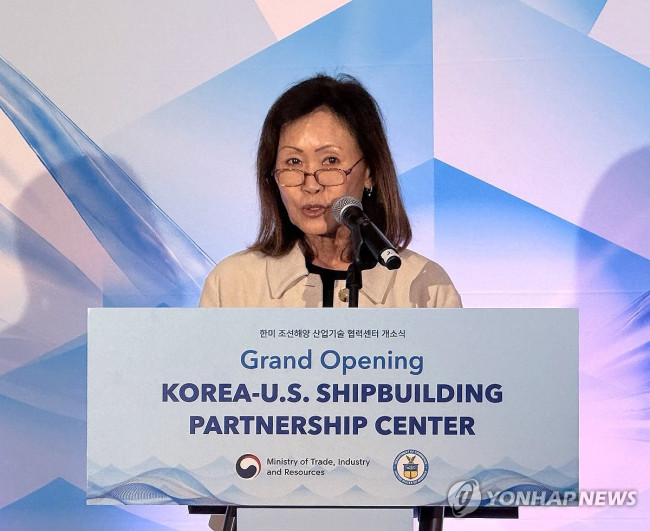 First U.S. Ambassador of Trump's Second Term to Arrive This Week… Will It Provide Momentum to Resolve Pending Issues?
U.S. Ambassador to South Korea Michelle Steel speaks at the opening ceremony of the Korea-U.S. Shipbuilding Cooperation Center held at the Mayflower Hotel in Washington, D.C., on the 23rd (local time)
First U.S. Ambassador of Trump's Second Term to Arrive This Week… Will It Provide Momentum to Resolve Pending Issues?
U.S. Ambassador to South Korea Michelle Steel speaks at the opening ceremony of the Korea-U.S. Shipbuilding Cooperation Center held at the Mayflower Hotel in Washington, D.C., on the 23rd (local time)
 President Yoon, regarding the first-instance ruling on the Public Official Election Act: “An excessive political verdict that distorts the facts… We will appeal immediately.”
The first-instance sentencing hearing for President Yoon Suk Yeol regarding violations of the Public Official Election Act is being broadcast live at Seoul Station on the 27th. [Photo=Yonhap News]Pres
President Yoon, regarding the first-instance ruling on the Public Official Election Act: “An excessive political verdict that distorts the facts… We will appeal immediately.”
The first-instance sentencing hearing for President Yoon Suk Yeol regarding violations of the Public Official Election Act is being broadcast live at Seoul Station on the 27th. [Photo=Yonhap News]Pres
 91% of Net Influx of MZ Generation Goes to Seoul Metropolitan Area… Population Migration Also Shows 'K-shaped Polarization' by Industry
[Provided by Leaders Index]Over the past four years, the MZ generation population has become increasingly concentrated in the Seoul metropolitan area and the Chungcheong region. While cities cen
91% of Net Influx of MZ Generation Goes to Seoul Metropolitan Area… Population Migration Also Shows 'K-shaped Polarization' by Industry
[Provided by Leaders Index]Over the past four years, the MZ generation population has become increasingly concentrated in the Seoul metropolitan area and the Chungcheong region. While cities cen
 'Godfather of Japanese Mystery Novels' Keigo Higashino Passes Away After Battle with Cancer at 68
Famous Japanese mystery novelist Keigo Higashino [AFP=Yonhap News]It has been belatedly reported that Keigo Higashino, the "godfather of Japanese mystery novels" and author of bestsellers such as "The
'Godfather of Japanese Mystery Novels' Keigo Higashino Passes Away After Battle with Cancer at 68
Famous Japanese mystery novelist Keigo Higashino [AFP=Yonhap News]It has been belatedly reported that Keigo Higashino, the "godfather of Japanese mystery novels" and author of bestsellers such as "The
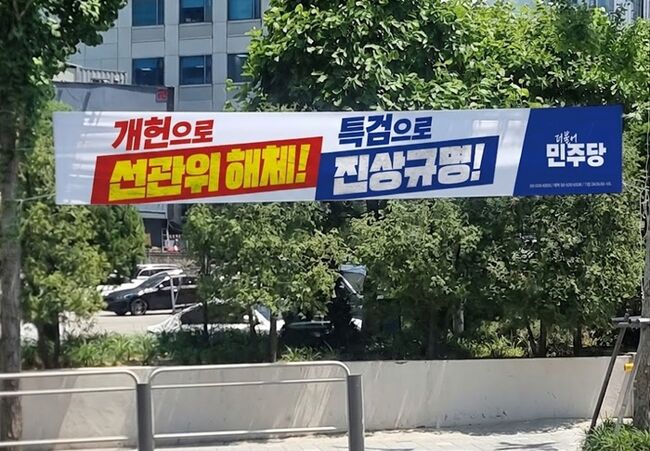 [Cho Yang-geon Column] The NEC: Facing a Fate of "Discarding the Dog After the Hunt"
Banner calling for the "dissolution of the NEC" posted by the Democratic Party. [AI-generated image]Banners calling for the "dissolution of the National Election Commission (NEC)" posted by the Democr
[Cho Yang-geon Column] The NEC: Facing a Fate of "Discarding the Dog After the Hunt"
Banner calling for the "dissolution of the NEC" posted by the Democratic Party. [AI-generated image]Banners calling for the "dissolution of the National Election Commission (NEC)" posted by the Democr
 [Photo] Evidence of Election Fraud Flooding U.S. Media… Trump Had 2.7 Million Votes Stolen
 [Video] U.S. Semiquincentennial Air Show... 'Art in the Sky' streaks across New York
 [Editorial Cartoon] A Draconian Law That Undermines Freedom of Expression

 List
List