
The summit between South Korea and Japan held in Andong, Gyeongbuk, was not merely a diplomatic event. The message was clear from the very location chosen by the leaders of both nations. It was a strategic meeting aimed at breaking free from the frame of historical grievances and redesigning the survival structure of all of East Asia. This summit posed the question of whether South Korea and Japan should move beyond mere 'cooperation and collaboration' to consider a Japan-Korea alliance as a unified strategic system.
In ancient times, South Korea and Japan exchanged civilizations such as rice cultivation and Buddhism. During the Three Kingdoms period, they formed close geopolitical diplomatic relations, including military alliances between Baekje and Wa. However, they also left deep historical scars of brutal provocations and sovereignty infringements through the Imjin War and Japanese colonial rule.
Following liberation, the normalization of diplomatic relations in 1965, carried out under the Cold War order, served as a crucial economic catalyst for South Korea's industrialization and national strengthening, despite the pain of past history.
Today, both South Korea and Japan stand together before the immense storm of confrontation on the 'First Island Chain,' the frontline against China's expansion, and the global supply chain crisis. The time has come to reject sentimental ideology and actively consider a 'Japan-Korea Alliance,' a security and economic union for the sake of cold, hard national interest and survival.
The strategic environment in East Asia is rapidly changing. China's naval buildup, Russia's rearmament of the Far East, and North Korea's advancement of nuclear and missile capabilities are not mere fluctuations in international affairs. They demand a military tectonic shift that reorganizes South Korea, Japan, and Taiwan into a single theater of operations. In this situation, for South Korea and Japan to remain 'neighbors too far to embrace' by clinging to old emotions is a outdated perception that ignores the harsh realities of international politics.
Just as South Korea and North Korea are a single territory indivisible by constitution, the immense geopolitical changes of the 21st century make us realize that South Korea and Japan are also not two separate countries. Both nations must break free from the emotional framework of historical grievances, a long-standing burden, and become a realistic alliance. Emotion cannot be the standard for strategies that determine a nation's survival.
The strategy most favored by North Korea, China, and Russia is the separation of South Korea and Japan. While conflict over past history may appear to be an internal issue, it is in reality strategic disruption utilized by external forces and an anti-Japan cartel. It is time for South Korea to take the initiative and propose a 'Japan-Korea Alliance,' a security and economic union, shedding the emotional shackles that waste national energy.
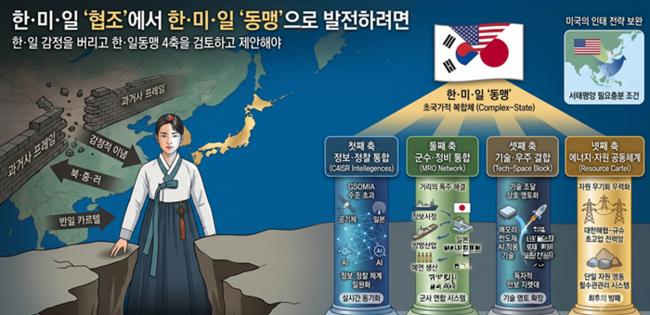
South Korea and Japan are already functionally a single organism. A 'Japan-Korea Alliance' is not an option but a structural inevitability, not a matter of cooperation but of combined military operations. This is an inevitable response to the military consolidation of North Korea, China, and Russia. The 'Japan-Korea Alliance' that South Korea and Japan must build is a strategic union and integration of four pillars.
First Pillar: Integration of Intelligence and Reconnaissance (C4ISR Intelligence)
The first pillar of a 'Japan-Korea Alliance' is the 'physical unification of intelligence and reconnaissance systems,' going beyond the level of the General Security of Military Information Agreement (GSOMIA). South Korea's ultra-precise military satellites and surveillance assets targeting North Korea must be synchronized in real-time with Japan's extensive signals intelligence (ELINT) and maritime early warning capabilities through artificial intelligence (AI) analysis. When the eyes and ears of both nations are connected as a single organism, deceptive and surprise provocations and cyber intrusions by North Korea, China, and Russia can be thwarted.
Second Pillar: Integration of Logistics and Maintenance (MRO Network)
The belt-style shipbuilding, defense, and ammunition production capabilities along South Korea's southern coast, renowned globally, must be organically combined with the frontline forward base infrastructure of the Japanese archipelago. This is a solution to the limitations of a 5,000-mile long supply line from the U.S. mainland. If a military alliance system is established where South Korea's ammunition and maintenance (MRO) belt is interlocked in real-time with Japan's ports and bases in times of contingency, a massive ironclad seawall can be completed to deter the 'First Island Chain,' China's territorial expansion front.
Third Pillar: Convergence of Technology and Space (Tech-Space Block)
By uniting South Korea's world-leading cutting-edge memory semiconductor and AI application technologies with Japan's exclusive advantages in compound semiconductor materials and equipment, and its advanced aerospace technology, into a single alliance, it signifies 'mutual territorialization of technology procurement' beyond simple bilateral industrial cooperation. A unique technology and space bloc formed by both nations will become an independent security leverage that no one can infringe upon.
Fourth Pillar: Joint Energy and Resource System (Resource Cartel)
China's critical weaponization of resources and supply chain disruptions must be fundamentally blocked by connecting the 'Korea Strait–Kyushu high-voltage power grid' and establishing a 'South Korea-Japan Joint Critical Mineral Management System.' The energy arteries of both nations and the stockpiles of essential resources such as rare earth elements must be organically integrated and declared as a single resource territory. This joint alliance system, which ensures mutual cross-guarantee of pre-stocked supplies and power without isolation in extreme crisis situations where Sea Lines of Communication (SLOC) are threatened, will become the ultimate shield to neutralize the serial provocations of North Korea, China, and Russia.
A 'Japan-Korea Alliance' is not a substitute for the ROK-U.S. alliance. It signifies the completion of a 'ROK-U.S.-Japan Alliance' that realizes the U.S.'s Indo-Pacific strategy. If the 'ROK-U.S.-Japan Alliance' undergoes new formation and training, it can resolve reckless actions and maintain logistics and maintenance independently in the Western Pacific, and jointly deter China's naval expansion. Therefore, for the U.S. to expand its global operational radius and maintain the Western Pacific, a 'Japan-Korea Alliance' is a necessary and sufficient condition.
If a 'Japan-Korea Alliance' succeeds, it can develop into a national union. Emotions are variables, but geopolitics are constants. Once a 'Japan-Korea Alliance' is established, South Korea and Japan will not be two separate countries. They will become a single security and economic bloc that no one can touch. Even before its realization, it is a military organism that provides immense energy.
From proposal to realization, a 'Japan-Korea Alliance' will encounter countless emotional resistances, but if South Korea and Japan are to survive together, it is now time to consider and design a 'Japan-Korea Alliance.' The next 100 years for South Korea and for ROK-U.S.-Japan will be determined by how it is designed. Dreams must be realized.

◆ Park Pil-gyu
Editorial Board Member, The Hankook Ilbo
40th Class, Korea Military Academy

 Iranian Foreign Ministry: "Continuing Message Exchanges with the U.S. and Activities of Mediating Countries"
Esmaeil Baghaei, Spokesperson for the Iranian Ministry of Foreign Affairs [Xinhua, Yonhap News file photo]Esmaeil Baghaei, spokesperson for the Iranian Ministry of Foreign Affairs, stated on the 26th
Iranian Foreign Ministry: "Continuing Message Exchanges with the U.S. and Activities of Mediating Countries"
Esmaeil Baghaei, Spokesperson for the Iranian Ministry of Foreign Affairs [Xinhua, Yonhap News file photo]Esmaeil Baghaei, spokesperson for the Iranian Ministry of Foreign Affairs, stated on the 26th
 President Yoon: "Do You Think You Are Safe from the Special Counsel?"... Final Statement Video Released
President Yoon Suk Yeol rebuking the special prosecutor on the 24th. [Court video / @birds_justice X account subtitle GIF] A video of President Yoon Suk Yeol's closing statement at his trial rega
President Yoon: "Do You Think You Are Safe from the Special Counsel?"... Final Statement Video Released
President Yoon Suk Yeol rebuking the special prosecutor on the 24th. [Court video / @birds_justice X account subtitle GIF] A video of President Yoon Suk Yeol's closing statement at his trial rega
 President Yoon, regarding the first-instance ruling on the Public Official Election Act: “An excessive political verdict that distorts the facts… We will appeal immediately.”
The first-instance sentencing hearing for President Yoon Suk Yeol regarding violations of the Public Official Election Act is being broadcast live at Seoul Station on the 27th. [Photo=Yonhap News]Pres
President Yoon, regarding the first-instance ruling on the Public Official Election Act: “An excessive political verdict that distorts the facts… We will appeal immediately.”
The first-instance sentencing hearing for President Yoon Suk Yeol regarding violations of the Public Official Election Act is being broadcast live at Seoul Station on the 27th. [Photo=Yonhap News]Pres
 WSJ: "SK Hynix ADR Premium Is a Sign of AI Trading Overheat"
Advertisement for SK Hynix ADR listing in New York's Times Square [Reuters=Yonhap News file photo]The Wall Street Journal (WSJ) has pointed out that the price of SK Hynix’s American Depositary Recei
WSJ: "SK Hynix ADR Premium Is a Sign of AI Trading Overheat"
Advertisement for SK Hynix ADR listing in New York's Times Square [Reuters=Yonhap News file photo]The Wall Street Journal (WSJ) has pointed out that the price of SK Hynix’s American Depositary Recei
 'Godfather of Japanese Mystery Novels' Keigo Higashino Passes Away After Battle with Cancer at 68
Famous Japanese mystery novelist Keigo Higashino [AFP=Yonhap News]It has been belatedly reported that Keigo Higashino, the "godfather of Japanese mystery novels" and author of bestsellers such as "The
'Godfather of Japanese Mystery Novels' Keigo Higashino Passes Away After Battle with Cancer at 68
Famous Japanese mystery novelist Keigo Higashino [AFP=Yonhap News]It has been belatedly reported that Keigo Higashino, the "godfather of Japanese mystery novels" and author of bestsellers such as "The
 [Park Pil-kyu Security Column] To the Ignorant Trying to Clothe a Beast in Sheep's Clothing
Rep. Kim Byung-joo of the Democratic Party of Korea [Photo=Yonhap News]“The Air Force Academy doesn't teach you how to fly a plane!” “The Army, Navy, and Air Force academies are exactly the
[Park Pil-kyu Security Column] To the Ignorant Trying to Clothe a Beast in Sheep's Clothing
Rep. Kim Byung-joo of the Democratic Party of Korea [Photo=Yonhap News]“The Air Force Academy doesn't teach you how to fly a plane!” “The Army, Navy, and Air Force academies are exactly the
 [Issue Diagnosis] Two Effects of the Election Petition Review
 [Photo] Evidence of Election Fraud Flooding U.S. Media… Trump Had 2.7 Million Votes Stolen
 [Video] U.S. Semiquincentennial Air Show... 'Art in the Sky' streaks across New York
 [Editorial Cartoon] A Draconian Law That Undermines Freedom of Expression

 List
List










