Samsung Electronics [Seoul=Yonhap News]
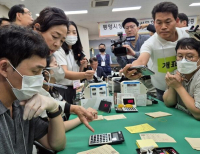
With Samsung Electronics' labor and management reaching an agreement on performance-based pay disputes on the 20th, avoiding a strike, hopes are rekindled that the semiconductor boom, which has led the economic recovery phase, will continue.
The Korean economy is expected to achieve higher growth than last year by expanding industrial production and stimulating domestic demand, leveraging the semiconductor super cycle this year.
However, challenges remain, including the persistent inflation stemming from the Middle East conflict, which is increasing the burden on households across the economy.
Experts have urged the government to focus on price stability to prepare for the impact of rising interest rates and to identify growth engines for the future.
◇ Samsung Electronics Avoids Crisis... "Full-scale Strike Could Lower Growth Rate by Up to 0.5%p"
After prolonged negotiations, Samsung Electronics averted the worst-case scenario of halting production amidst high demand that outstrips supply, by reaching a labor-management agreement.
The first-quarter real Gross Domestic Product (GDP) growth rate (seasonally adjusted, preliminary) was 1.7%, the highest in five years and six months since the third quarter of 2020 (2.2%). The semiconductor industry was a decisive contributor to this.
KDI had raised its growth forecast for this year by 0.6 percentage points (p) from 1.9% to 2.5% in just three months, explaining that "the semiconductor's contribution among the 0.6%p is over 0.3%p" (Jeong Gyu-cheol, Head of KDI's Macro and Financial Policy Research Division). This implies that a full-scale strike at Samsung Electronics could have impacted the growth rate by that much.
The Bank of Korea has reportedly submitted a report to the Ministry of Economy and Finance analyzing that a prolonged 18-day strike by Samsung Electronics' union, as initially planned, could lead to a decrease in Korea's economic growth rate by up to 0.5 percentage points (p) this year.
 Labor, Management, and Government Join Hands [Suwon=Yonhap News]
Kim Kwang-seok, Head of Economic Research at the Korea Economic Research Institute, stated, "If Samsung Electronics had gone on strike, it would have sent a signal to other companies, and it could have led to more companies demanding their requests through disputes and strikes." He evaluated the Samsung Electronics labor-management agreement as having "removed a very significant negative factor."
However, given the confrontation that lasted until the brink of a strike, there is a possibility that the union's strong stance in demanding performance bonuses could spread to other companies.
For instance, Kakao's labor and management are currently in conflict over the performance compensation system. On the 20th, it was reported that strike votes at five Kakao affiliates – Kakao Corp., Kakao Pay, Kakao Enterprise, DK Techin, and XL Games – all passed with a majority in favor.
◇ Economic Situation Remains Uncertain... Household Burden and Interest Rate Variables in an Era of High Inflation
Although the risk of a Samsung Electronics strike has been averted, it is difficult to be optimistic about the Korean economy's smooth sailing this year. The global economy, overall, remains in a phase of low growth.
The Korea Institute for International Economic Policy (KIEP), a state-funded research institution, projected in its recent '2026 World Economic Outlook Update' report that the global economy will grow by 3.0% this year and 3.1% next year. The International Monetary Fund (IMF) revised down its growth forecast for this year to 3.1% last month, and expects 3.2% for next year.
This indicates a continuation of low growth compared to the average global growth rate of 3.7% in the decade before the pandemic (2010-2019).
The environment facing the Korean economy, which is highly dependent on exports, is thus not favorable.
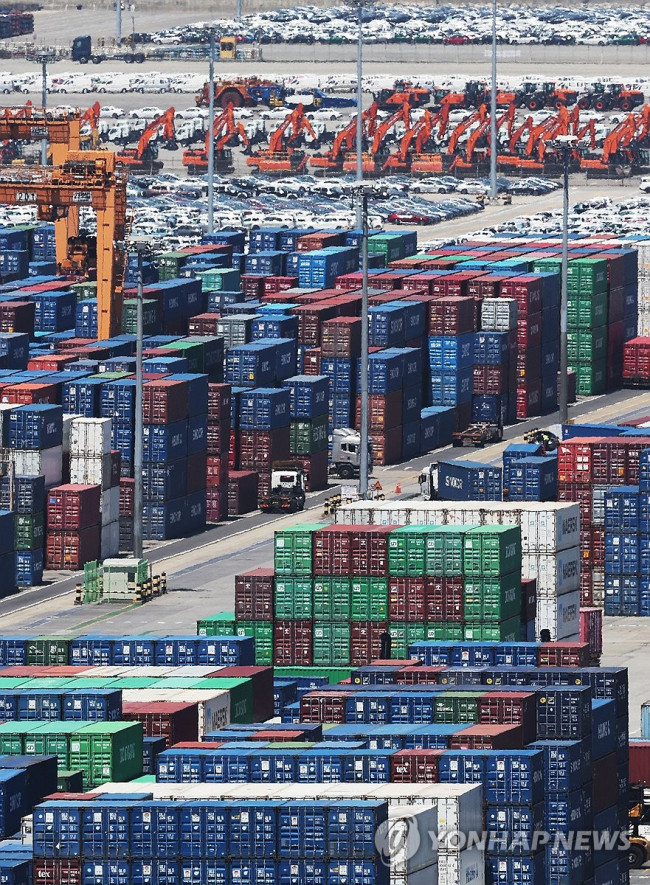 Containers at Pyeongtaek Port, Gyeonggi Province [Yonhap News Archive Photo]
The adverse effects of the Middle East conflict are becoming visible.
The primary variable to consider is inflation. Last month's consumer price index rose by 2.6% compared to a year ago, the highest increase in 21 months since July 2024 (2.6%). This was a result of efforts to suppress the inflation rate, such as price caps on oil.
The import price index (in Korean Won, year-on-year) recorded 20.4% in March and 20.2% in April, rising into the 20% range for the first time in three and a half years since September 2022 (24.2%), which was at the beginning of the Ukraine war. The rise in import prices will be reflected in consumer prices with a time lag, potentially impacting raw material supply and increasing production costs.
Professor Seok Byung-hoon of Economics at Ewha Womans University diagnosed the situation as being under inflationary pressure from the semiconductor boom, the supplementary budget, and high oil prices. He predicted that "managing inflation will become crucial from the second half of this year to the first half of next year."
◇ Rising Interest Rates Raise Concerns About Household Burden and Potential Worsening Employment
Inflation stimulates interest rates. Kim, Head of Economic Research, predicted that if inflation cannot be stabilized at an appropriate level, it will eventually lead to an increase in the base interest rate. Among banking circles, forecasts that the Bank of Korea will raise its base interest rate in the second half of the year are emerging.
The burden on households will increase. According to data submitted by National Assembly Member Park Sung-hoon of the People Power Party to the Bank of Korea, a 0.25 percentage point (p) increase in loan interest rates would result in a 3.2 trillion won increase in interest payments for household borrowers.
In the Seoul bond market, the yield on 3-year government bonds rose to the 3.7% range on the 15th, the highest in approximately two and a half years, and even climbed to 3.814% during intraday trading on the 18th. It remained at a high level of 3.760% on the 20th.
The yield on 10-year U.S. Treasury bonds, which serve as a benchmark for global bonds, reached 4.687% during intraday trading on the 19th (local time), the highest level since January 2025. The yield on 30-year Treasury bonds briefly rose to 5.20% on the same day, marking the highest since July 2007, nearly 19 years ago, before the global financial crisis. Voices expecting the Federal Reserve (Fed) to raise interest rates are also growing.
Foreign exchange volatility also persists.
The won/dollar exchange rate, which had been noticeably rising since the end of last year, surged to 1,530.1 won as of the weekly closing price in the Seoul foreign exchange market at the end of March. After hovering below 1,500 won for a while, it exceeded 1,500 won for four consecutive days from the 15th to the 20th of this month.
While semiconductors are supporting the Korean economy, other industries are struggling, and inter-sectoral asymmetry is also a problem.
Professor Seok warned, "In the current situation, excluding semiconductors and other sectors, most companies are not doing well, and the struggling sectors could face even greater difficulties. This means that polarization will worsen."
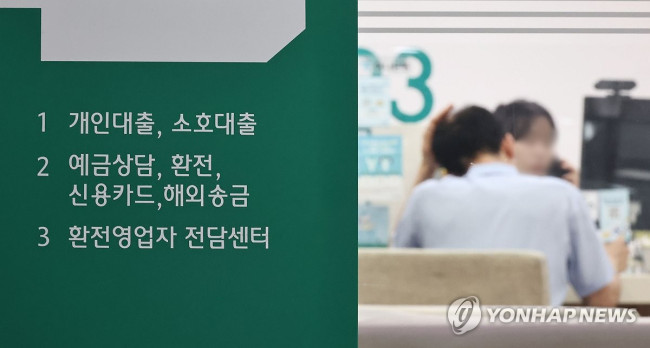 Bank Loan Counter [Yonhap News Archive Photo]
Employment indicators, which react with a lag, are also showing concerning trends. According to employment trend data released by the National Statistical Office, the increase in employed persons last month was 74,000, the smallest in 16 months, and the employment rate for those aged 15 and over fell by 0.2 percentage points (p) to 63.0%. The decline in the employment rate is the first in 16 months since December 2024 (-0.3%p).
The government plans to provide employment support through youth new deal policies, particularly for young people facing difficulties. However, it is challenging for the government to directly create jobs that young people prefer.
◇ Turning Point Approaches; Growth Drivers Beyond Semiconductors Needed... "Concentrated Investment in Innovative Fields"
Experts recommend developing growth engines that look beyond the current semiconductor boom.
While the economy is currently in a recovery phase driven by the semiconductor boom, it is unlikely that this boom will continue indefinitely.
KIEP's report pointed out that "the contribution of AI-related investments to GDP is projected to peak in 2025 and gradually decelerate from 2026 onwards, making it important to determine the turning point of the global AI demand cycle on which Korea relies."
KDI forecasts that next year's growth rate will be 1.7%, 0.8%p lower than this year's forecast.
There are also calls to effectively utilize available financial resources when they are abundant.
Joo Won, Head of Research at Hyundai Research Institute, stated, "Investment for the future is truly important. Although we have revised up the economic growth rate and expect tax revenues to increase, those funds should be used for future investments."
The government plans to focus on nurturing seven leading physical AI sectors, including robots, automobiles, and ships, and 15 ultra-innovative economic leading projects, such as graphene, superconductors, and small modular reactors (SMRs), to ensure Korea leads in the era of AI transformation.
In this regard, Deputy Prime Minister and Minister of Economy and Finance Koo Yoon-cheol explained the utilization of excess tax revenue during an investment briefing on the Korean economy held in London on the 18th (local time) during his visit to the UK, stating that the government will "concentrate investment in areas that will lead innovation."

 [Statement by the Seobeokka KMA Patriots Association] ㉛ Recount the ballots openly, as the previous recount covered up election fraud
Recount of the Tongyeong mayoral election [Photo=Yonhap News]South Korea's liberal democracy is dying. The National Election Commission (NEC), which has degraded into a criminal organization through t
[Statement by the Seobeokka KMA Patriots Association] ㉛ Recount the ballots openly, as the previous recount covered up election fraud
Recount of the Tongyeong mayoral election [Photo=Yonhap News]South Korea's liberal democracy is dying. The National Election Commission (NEC), which has degraded into a criminal organization through t
 What is the significance of the "Trump 2028" red hat that keeps reappearing?
It is noteworthy that while it is "highly likely" that President Donald Trump is "seriously considering" a run for the presidency in 2028, he is also "deliberately" fueling speculation regarding wheth
What is the significance of the "Trump 2028" red hat that keeps reappearing?
It is noteworthy that while it is "highly likely" that President Donald Trump is "seriously considering" a run for the presidency in 2028, he is also "deliberately" fueling speculation regarding wheth
 First U.S. Ambassador of Trump's Second Term to Arrive This Week… Will It Provide Momentum to Resolve Pending Issues?
U.S. Ambassador to South Korea Michelle Steel speaks at the opening ceremony of the Korea-U.S. Shipbuilding Cooperation Center held at the Mayflower Hotel in Washington, D.C., on the 23rd (local time)
First U.S. Ambassador of Trump's Second Term to Arrive This Week… Will It Provide Momentum to Resolve Pending Issues?
U.S. Ambassador to South Korea Michelle Steel speaks at the opening ceremony of the Korea-U.S. Shipbuilding Cooperation Center held at the Mayflower Hotel in Washington, D.C., on the 23rd (local time)
 President Yoon, regarding the first-instance ruling on the Public Official Election Act: “An excessive political verdict that distorts the facts… We will appeal immediately.”
The first-instance sentencing hearing for President Yoon Suk Yeol regarding violations of the Public Official Election Act is being broadcast live at Seoul Station on the 27th. [Photo=Yonhap News]Pres
President Yoon, regarding the first-instance ruling on the Public Official Election Act: “An excessive political verdict that distorts the facts… We will appeal immediately.”
The first-instance sentencing hearing for President Yoon Suk Yeol regarding violations of the Public Official Election Act is being broadcast live at Seoul Station on the 27th. [Photo=Yonhap News]Pres
 91% of Net Influx of MZ Generation Goes to Seoul Metropolitan Area… Population Migration Also Shows 'K-shaped Polarization' by Industry
[Provided by Leaders Index]Over the past four years, the MZ generation population has become increasingly concentrated in the Seoul metropolitan area and the Chungcheong region. While cities cen
91% of Net Influx of MZ Generation Goes to Seoul Metropolitan Area… Population Migration Also Shows 'K-shaped Polarization' by Industry
[Provided by Leaders Index]Over the past four years, the MZ generation population has become increasingly concentrated in the Seoul metropolitan area and the Chungcheong region. While cities cen
 'Godfather of Japanese Mystery Novels' Keigo Higashino Passes Away After Battle with Cancer at 68
Famous Japanese mystery novelist Keigo Higashino [AFP=Yonhap News]It has been belatedly reported that Keigo Higashino, the "godfather of Japanese mystery novels" and author of bestsellers such as "The
'Godfather of Japanese Mystery Novels' Keigo Higashino Passes Away After Battle with Cancer at 68
Famous Japanese mystery novelist Keigo Higashino [AFP=Yonhap News]It has been belatedly reported that Keigo Higashino, the "godfather of Japanese mystery novels" and author of bestsellers such as "The
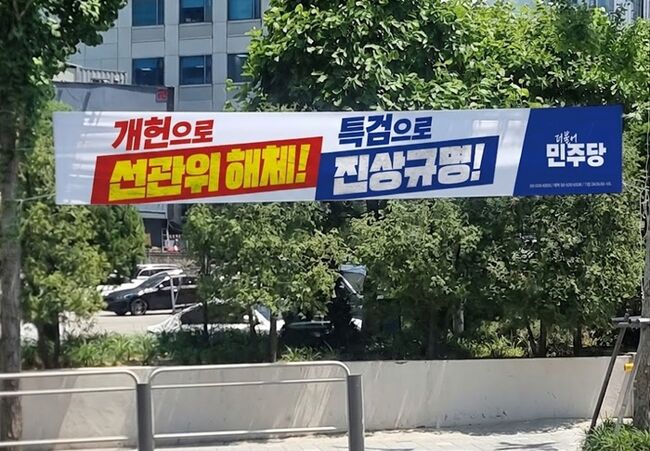 [Cho Yang-geon Column] The NEC: Facing a Fate of "Discarding the Dog After the Hunt"
Banner calling for the "dissolution of the NEC" posted by the Democratic Party. [AI-generated image]Banners calling for the "dissolution of the National Election Commission (NEC)" posted by the Democr
[Cho Yang-geon Column] The NEC: Facing a Fate of "Discarding the Dog After the Hunt"
Banner calling for the "dissolution of the NEC" posted by the Democratic Party. [AI-generated image]Banners calling for the "dissolution of the National Election Commission (NEC)" posted by the Democr
 [Photo] Evidence of Election Fraud Flooding U.S. Media… Trump Had 2.7 Million Votes Stolen
 [Video] U.S. Semiquincentennial Air Show... 'Art in the Sky' streaks across New York
 [Editorial Cartoon] A Draconian Law That Undermines Freedom of Expression

 List
List