
As South Korean apartments evolve into luxury homes with multi-billion won price tags and designer furnishings, the low-cost detectors on their ceilings represent our severe 'safety poverty'.
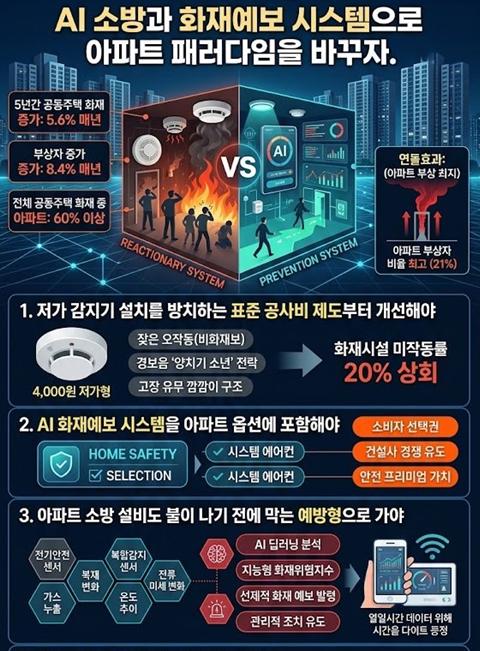
According to statistics from the National Fire Agency, fires in multi-unit residential buildings have sharply increased by 5.6% annually over the past five years, and the number of injuries has risen by 8.4%. Notably, over 60% of all fires in multi-unit residential buildings are concentrated in apartments, accounting for the highest proportion among residential facilities.
The trend of building taller and denser apartments causes a chimney effect, leading to rapid smoke ascent during fires. This results in the highest injury rate (21%) among all fire incidents.
Despite the escalating risk of casualties each year, the invisible fire safety equipment remains bound by the minimum legal standards. Luxury apartments that neglect older wired detectors prone to malfunctions are, in essence, 'castles of sand' hiding fatal dangers within their glittering exteriors.
1. The standard construction cost system, which permits the installation of low-cost detectors, must be improved.
The flaws in the current standard construction cost system are the root cause behind the mass production and neglect of low-cost detectors. Within the uniform framework of standard construction costs set by the government, fire safety equipment is always the first item to have its budget cut. To maximize profits within the allocated cost limits, construction companies first reduce the unit prices of less visible fire safety materials.
Consequently, detectors, the frontline sentinels of fire prevention, are thoroughly ignored. Instead, low-cost, substandard products intended solely to pass building permits are habitually installed. These low-cost wired detectors, born from such systemic limitations, create three fatal problems.
First, repeated false alarms due to frequent malfunctions.
They indiscriminately trigger alarms from the slightest steam from cooking, cigarette smoke, or condensation due to seasonal changes.
Second, the alarm siren degrades into a 'boy who cried wolf'.
Exhausted by incessant false alarms, management offices and residents often turn off the receivers. In hindsight, the aftermath of major fire disasters is invariably preceded by such artificial disabling of fire safety systems.
Third, a 'blind spot' where malfunctions go undetected.
Even if a wire is broken or equipment becomes obsolete, the existing wired system cannot precisely pinpoint which unit or room has the problem. In fact, according to National Fire Agency statistics, fire safety equipment fails to operate properly in over 20% of fire incidents. The loophole in the standard construction cost system creates a dangerous reality where the lives of an entire family are entrusted to cheap detectors whose operational status is uncertain.
2. The AI Fire Early Warning System should be included as an apartment option.
To integrate technological innovation into residential spaces, AI fire early warning systems must be introduced as a selectable option for consumers, similar to system air conditioners. This means the government should relax relevant regulations to grant consumers the right to choose high-quality safety, even if it incurs additional costs.
If the optionalization of advanced disaster prevention systems directly related to life is institutionally established, it will serve as a catalyst for voluntary safety technology competition among construction companies.
The true value of a living space is not defined by its outward splendor, but by the safety that perfectly protects the lives of its residents. In the future, the inclusion of advanced AI fire early warning systems will be the ultimate proof of premium value at model homes, overshadowing imported luxury materials. Safety is not a wasted expense; it is an absolute value that can never be compromised and the most certain investment.
3. Apartment fire safety equipment must also shift to a preventative approach, stopping fires before they start.
Disasters exploit the crevices of complacency, such as 'it won't happen to me.' The complacency of thinking, "A fire won't break out in this expensive luxury apartment," becomes the prelude to a major catastrophe. The reason past fire prevention and disaster management remained reactive, only sounding alarms after a fire had already started, was due to this very complacency. Just as we check the weather forecast daily to prepare an umbrella, buildings must transition to a preventative system that self-diagnoses their condition and warns of fire risks in advance.
Fires never occur by accident; they always leave subtle signs before their occurrence. Advanced AI fire fighting technology collects and analyzes risk patterns from the pre-fire stage, such as temperature trends, minute changes in current, gas leaks, and microscopic smoke particles, in real-time through per-unit electrical safety sensors and multi-functional detection sensors.
Through the big data accumulated and deep learning analysis, an 'intelligent fire risk index' for the space is derived. This system issues preemptive fire warnings by detecting when the risk index rises at the anomaly stage, before flames or visible smoke appear. Risk signals are instantly transmitted to the disaster prevention room and residents' smartphones, prompting preliminary checks and management measures, and ultimately preventing the possibility of a major catastrophe at its source.
Luxury without guaranteed safety is merely an illusion. Breaking down the systemic barriers of standard construction costs and institutionalizing the AI fire early warning system as a sales option will be the first step in returning the sovereignty of residential safety to consumers. We must urgently transition from past firefighting practices, which were merely reactive, to an intelligent preventative system that stops fires before they happen.
We must transform South Korean apartments into luxury homes built on safety through the adoption of advanced fire fighting technology.
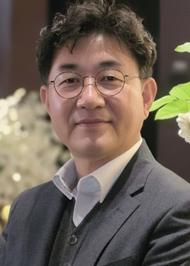
◆ Youngjin Cho
CEO of Rose AI

 Iranian Foreign Ministry: "Continuing Message Exchanges with the U.S. and Activities of Mediating Countries"
Esmaeil Baghaei, Spokesperson for the Iranian Ministry of Foreign Affairs [Xinhua, Yonhap News file photo]Esmaeil Baghaei, spokesperson for the Iranian Ministry of Foreign Affairs, stated on the 26th
Iranian Foreign Ministry: "Continuing Message Exchanges with the U.S. and Activities of Mediating Countries"
Esmaeil Baghaei, Spokesperson for the Iranian Ministry of Foreign Affairs [Xinhua, Yonhap News file photo]Esmaeil Baghaei, spokesperson for the Iranian Ministry of Foreign Affairs, stated on the 26th
 President Yoon: "Do You Think You Are Safe from the Special Counsel?"... Final Statement Video Released
President Yoon Suk Yeol rebuking the special prosecutor on the 24th. [Court video / @birds_justice X account subtitle GIF] A video of President Yoon Suk Yeol's closing statement at his trial rega
President Yoon: "Do You Think You Are Safe from the Special Counsel?"... Final Statement Video Released
President Yoon Suk Yeol rebuking the special prosecutor on the 24th. [Court video / @birds_justice X account subtitle GIF] A video of President Yoon Suk Yeol's closing statement at his trial rega
 President Yoon, regarding the first-instance ruling on the Public Official Election Act: “An excessive political verdict that distorts the facts… We will appeal immediately.”
The first-instance sentencing hearing for President Yoon Suk Yeol regarding violations of the Public Official Election Act is being broadcast live at Seoul Station on the 27th. [Photo=Yonhap News]Pres
President Yoon, regarding the first-instance ruling on the Public Official Election Act: “An excessive political verdict that distorts the facts… We will appeal immediately.”
The first-instance sentencing hearing for President Yoon Suk Yeol regarding violations of the Public Official Election Act is being broadcast live at Seoul Station on the 27th. [Photo=Yonhap News]Pres
 WSJ: "SK Hynix ADR Premium Is a Sign of AI Trading Overheat"
Advertisement for SK Hynix ADR listing in New York's Times Square [Reuters=Yonhap News file photo]The Wall Street Journal (WSJ) has pointed out that the price of SK Hynix’s American Depositary Recei
WSJ: "SK Hynix ADR Premium Is a Sign of AI Trading Overheat"
Advertisement for SK Hynix ADR listing in New York's Times Square [Reuters=Yonhap News file photo]The Wall Street Journal (WSJ) has pointed out that the price of SK Hynix’s American Depositary Recei
 'Godfather of Japanese Mystery Novels' Keigo Higashino Passes Away After Battle with Cancer at 68
Famous Japanese mystery novelist Keigo Higashino [AFP=Yonhap News]It has been belatedly reported that Keigo Higashino, the "godfather of Japanese mystery novels" and author of bestsellers such as "The
'Godfather of Japanese Mystery Novels' Keigo Higashino Passes Away After Battle with Cancer at 68
Famous Japanese mystery novelist Keigo Higashino [AFP=Yonhap News]It has been belatedly reported that Keigo Higashino, the "godfather of Japanese mystery novels" and author of bestsellers such as "The
 [Park Pil-kyu Security Column] To the Ignorant Trying to Clothe a Beast in Sheep's Clothing
Rep. Kim Byung-joo of the Democratic Party of Korea [Photo=Yonhap News]“The Air Force Academy doesn't teach you how to fly a plane!” “The Army, Navy, and Air Force academies are exactly the
[Park Pil-kyu Security Column] To the Ignorant Trying to Clothe a Beast in Sheep's Clothing
Rep. Kim Byung-joo of the Democratic Party of Korea [Photo=Yonhap News]“The Air Force Academy doesn't teach you how to fly a plane!” “The Army, Navy, and Air Force academies are exactly the
 [Issue Diagnosis] Two Effects of the Election Petition Review
 [Photo] Evidence of Election Fraud Flooding U.S. Media… Trump Had 2.7 Million Votes Stolen
 [Video] U.S. Semiquincentennial Air Show... 'Art in the Sky' streaks across New York
 [Editorial Cartoon] A Draconian Law That Undermines Freedom of Expression

 List
List










