 The power struggle between the US and China resembles a giant chessboard.
The stage of international politics is always like an intricately woven domino set. The Russia-Ukraine war, now in its fourth year, has devolved into a tedious war of attrition amidst a stalemate on the front lines. Meanwhile, in the Middle East, attention is focused on whether the confrontation between the United States and Iran over the Strait of Hormuz will lead to a peace treaty.
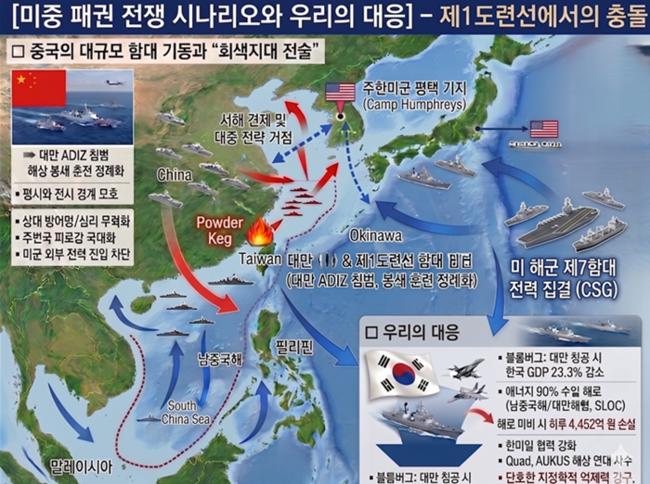
These simultaneous conflicts have resulted in the dispersal of the diplomatic focus and military assets of the United States, the world's sole superpower. While the US has become mired in the "two-front war" quagmire, China is creating a massive powder keg in the area of the First Island Chain (connecting Okinawa, Taiwan, the Philippines, and Malaysia) across the West Sea, East China Sea, and South China Sea.
The recent incident of over 100 Chinese warships and coast guard vessels gathering around the Taiwan Strait is a signal flare for a geopolitical upheaval, going beyond a mere show of force.
Is China's Large-Scale Fleet Maneuver an Advanced 'Gray Zone Tactic'?
The large-scale fleet maneuvers being deployed by China are not an immediate declaration of war. Rather, they represent an advanced 'gray zone tactic' that blurs the lines between peacetime and wartime, gradually undermining the opponent's defense network and psyche. Instead of clear signs of full-scale war such as the movement of war provisions or large troop formations, China is maximizing the fatigue of neighboring countries through constant patrols and military exercises disguised as training.
By frequently encroaching on Taiwan's Air Defense Identification Zone (ADIZ) and regularizing maritime blockade drills, China is instilling a sense of isolation in Taiwanese society. By maintaining a constant deployment of dozens of warships in the West Sea, adjacent to the Korean Peninsula, it is demonstrating, to a practical level, its multi-dimensional defense capabilities that would fundamentally block the entry of external forces like the US military in case of an emergency.
The US's 'Flower Card' and China's 'Feint to the East, Attack to the West'
The power struggle between the US and China resembles a giant chessboard. To gain hegemony in the Western Pacific, both countries are employing meticulous strategies with different calculations.
Firstly, the US strategy takes the form of a 'flower card,' supporting proxy wars without direct military deployment. Through conflicts in Europe and the Middle East, the US is indirectly inducing the depletion of Russia's and Iran's national strength, while using this as justification to solidify NATO's unity and strengthen ROK-US-Japan security cooperation to an unprecedented level. The calculation is to meticulously weave a global alliance network to complete a vast encirclement that will choke China in the long run.
In response, China is counteracting with an opportunistic 'feint to the east, attack to the west' strategy, accurately seizing the window of opportunity when US attention and military power are dispersed. While the US is busy putting out fires in the western part of Eurasia, China intends to preemptively internalize the First Island Chain, a strategic linchpin in the Western Pacific.
China's permanent military pressure in this maritime zone appears to be a sophisticated ploy to shake the balance of power in the Western Pacific and completely control Taiwan and its surrounding waters.
Scenarios and Our Response in the First Island Chain Going Forward
Three scenarios can be anticipated for a conflict in the First Island Chain. First, a 'soft landing type siege pressure' that effectively isolates Taiwan. Second, an 'accidental military conflict' triggered by inspections by Chinese coast guard vessels in the South China Sea and West Sea, such as at Scarborough Shoal. Finally, a 'short and swift full-scale invasion' that would destroy global supply chains.
This directly impacts our survival. Bloomberg Economics predicted that in the event of a Chinese invasion of Taiwan, South Korea's GDP would decrease by 23.3%, making it the hardest-hit country in the world excluding Taiwan. South Korea imports over 90% of its core energy, such as crude oil, through the South China Sea and Taiwan Strait (SLOC), and it is estimated that if sea routes are paralyzed, economic losses of approximately 445.2 billion won would occur daily.
Therefore, the US and the West must build firm geopolitical deterrence to avoid losing dominance in the West Sea and East China Sea. We must recognize that even a non-violent show of force is an invasion, and we must defend our maritime territories and logistics networks, which are our economic lifelines, by strengthening maritime cooperation with ROK-US-Japan, the Quad (Quadrilateral Security Dialogue), and AUKUS (Australia, the United Kingdom, and the United States Security Pact).
In the Era of US-China Hegemony, Pursuing Wartime Operational Control (OPCON) Transfer Should Be Done Prudently
If a hospital director were to enter an operating room where resident doctors are performing surgery and order them, "Perform surgery on the 'security office' patient alone right now," would a doctor worried about promotion and their position be able to resist by saying, "My skills are not yet sufficient"? In a specialized organization like the military, expecting 'objective policy verification' from active-duty soldiers may be an impossible equation from the outset.
When the supreme commander, who holds the leash of personnel appointments, pushes for a policy with a predetermined answer, no active-duty officer will dare to say, "The conditions are not met," in the face of formidable power. We already have the painful memory of witnessing the process of pushing for the September 19 Military Agreement during the Moon Jae-in administration, an agreement akin to surrender, which tied the military's hands and blinded its vision according to the directives of those in power.
The transfer of OPCON is not a matter of sentimental pride related to 'autonomy.' It is a ruthless survival game to protect the nation and its people in case of emergency. China likely analyzed post-hoc that it missed the opportunity to annex Taiwan by participating in the Korean War.
If present-day China attempts to annex Taiwan with next year as the target, wouldn't China's strategy teams be instigating North Korea to provoke the Korean Peninsula as a card to divert US forces? At a time when the US-China hegemony competition is becoming overt, the transfer of OPCON, which would lead to the dissolution of the ROK-US Combined Forces Command, is reckless.
Currently, the Ministry of National Defense's OPCON transfer should be entrusted to an 'OPCON Advisory Committee' composed of reserve officers who served in the ROK-US Combined Forces Command and civilian military experts. It should be ensured that the OPCON transfer is reviewed solely by the criteria of 'national interest and survival,' excluding politics.
It should be pursued as a long-term task based on military common sense and conscience, without regard to the administration's sentiments. This is akin to how entrusting building safety inspections to independent external supervisors prevents shoddy construction.
The security apparatus and the military must face international affairs squarely. Administrations are short-lived, but national security is eternal. Now, we must respond with a stronger and more meticulous maritime security alliance with regional allies, led by ROK, the US, and Japan. We hope to prevent catastrophic conflicts by maintaining a balance of power with firm deterrence and unwavering ROK-US-Japan solidarity.

◆ Park Pil-gyu, Committee Member
Editorial Board Member, The Hankook Ilbo
40th graduating class, Korea Military Academy

 Iranian Foreign Ministry: "Continuing Message Exchanges with the U.S. and Activities of Mediating Countries"
Esmaeil Baghaei, Spokesperson for the Iranian Ministry of Foreign Affairs [Xinhua, Yonhap News file photo]Esmaeil Baghaei, spokesperson for the Iranian Ministry of Foreign Affairs, stated on the 26th
Iranian Foreign Ministry: "Continuing Message Exchanges with the U.S. and Activities of Mediating Countries"
Esmaeil Baghaei, Spokesperson for the Iranian Ministry of Foreign Affairs [Xinhua, Yonhap News file photo]Esmaeil Baghaei, spokesperson for the Iranian Ministry of Foreign Affairs, stated on the 26th
 President Yoon: "Do You Think You Are Safe from the Special Counsel?"... Final Statement Video Released
President Yoon Suk Yeol rebuking the special prosecutor on the 24th. [Court video / @birds_justice X account subtitle GIF] A video of President Yoon Suk Yeol's closing statement at his trial rega
President Yoon: "Do You Think You Are Safe from the Special Counsel?"... Final Statement Video Released
President Yoon Suk Yeol rebuking the special prosecutor on the 24th. [Court video / @birds_justice X account subtitle GIF] A video of President Yoon Suk Yeol's closing statement at his trial rega
 President Yoon, regarding the first-instance ruling on the Public Official Election Act: “An excessive political verdict that distorts the facts… We will appeal immediately.”
The first-instance sentencing hearing for President Yoon Suk Yeol regarding violations of the Public Official Election Act is being broadcast live at Seoul Station on the 27th. [Photo=Yonhap News]Pres
President Yoon, regarding the first-instance ruling on the Public Official Election Act: “An excessive political verdict that distorts the facts… We will appeal immediately.”
The first-instance sentencing hearing for President Yoon Suk Yeol regarding violations of the Public Official Election Act is being broadcast live at Seoul Station on the 27th. [Photo=Yonhap News]Pres
 WSJ: "SK Hynix ADR Premium Is a Sign of AI Trading Overheat"
Advertisement for SK Hynix ADR listing in New York's Times Square [Reuters=Yonhap News file photo]The Wall Street Journal (WSJ) has pointed out that the price of SK Hynix’s American Depositary Recei
WSJ: "SK Hynix ADR Premium Is a Sign of AI Trading Overheat"
Advertisement for SK Hynix ADR listing in New York's Times Square [Reuters=Yonhap News file photo]The Wall Street Journal (WSJ) has pointed out that the price of SK Hynix’s American Depositary Recei
 'Godfather of Japanese Mystery Novels' Keigo Higashino Passes Away After Battle with Cancer at 68
Famous Japanese mystery novelist Keigo Higashino [AFP=Yonhap News]It has been belatedly reported that Keigo Higashino, the "godfather of Japanese mystery novels" and author of bestsellers such as "The
'Godfather of Japanese Mystery Novels' Keigo Higashino Passes Away After Battle with Cancer at 68
Famous Japanese mystery novelist Keigo Higashino [AFP=Yonhap News]It has been belatedly reported that Keigo Higashino, the "godfather of Japanese mystery novels" and author of bestsellers such as "The
 [Park Pil-kyu Security Column] To the Ignorant Trying to Clothe a Beast in Sheep's Clothing
Rep. Kim Byung-joo of the Democratic Party of Korea [Photo=Yonhap News]“The Air Force Academy doesn't teach you how to fly a plane!” “The Army, Navy, and Air Force academies are exactly the
[Park Pil-kyu Security Column] To the Ignorant Trying to Clothe a Beast in Sheep's Clothing
Rep. Kim Byung-joo of the Democratic Party of Korea [Photo=Yonhap News]“The Air Force Academy doesn't teach you how to fly a plane!” “The Army, Navy, and Air Force academies are exactly the
 [Issue Diagnosis] Two Effects of the Election Petition Review
 [Photo] Evidence of Election Fraud Flooding U.S. Media… Trump Had 2.7 Million Votes Stolen
 [Video] U.S. Semiquincentennial Air Show... 'Art in the Sky' streaks across New York
 [Editorial Cartoon] A Draconian Law That Undermines Freedom of Expression

 List
List










