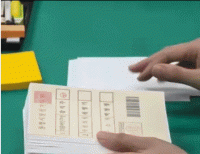
On the 4th, numerous citizens and organizations gathered in front of the National Election Commission in Gwacheon, Gyeonggi Province, to hold a rally claiming 'election fraud' and demanding a 're-election' due to the ballot shortage incident in the 9th National Simultaneous Local Elections. [Photo=Yonhap News]
The ballot shortage that occurred during the main vote of the June 3rd local elections is escalating into a new controversy.
This is because reports have emerged questioning not only whether records are verifiable for the printing, storage, distribution, transportation, use, and recovery of unused ballots, but also the budget and distribution of ballots by the National Election Commission.
The reports from the JoongAng Ilbo, which stated that the Election Commission secured a budget for printing up to 110% of the total number of voters but actually printed only around 50% for the main vote, and the Dong-A Ilbo report, which stated that in Songpa-gu, Seoul, although there should have been over 40,000 ballots left in total, they were not distributed to some polling stations on time, are now intertwined.
This incident is not simply a matter of "whether there was a shortage of ballots."
The core issues are: on what basis was the budget set, why was the actual production volume reduced to half, and why did the printed ballots not arrive at some polling stations on time.
If the budget calculation, production standards, reserve stock, and on-site distribution operated under different criteria, it should be seen not as an on-site error but as a problem with the election management judgment system.
The budget was generous, so why was production only half?
According to the JoongAng Ilbo report, the Election Commission secured a budget to print ballots up to 110% of the total voter population, but it was revealed that in many areas, only about 50% of the ballots were printed for the main vote.
It was also raised that Songpa-gu secured about 50% of the ballots for the main vote, Gwangjin-gu about 50%, and Gangnam-gu about 55%.
Election management bodies can adjust the printing volume based on the actual voter turnout. The method of determining the production volume of ballots for the main vote by summing up the early voting rate and the projected turnout for the main vote cannot be definitively deemed problematic in itself.
However, if a budget was secured for up to 110% of the total voter population, the criteria for setting the actual production volume at around 50% must be transparently explained.
The budget was set close to the maximum, the actual production was reduced to about half, and a shortage occurred on the ground. If so, the public's question is natural.
By what formula was the 110% budget established? On what basis was the 50% production decided? How was the budget for the unproduced ballots handled? If the Election Commission is to state that "ballots were sufficient," it must first explain the discrepancy between the budget and the production volume in writing.
Songpa was structured to have 40,000 left over, but they weren't there on-site
The Dong-A Ilbo article shows a different aspect. The Songpa-gu Election Commission printed approximately 280,000 ballots, which is about 50% of Songpa-gu's total voter population of 565,638.
The number of Songpa residents who actually participated in the main vote on the 3rd was 239,910. Considering the total volume alone, there was a structure where over 40,000 ballots could have been left over.
However, it is known that the Songpa-gu Election Commission did not send about 10% of the allocated ballots for each polling station to the stations but kept them separately as reserves.
Subsequently, a situation arose where ballots were insufficient at some polling stations, causing voters to wait. However, the reserved ballots were not supplied to the field on time.
According to the structure explained by the Election Commission, the Songpa-gu incident is not a "problem caused by a lack of ballots" but a "problem where ballots existed but were not present at the necessary locations."
This distinction is important. If there was an absolute shortage of ballots, the prediction failure becomes the central issue. However, if ballots remained but did not reach the polling stations, the problem lies with the distribution and transportation system.
If a shortage occurred at some polling stations even though the main vote turnout did not exceed 50%, the criteria for allocating ballots to each polling station and the criteria for supplying reserves must be examined.
The Election Commission's explanation also faltered. The National Election Commission initially explained that the polling stations where the problem occurred were 14 in Seoul, but later the Incheon Election Commission belatedly apologized, stating that there was a shortage of ballots at two locations within its jurisdiction.
If the scope of the incident was not accurately grasped from the beginning, the Election Commission's post-incident explanations become subjects of scrutiny rather than grounds for trust.
A Structure Where Budget, Production, and Distribution Operated Separately
When the JoongAng Ilbo and Dong-A Ilbo reports are considered together, the structure of this incident becomes clearer.
The JoongAng Ilbo report shows the discrepancy between the budget and the production volume. The Dong-A Ilbo report shows the problem of produced ballots not being distributed to the field on time.
One is a problem of prior judgment, and the other is a problem of on-site execution.
Ultimately, this incident can be divided into three stages.
First, the stage where a budget was secured up to 110% of the total voter population.
Second, the stage where only about 50% of the ballots for the main vote were actually produced.
Third, the stage where even these produced ballots were partially reserved and not supplied to the field on time.
If these three stages had operated in conjunction, the problem might not have become so large.
Even if the production volume was reduced, if the demand prediction for each polling station was accurate and the reserve supply system operated swiftly, the situation of voters waiting for ballots could have been reduced.
Conversely, if the production volume was reduced, the distribution to each polling station was tight, and the supply of reserves was also delayed, then the shortage situation becomes a structurally predictable outcome.
If the Election Commission determined that remaining ballots could lead to distrust, then a method of accurately managing even the remaining ballots should have taken precedence over reducing the number of leftover ballots.
If the attempt to reduce leftover ballots led to voters waiting for ballots on site, this is not the resolution of distrust but an amplification of distrust.
What Needs Explaining Are the Election Commission's Standards, Not the Public's Suspicions
In this incident, the target of explanation for the Election Commission is not the public's suspicion, but the Election Commission's own judgment criteria.
It must explain why a budget for up to 110% of the total voter population was secured, why the actual production was reduced to about 50%, why a portion of the allocated ballots for each polling station was kept as reserves, and why the reserves were not immediately supplied after a shortage was reported.
This explanation must be in writing, not just in words.
The budget formulation formula, the actual printing order volume, the initial distribution volume to each polling station, the Election Commission's reserve stock, the time of request for additional transportation, the actual arrival time, and the final usage and remaining quantities must be verifiable.
Only then can the questions "The budget was sufficient, so why was production reduced?" and "Ballots remained, so why were they not at the polling stations?" be answered.
The entity that caused the confusion is not the public.
Voters who visited the polling stations were people who intended to exercise their right to vote at the designated time and place. If the ballots that a state agency should have prepared and distributed were not present at the polling stations, that responsibility cannot be attributed to the voters.
Before blaming the public's distrust, the Election Commission must disclose its own standards.
The essence of this incident is not that the Election Commission failed to prepare even a single ballot. Rather, a more serious question exists separately.
The budget was sufficiently secured, and in some areas, there was a structure where ballots would remain, so why did voters have to wait for ballots at the polling stations?
The investigation into the truth must start with this question.
The gap between the 110% budget and 50% production, the gap between 50% production and on-site distribution, and the gap between reserve stock and additional transportation must each be verified.
Election management is not an administration where only the results matter. It is a constitutional procedure that must prepare so that voters can vote without obstruction at the designated time and place, and that preparation process must be verifiable afterward.
The question left by this incident is clear.
Why did the Election Commission's ballot management operate separately at the budget, production, and distribution stages?
If the answer to this question is not presented with documents and numbers, the ballot shortage incident will remain not as a one-time happening but as a structural crack in election management trust.

 Iranian Foreign Ministry: "Continuing Message Exchanges with the U.S. and Activities of Mediating Countries"
Esmaeil Baghaei, Spokesperson for the Iranian Ministry of Foreign Affairs [Xinhua, Yonhap News file photo]Esmaeil Baghaei, spokesperson for the Iranian Ministry of Foreign Affairs, stated on the 26th
Iranian Foreign Ministry: "Continuing Message Exchanges with the U.S. and Activities of Mediating Countries"
Esmaeil Baghaei, Spokesperson for the Iranian Ministry of Foreign Affairs [Xinhua, Yonhap News file photo]Esmaeil Baghaei, spokesperson for the Iranian Ministry of Foreign Affairs, stated on the 26th
 President Yoon: "Do You Think You Are Safe from the Special Counsel?"... Final Statement Video Released
President Yoon Suk Yeol rebuking the special prosecutor on the 24th. [Court video / @birds_justice X account subtitle GIF] A video of President Yoon Suk Yeol's closing statement at his trial rega
President Yoon: "Do You Think You Are Safe from the Special Counsel?"... Final Statement Video Released
President Yoon Suk Yeol rebuking the special prosecutor on the 24th. [Court video / @birds_justice X account subtitle GIF] A video of President Yoon Suk Yeol's closing statement at his trial rega
 President Yoon, regarding the first-instance ruling on the Public Official Election Act: “An excessive political verdict that distorts the facts… We will appeal immediately.”
The first-instance sentencing hearing for President Yoon Suk Yeol regarding violations of the Public Official Election Act is being broadcast live at Seoul Station on the 27th. [Photo=Yonhap News]Pres
President Yoon, regarding the first-instance ruling on the Public Official Election Act: “An excessive political verdict that distorts the facts… We will appeal immediately.”
The first-instance sentencing hearing for President Yoon Suk Yeol regarding violations of the Public Official Election Act is being broadcast live at Seoul Station on the 27th. [Photo=Yonhap News]Pres
 WSJ: "SK Hynix ADR Premium Is a Sign of AI Trading Overheat"
Advertisement for SK Hynix ADR listing in New York's Times Square [Reuters=Yonhap News file photo]The Wall Street Journal (WSJ) has pointed out that the price of SK Hynix’s American Depositary Recei
WSJ: "SK Hynix ADR Premium Is a Sign of AI Trading Overheat"
Advertisement for SK Hynix ADR listing in New York's Times Square [Reuters=Yonhap News file photo]The Wall Street Journal (WSJ) has pointed out that the price of SK Hynix’s American Depositary Recei
 'Godfather of Japanese Mystery Novels' Keigo Higashino Passes Away After Battle with Cancer at 68
Famous Japanese mystery novelist Keigo Higashino [AFP=Yonhap News]It has been belatedly reported that Keigo Higashino, the "godfather of Japanese mystery novels" and author of bestsellers such as "The
'Godfather of Japanese Mystery Novels' Keigo Higashino Passes Away After Battle with Cancer at 68
Famous Japanese mystery novelist Keigo Higashino [AFP=Yonhap News]It has been belatedly reported that Keigo Higashino, the "godfather of Japanese mystery novels" and author of bestsellers such as "The
 [Park Pil-kyu Security Column] To the Ignorant Trying to Clothe a Beast in Sheep's Clothing
Rep. Kim Byung-joo of the Democratic Party of Korea [Photo=Yonhap News]“The Air Force Academy doesn't teach you how to fly a plane!” “The Army, Navy, and Air Force academies are exactly the
[Park Pil-kyu Security Column] To the Ignorant Trying to Clothe a Beast in Sheep's Clothing
Rep. Kim Byung-joo of the Democratic Party of Korea [Photo=Yonhap News]“The Air Force Academy doesn't teach you how to fly a plane!” “The Army, Navy, and Air Force academies are exactly the
 [Issue Diagnosis] Two Effects of the Election Petition Review
 [Photo] Evidence of Election Fraud Flooding U.S. Media… Trump Had 2.7 Million Votes Stolen
 [Video] U.S. Semiquincentennial Air Show... 'Art in the Sky' streaks across New York
 [Editorial Cartoon] A Draconian Law That Undermines Freedom of Expression

 List
List