 At 8:40 AM on the 4th, in front of the main gate of the National Election Commission. A crowd is gathering towards the main gate as an official vehicle of National Election Commission Chairman Noh Tae-hak attempts to enter.
The main issue surrounding the shortage of ballot papers in the June 3rd local elections is shifting. Initially, the problem seemed to be "whether there was a shortage of ballot papers." However, the details that have since emerged are more complex.
In some areas, the explanation is that ballot papers were not absolutely insufficient, but rather that the ballot papers held by the Election Commission were not delivered to polling stations on time.
If this is the case, the essence of this situation moves from a simple issue of quantity to a question of the verifiability of the election management system.
The problem is not whether the Election Commission said "there were enough ballot papers." What is more important is whether the public can verify that statement.
It should be possible for a third party to verify when and where the ballot papers were printed and in what quantity, to whom and at what time and how many were delivered, and at which polling station how many were used and how many remained.
Trust in elections does not come from verbal explanations.
It comes from the existence of a chain of custody, where the entire process from the printing, storage, distribution, transportation, use, and return of unused ballot papers is continuously recorded and verifiable.
They say there were ballot papers, so why weren't they at the polling stations?
According to a report by The Dong-A Ilbo, the Songpa District Election Commission printed ballot papers equivalent to 50% of the total number of voters in Songpa-gu in preparation for the main election. However, not all ballot papers were distributed to each polling station; some were kept as reserves.
As the voter turnout exceeded expectations, some polling stations experienced ballot paper shortages in the afternoon, causing voters to wait. However, the reserve ballot papers were not supplied to the polling stations in a timely manner.
According to the Election Commission's explanation, this situation is not "a problem caused by a lack of ballot papers" but rather "a problem where ballot papers existed but did not reach the polling stations that needed them in time."
This distinction is significant. The former is akin to a failure in predicting voter turnout, while the latter is closer to a failure in the election management system.
Furthermore, while the National Election Commission initially stated that the problem occurred at 14 polling stations in Seoul, it was later confirmed that there were also ballot paper shortages in Incheon.
If the exact location and scope of the problem were not accurately identified from the outset, then subsequent explanations are also subject to verification.
Explanations asking for trust: are there verifiable records?
The biggest problem with the Election Commission's explanation is that it is asking the public to trust them again.
If there had been a verifiable system, the explanation should have come in documents, not just words. They should have disclosed when and how many were printed, how many were sent to which polling stations, where the reserves were stored, and at what time and how many were additionally transported after the shortage was reported.
The entity that created the confusion was not the public, but the Election Commission.
Voters who visited polling stations were people trying to exercise their right to vote at the designated time and place. If the ballot papers, which should have been prepared and distributed by a state agency, were not present at the polling stations, the responsibility cannot be shifted to the voters.
Before blaming the public's suspicion, the Election Commission should first provide records that the public can verify.
The core of election trust: Chain of Custody
In election management, "chain of custody" refers to the procedure by which the movement and storage of ballot papers, ballot boxes, and election equipment are recorded without interruption.
Just as in criminal cases, where it is verified whose hands an exhibit passed through and where it was stored, in elections, the entire process of ballot papers moving from the printing office to the polling station, from the polling station to the counting office, and back to the storage location must be verifiable by time, place, quantity, and responsible person.
This way, even if suspicions arise later, they can be explained with records, not just words.
If the ballot papers were sufficient, that sufficiency must be proven through the printing volume, distribution volume, reserve storage volume, additional transport volume, usage volume, and remaining volume. The statement "sufficient" is just the starting point.
It becomes an explanation only when it is supported by verifiable documents and numbers.
Foreign countries record unused ballot papers without reducing them
Foreign examples make this principle even clearer. While election systems and the scope of disclosure vary by country, there are commonalities.
Not only are used ballot papers managed, but unused, damaged, remaining, and reserve ballot papers are all included within a single management account, and records are kept so that candidates, political parties, observers, or courts can verify them if necessary through recount procedures.
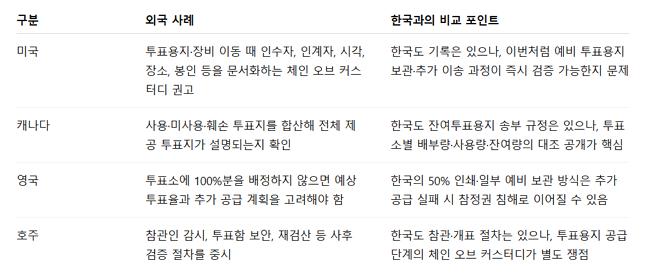
As seen in the table, the issue is not that all foreign systems are the same. The commonality is a structure that encourages "verify," not "trust us."
The United States emphasizes the movement records of ballot papers and election equipment, while Canada sums up used, unused, and damaged ballot papers to confirm if the total number of ballot papers is explained. The UK requires a plan for additional supply if less than 100% of voters are allocated to a polling station, and Australia places ballot boxes and ballot papers within a sealing, tracking, and re-counting procedure.
The problem arises not from leftover ballot papers, but when the origin, movement, storage, and collection process of those leftover ballot papers cannot be explained.
If the Election Commission determined that leftover ballot papers could be a source of distrust, the solution was not to reduce the number of leftover ballot papers. They should have included all ballot papers, including the leftovers, within the record-keeping system.
The loophole in this incident is the ballot paper supply process
In Korea, there is a procedure to send ballot boxes, keys, polling station records, and remaining ballot papers to the relevant Election Commission after voting concludes. Evidence preservation is also possible during election litigation.
However, the issue in this incident is not just storage after voting is complete.
The core of the issue is how ballot papers were prepared during the voting period, how many were distributed to each polling station, why reserves were kept, and through what route they were transported after the shortage was reported.
Used ballot papers, unused ballot papers, damaged ballot papers, reserve ballot papers, and additional transported ballot papers must all reconcile within a single account.
This way, even if ballot papers remain, they do not become a cause for suspicion, and if ballot papers are insufficient, the cause can be accurately determined.
The essence of this incident is not that Korea has no election management procedures. The problem lies in whether those procedures operated in a way that the public, candidates, political parties, and observers could verify, especially at the ballot paper supply stage.
Therefore, the investigation into the truth should not end with simple disciplinary action or an apology.
The criteria for calculating the number of ballot papers printed, the initial distribution volume per polling station, the Election Commission's reserve volume, the time of request for additional transport, the actual arrival time, the number of people waiting on-site, the voting delay time, and the final usage and remaining quantities must all be disclosed and cross-referenced.
It is necessary to confirm through records at which stage the judgment was wrong, at which stage the transport was delayed, and which responsible person made what decision.
An election is not an administrative procedure conducted based on trust in the Election Commission's words.
It is a constitutional procedure where the public, candidates, political parties, and observers must be able to verify whether the Election Commission's words are correct.
The explanation "the ballot papers were sufficient" is not enough. If they were sufficient, that sufficiency must be proven through documentation.
There is only one question left by this incident.
Is a verifiable chain of custody operating in Korean elections, rather than verbal explanations?

 Iranian Foreign Ministry: "Continuing Message Exchanges with the U.S. and Activities of Mediating Countries"
Esmaeil Baghaei, Spokesperson for the Iranian Ministry of Foreign Affairs [Xinhua, Yonhap News file photo]Esmaeil Baghaei, spokesperson for the Iranian Ministry of Foreign Affairs, stated on the 26th
Iranian Foreign Ministry: "Continuing Message Exchanges with the U.S. and Activities of Mediating Countries"
Esmaeil Baghaei, Spokesperson for the Iranian Ministry of Foreign Affairs [Xinhua, Yonhap News file photo]Esmaeil Baghaei, spokesperson for the Iranian Ministry of Foreign Affairs, stated on the 26th
 President Yoon: "Do You Think You Are Safe from the Special Counsel?"... Final Statement Video Released
President Yoon Suk Yeol rebuking the special prosecutor on the 24th. [Court video / @birds_justice X account subtitle GIF] A video of President Yoon Suk Yeol's closing statement at his trial rega
President Yoon: "Do You Think You Are Safe from the Special Counsel?"... Final Statement Video Released
President Yoon Suk Yeol rebuking the special prosecutor on the 24th. [Court video / @birds_justice X account subtitle GIF] A video of President Yoon Suk Yeol's closing statement at his trial rega
 President Yoon, regarding the first-instance ruling on the Public Official Election Act: “An excessive political verdict that distorts the facts… We will appeal immediately.”
The first-instance sentencing hearing for President Yoon Suk Yeol regarding violations of the Public Official Election Act is being broadcast live at Seoul Station on the 27th. [Photo=Yonhap News]Pres
President Yoon, regarding the first-instance ruling on the Public Official Election Act: “An excessive political verdict that distorts the facts… We will appeal immediately.”
The first-instance sentencing hearing for President Yoon Suk Yeol regarding violations of the Public Official Election Act is being broadcast live at Seoul Station on the 27th. [Photo=Yonhap News]Pres
 WSJ: "SK Hynix ADR Premium Is a Sign of AI Trading Overheat"
Advertisement for SK Hynix ADR listing in New York's Times Square [Reuters=Yonhap News file photo]The Wall Street Journal (WSJ) has pointed out that the price of SK Hynix’s American Depositary Recei
WSJ: "SK Hynix ADR Premium Is a Sign of AI Trading Overheat"
Advertisement for SK Hynix ADR listing in New York's Times Square [Reuters=Yonhap News file photo]The Wall Street Journal (WSJ) has pointed out that the price of SK Hynix’s American Depositary Recei
 'Godfather of Japanese Mystery Novels' Keigo Higashino Passes Away After Battle with Cancer at 68
Famous Japanese mystery novelist Keigo Higashino [AFP=Yonhap News]It has been belatedly reported that Keigo Higashino, the "godfather of Japanese mystery novels" and author of bestsellers such as "The
'Godfather of Japanese Mystery Novels' Keigo Higashino Passes Away After Battle with Cancer at 68
Famous Japanese mystery novelist Keigo Higashino [AFP=Yonhap News]It has been belatedly reported that Keigo Higashino, the "godfather of Japanese mystery novels" and author of bestsellers such as "The
 [Park Pil-kyu Security Column] To the Ignorant Trying to Clothe a Beast in Sheep's Clothing
Rep. Kim Byung-joo of the Democratic Party of Korea [Photo=Yonhap News]“The Air Force Academy doesn't teach you how to fly a plane!” “The Army, Navy, and Air Force academies are exactly the
[Park Pil-kyu Security Column] To the Ignorant Trying to Clothe a Beast in Sheep's Clothing
Rep. Kim Byung-joo of the Democratic Party of Korea [Photo=Yonhap News]“The Air Force Academy doesn't teach you how to fly a plane!” “The Army, Navy, and Air Force academies are exactly the
 [Issue Diagnosis] Two Effects of the Election Petition Review
 [Photo] Evidence of Election Fraud Flooding U.S. Media… Trump Had 2.7 Million Votes Stolen
 [Video] U.S. Semiquincentennial Air Show... 'Art in the Sky' streaks across New York
 [Editorial Cartoon] A Draconian Law That Undermines Freedom of Expression

 List
List









