Officials from the joint police and prosecution investigation headquarters tasked with uncovering the truth behind the ballot paper shortage crisis are entering the National Election Commission (NEC) building in Gwacheon, Gyeonggi-do, on the 23rd for a search and seizure. The joint headquarters is investigating circumstances regarding the false entry of voter turnout and the arbitrary alteration of computer statistics by NEC employees. [Photo = Yonhap News]
It is reported that the National Election Commission (NEC) has once again refused to allow a broadcast of the oral arguments in the election petition related to the ballot paper shortage crisis during the June 3 local elections.
Although People Power Party representative Jang Dong-hyeok announced that he would personally attend to present oral arguments, the NEC has made it clear that it will not disclose the process to the public.
It is a decision that effectively hears the petitioner's arguments while keeping the public's eyes and ears covered.
This election petition is not a mere procedure for disputing simple administrative errors.
On June 3, an unprecedented crisis occurred where voting was suspended due to a shortage of ballot papers at 12 polling stations in the Songpa-gu area of Seoul, as well as some polling stations in Gangnam-gu and Gwangjin-gu. The police have viewed this as an incident that infringed upon the people's right to vote and conducted searches and seizures at seven locations, including the NEC, the Seoul Metropolitan Election Commission, and local election commissions.
This is a procedure to determine whether citizens’ rights to exercise their vote at designated times and locations were properly guaranteed, and whether illegal or inadequate actions by election management agencies affected the election results.
It is a forum that judges the legitimacy of an election, which is the starting point of democracy. Is there any public procedure more deserving of full transparency before the people than this?
One cannot help but compare this to the trial for insurrection.
The court broadcast parts of former President Yoon Suk-yeol’s trial for insurrection, including the first-instance sentencing process, in consideration of the gravity of crimes such as insurrection, sedition, and rebellion, the public's right to know, and the need for historical records. The proceedings from the start of the trial to the witness examination were also made public.
Of course, criminal trials and election petitions differ in their legal nature and the grounds for public disclosure. The criteria for broadcasting criminal trials cannot be applied to election petitions as they are.
However, the fact that the procedural format is different cannot be a reason to keep the process of deliberating whether the people's voting rights were infringed behind closed doors.
One must ask the NEC:
Do you consider the situation where citizens were unable to properly exercise their right to vote less damaging to democracy than an insurrection trial? If insurrection is an act that destroys constitutional order by force, then the infringement of the people's voting rights due to failures in election management is an act that shakes the very roots of constitutional order.
When an election collapses, the democratic legitimacy of the power constituted through that election is also shaken.
How can the public accept a standard where insurrection trials are shown to the nation, yet hearings to judge the legality of an election are held behind closed doors?
If the logic that transparency is necessary to protect democracy does not apply to election petitions, it is not a principle, but a double standard based on institutional convenience.
Moreover, the NEC is not a neutral third party in this incident. The police investigating the ballot shortage crisis conducted search and seizure operations on the NEC and its affiliated election commissions.
It is reported that the search and seizure warrants named around 10 individuals, including former NEC Chairman Noh Tae-ak, former Secretary-General Heo Cheol-hoon, and various local election commission chairpersons, as suspects charged with violating the Public Official Election Act and dereliction of duty.
In criminal proceedings, the very organization that is the subject of the investigation is now judging whether its own management acts and those of its subordinate agencies were lawful in the election petition. This is a "self-trial" where the agency that managed the election judges its own wrongdoing and informs the public of its own conclusion.
It is difficult to describe such a structure as normal.
Even if the current Public Official Election Act stipulates that petitions regarding the validity of local elections are to be deliberated by the NEC or city/provincial election commissions, the NEC must disclose the deliberation process even more transparently to offset the structural limitations of the system.
Just because the law grants the NEC decision-making power does not mean it grants them the right to block public oversight.
Transparency is not an option, especially in cases where the neutrality of the judging agency is inevitably called into question.
It is a minimum condition for ensuring the legitimacy of the decision. The public must be able to verify for themselves what evidence was submitted, what the petitioner and the respondent argued, what questions the committee members asked, and how the NEC responded.
We are not asking for internal deliberations and final voting of the NEC to be made public. Committee members' discussions and decisions can proceed behind closed doors as required by law.
However, there is no reason to hide the oral arguments and the exchange of evidence between the parties. If there is data directly related to personal information or the secrecy of the ballot, only those parts should be restricted.
It is a reversal of priorities to close off the entire hearing on the grounds that there is information that exceptionally needs to be protected.
A live broadcast is not a political favor granted to Representative Jang Dong-hyeok or any specific political party. It is a democratic oversight procedure to verify how the voting rights entrusted by the people were managed and whether those rights were actually infringed upon.
The NEC must not mistake the decision to disclose as a favor it can grant or withdraw at its discretion.
Releasing a few pages of a decision document after the fact is not enough.
If the NEC demands compliance after judging the responsibilities of itself and its affiliates in a hearing the public could not see, who would trust that decision? If the petition is dismissed, suspicions of protecting their own will grow, and if it is upheld, the objectivity of the judgment will be difficult to confirm if the process remains hidden.
The agency under investigation is exercising the power of judgment while simultaneously refusing public scrutiny. If they are confident that their election management was lawful, they should prove it before the people. There is no reason they cannot be transparent.
The owner of an election is not the NEC, but the people. No agency has the authority to judge the people's vote behind the people's backs.
The NEC must immediately retract its refusal to broadcast the proceedings and live-stream the oral arguments and evidence exchange of the election petition to the public, excluding only the exceptional parts related to personal information and the secrecy of the ballot.

 [Statement by the Seobeokka KMA Patriots Association] ㉛ Recount the ballots openly, as the previous recount covered up election fraud
Recount of the Tongyeong mayoral election [Photo=Yonhap News]South Korea's liberal democracy is dying. The National Election Commission (NEC), which has degraded into a criminal organization through t
[Statement by the Seobeokka KMA Patriots Association] ㉛ Recount the ballots openly, as the previous recount covered up election fraud
Recount of the Tongyeong mayoral election [Photo=Yonhap News]South Korea's liberal democracy is dying. The National Election Commission (NEC), which has degraded into a criminal organization through t
 What is the significance of the "Trump 2028" red hat that keeps reappearing?
It is noteworthy that while it is "highly likely" that President Donald Trump is "seriously considering" a run for the presidency in 2028, he is also "deliberately" fueling speculation regarding wheth
What is the significance of the "Trump 2028" red hat that keeps reappearing?
It is noteworthy that while it is "highly likely" that President Donald Trump is "seriously considering" a run for the presidency in 2028, he is also "deliberately" fueling speculation regarding wheth
 First U.S. Ambassador of Trump's Second Term to Arrive This Week… Will It Provide Momentum to Resolve Pending Issues?
U.S. Ambassador to South Korea Michelle Steel speaks at the opening ceremony of the Korea-U.S. Shipbuilding Cooperation Center held at the Mayflower Hotel in Washington, D.C., on the 23rd (local time)
First U.S. Ambassador of Trump's Second Term to Arrive This Week… Will It Provide Momentum to Resolve Pending Issues?
U.S. Ambassador to South Korea Michelle Steel speaks at the opening ceremony of the Korea-U.S. Shipbuilding Cooperation Center held at the Mayflower Hotel in Washington, D.C., on the 23rd (local time)
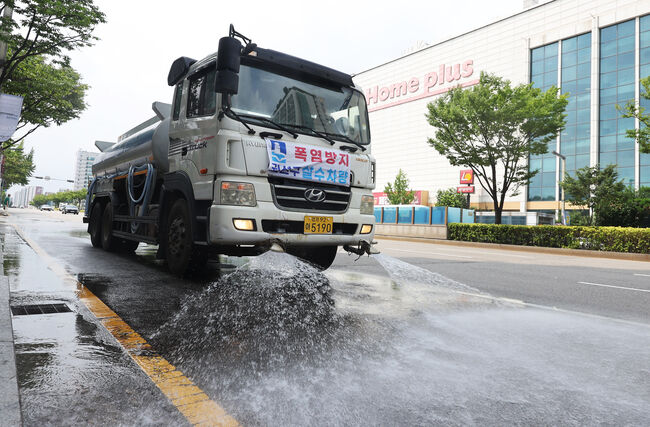 The Korean Peninsula wrapped in a thick blanket of scorching high pressure… Will the 1994 record be broken?
On the 28th, as the heatwave continues, a water sprinkler truck sprays water on Hyowon-ro, Gwonseon-gu, Suwon, Gyeonggi Province. [Photo = Yonhap News]The hottest years on record are considered to be
The Korean Peninsula wrapped in a thick blanket of scorching high pressure… Will the 1994 record be broken?
On the 28th, as the heatwave continues, a water sprinkler truck sprays water on Hyowon-ro, Gwonseon-gu, Suwon, Gyeonggi Province. [Photo = Yonhap News]The hottest years on record are considered to be
 Stock Market Crash 'Black Tuesday'… KOSPI down 10.8%, KOSDAQ down 7.7%
The KOSPI fell by more than 5% in early trading on the 28th, triggering a sell-side sidecar.On the 28th, the KOSPI plunged by more than 10%.Due to the sharp decline, a sell-side sidecar—a temporary
Stock Market Crash 'Black Tuesday'… KOSPI down 10.8%, KOSDAQ down 7.7%
The KOSPI fell by more than 5% in early trading on the 28th, triggering a sell-side sidecar.On the 28th, the KOSPI plunged by more than 10%.Due to the sharp decline, a sell-side sidecar—a temporary
 [World Heritage Committee] 25 New World Heritage Sites Inscribed in Busan… South Korea Successfully Expands 'Getbol' Listing
The Chairperson of the World Heritage Committee speaks at the plenary session of the 48th session of the World Heritage Committee, held at BEXCO in Busan on the 20th. [Photo: Yonhap News]A total of 25
[World Heritage Committee] 25 New World Heritage Sites Inscribed in Busan… South Korea Successfully Expands 'Getbol' Listing
The Chairperson of the World Heritage Committee speaks at the plenary session of the 48th session of the World Heritage Committee, held at BEXCO in Busan on the 20th. [Photo: Yonhap News]A total of 25
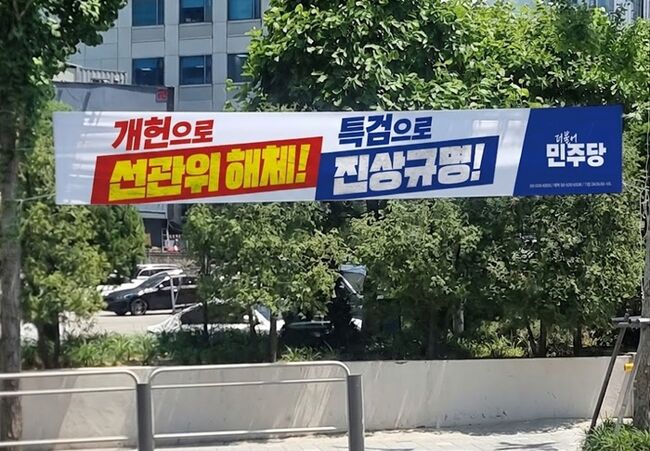 [Cho Yang-geon Column] The NEC: Facing a Fate of "Discarding the Dog After the Hunt"
Banner calling for the "dissolution of the NEC" posted by the Democratic Party. [AI-generated image]Banners calling for the "dissolution of the National Election Commission (NEC)" posted by the Democr
[Cho Yang-geon Column] The NEC: Facing a Fate of "Discarding the Dog After the Hunt"
Banner calling for the "dissolution of the NEC" posted by the Democratic Party. [AI-generated image]Banners calling for the "dissolution of the National Election Commission (NEC)" posted by the Democr
 [Photo] Evidence of Election Fraud Flooding U.S. Media… Trump Had 2.7 Million Votes Stolen
 [Video] U.S. Semiquincentennial Air Show... 'Art in the Sky' streaks across New York
 [Editorial Cartoon] A Draconian Law That Undermines Freedom of Expression

 List
List