서상문 박사가 보내온 이번 원고는 2025년 4월29일자 '한반도선진화재단' 홈페이지에 게재된 것입니다. 본문 3번 중 옆으로 누운 굵은 글씨 부분은 APEC 이전에 작성해 시제가 맞지 않음을 미리 알려드립니다. <편집자 주>
 Provisional Measures Zone (PMZ) between Korea and China
Maritime boundary issues between South Korea and China have resurfaced. This is due to China's unilateral installation of maritime structures in the Provisional Measures Zone (PMZ) in the Yellow Sea, where the 200-nautical mile Exclusive Economic Zones (EEZs) of both countries overlap. These structures, erected in 2018 (Shenlan 1), 2022 (a structure resembling an oil drilling rig for management facilities), and 2024 (Shenlan 2), are rumored by some to be fixed structures anchored to the seabed, although their exact nature has not been definitively confirmed. China has also deployed semi-submersible structures resembling watchtowers, Shenlan 1 and 2, around these installations.
 Dr. Seo Sang-moon, Historian, Chairman of the Korea Military Commentators Association, Director of the Institute for Future Studies of the Pan-East Sea RegionAccording to the Korea-China Fisheries Agreement signed in 2000, activities other than fishing are prohibited in the intermediate waters between Korea and China. Therefore, the unilateral installation of structures within China's portion of the Korea-China PMZ, without the consent of the South Korean government, is illegal. If China's claims are to be believed, that these are "floating structures" makes it difficult to definitively conclude a violation of international maritime law. However, based on the UN Convention on the Law of the Sea and international case law, actions that cause "permanent physical impact on the marine environment" in undelimited waters without the consent of the other party are prohibited.
This has fueled concerns within South Korea that this might be a planned step by China to expand its maritime boundary in the Yellow Sea, leading to a surge in anti-China sentiment. At the third Korea-China Maritime Cooperation Dialogue held in Seoul on April 23rd, China explained that two of the structures were floating and one was not a permanently fixed facility but purely a deep-sea aquaculture facility, thus unrelated to sovereignty or maritime boundary demarcation issues. They also claimed that these were not installed by the Chinese government but by private companies that invested the capital. However, South Korea insisted that all three facilities must be moved out of the PMZ and strongly opposed any further installations. China responded that there would be no further installations but moving the existing ones would be difficult.
Can we truly believe that China is telling the whole truth, and can we fully trust them to honor their promises? And is this installation of structures a standalone incident, or will it lead to further developments? The South Korean government must thoroughly investigate the facts from multiple perspectives, including the U.S.-China relations and China's strategic perception of South Korea, before formulating a meticulous response. To this end, it is crucial to first accurately understand the background and purpose behind China's installation of maritime structures on the Yellow Sea coast. To state the conclusion upfront: we must not respond complacently by fully believing China's aforementioned explanation. These structures are not unrelated to issues of maritime sovereignty or boundary demarcation; they could be a prelude to claiming more territory in future Yellow Sea maritime boundary demarcations or be used as a bargaining chip for Ieodo (known as "Suyan Rock" in China) in negotiations. From this point on, I will delve into these questions in detail, item by item.
1. Background: The Link Between Maritime Structures and the Ieodo Issue
The structures in question are inextricably linked to the Ieodo issue. This is because China views the East China Sea and the Yellow Sea, where Ieodo is located, not as separate entities but as a continuous whole from a national security perspective. When China seeks to claim territory, it typically follows a four-stage process from a national strategy standpoint. The first stage is "map aggression." This involves marking disputed or problematic territories on its own maps as its own before engaging in diplomatic negotiations with the other country. The second stage is to include the area in a joint management zone or, if bilateral agreement is not reached, to designate it as an international disputed area and then include it in a joint management zone. The third stage is joint development. The fourth stage is to attempt actual occupation while promoting its sovereignty during joint development. China has generally followed this process in the Nansha Islands. Similar precedents have been set in border disputes with India.
From this perspective, China has already completed the first stage, map aggression, regarding Ieodo. Ieodo falls within the 3 million km² area that China has declared as its territorial waters, continental shelf, and EEZ, which is equivalent to one-third of its land territory. China's announcement that Ieodo is part of its jurisdictional waters is the first step towards making it an international disputed area for the purpose of establishing a joint management zone, while it probes South Korea's reactions and awaits an opportunity.
The recent incident of China installing structures requires careful examination from this viewpoint. First, I would like to emphasize that China is a nation with a strong attachment to its territory and waters, no less so than Russia. Consequently, the field of "territorial studies" has naturally developed widely within Chinese academia, with extensive research conducted on the South China Sea and East China Sea.
China's ultimate goal is global dominance, or "world revolution," which it has temporarily put aside to focus on becoming a global hegemonic power surpassing the United States. Therefore, it is primarily concentrating on ensuring and expanding its national security and interests. In maritime affairs, China considers its security to be determined in the key coastal areas of Northeast Asia facing the U.S. and Japan, as well as in China's northeastern region, and the southeastern coastal areas including Tianjin, Beijing, Qingdao, Shanghai, Ningbo, Fuzhou, Xiamen, Hong Kong, and Guangzhou. How to defend these waters is a critical, existential task. This is why the CCP leadership has designated this region as a core area for national security since before the Korean War and has been preparing accordingly. On land, as can be seen in the map below, there are border regions to protect the core areas, but the border regions of China's coastline are the Yellow Sea (called "Huanghai" by China), the East China Sea, and the northern sea of the South China Sea, facing the coast from the Liaodong Peninsula in the north to Guangdong Province via Taiwan.
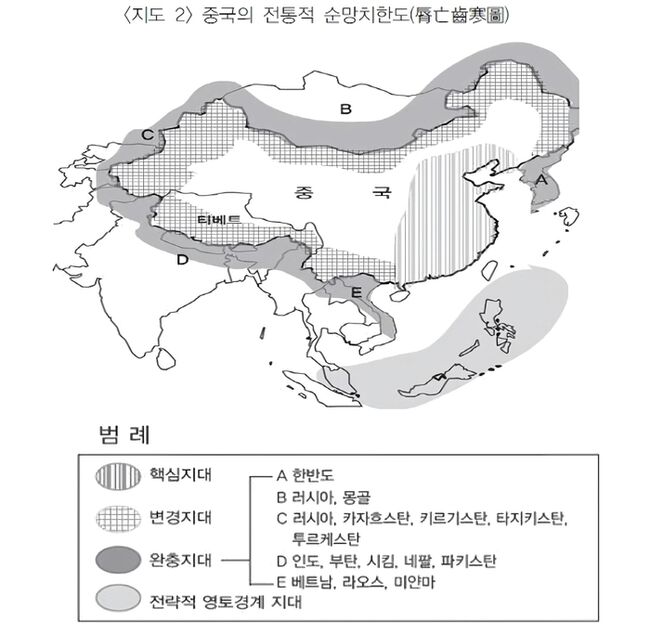
As China is engaging in a hegemonic struggle with the United States under President Xi Jinping, facing a counterattack from the U.S., China cannot afford to ignore U.S. pressure or the possibility of a U.S. attack on China in the event of a crisis in Taiwan or North Korea. In the future, China anticipates war with the United States if it uses force to take Taiwan. In the event of a Chinese invasion of Taiwan, the battlefield will not be confined to the Taiwan Strait. China has territorial disputes with Japan over the Senkaku Islands (called "Diaoyu Dao" in China) in the East China Sea and is in a potentially hostile relationship with Japan, which has U.S. military bases in Okinawa. Therefore, China is also anticipating an attack from Japan, which has declared its intention to intervene in any Taiwan crisis, making any Taiwan crisis directly linked to Japan's security. At the same time, China expects South Korea, which has a military alliance with the United States, to side with the U.S. in the event of a U.S.-China conflict and suspects U.S. involvement behind Ieodo. Furthermore, the U.S. has a cutting-edge military base in Pyeongtaek, South Korea, right at China's doorstep. China will never tolerate its core national security being jeopardized.
Located at coordinates 32°07'22.63" N, 125°10'56.81" E, Ieodo is situated in the center of a triangle connecting the Korean Peninsula, mainland China, and the Japanese archipelago. It serves as an intermediate point on the shipping route connecting China and Japan and a crucial gateway for both South Korea and China to access the Pacific Ocean. Ieodo is connected to the northern Yellow Sea and, being at the midpoint of the East China Sea, is a strategically vital point. Whichever of the three countries—Korea, China, or Japan—controls this area poses a security threat to the others; it is a strategic choke point, akin to constricting an opponent's throat. The Yellow Sea region is in close proximity to numerous ports such as Qingdao, Rizhao, and Dalian in China, Nampo and Pyongyang in North Korea, and Incheon and Pyeongtaek in South Korea. Therefore, whoever controls the Yellow Sea holds a leash that can threaten the safety of the remaining nations.
China believes that if it can control Ieodo, it can effectively defend against external maritime threats and ensure the safety and smooth flow of maritime navigation and trade. Conversely, if Ieodo is controlled by another country, it would pose a serious threat to China's territorial integrity and maritime safety. In this context, China views Ieodo as a forward operating base that threatens China's security and could be used by South Korea, and even Japan, to attack China in the event of a crisis. Moreover, the waters around Ieodo are rich in oil and gas resources, meaning control over Ieodo translates to mining rights for mineral resources in the surrounding areas.
China, which must prepare for potential attacks from Japan, regards Ieodo as a highly significant "island" that oversees the Yangtze River Delta to the west and checks the Yellow Sea to the east, evaluating it as a key point in the Yellow Sea and East China Sea. From the perspective of this macro security structure and China's response strategy, the East China Sea and the Yellow Sea are an inseparable, vast security barrier for Chinese strategists. This is clearly evident in China's perception of these two seas as one.
Furthermore, the Yellow Sea, a semi-enclosed sea surrounded by land and located on the periphery, is also a strategically vital sea for China. The Yellow Sea is bordered by the estuary of the Yalu River to the north and the northern bank of the Yangtze River estuary to the south, the southwestern tip of Jeju Island to the east, and China's Liaoning and Shandong Peninsulas to the west. It has an area of approximately 380,000 km², an average depth of 44 meters, and a maximum depth of 140 meters. China views the Yellow Sea, a crucial passage connecting Northeast Asia and the Pacific, as a strategic buffer zone that can protect its key geographical areas. Moreover, the Yellow Sea is rich in fishery resources, with an estimated annual catch of millions of tons of various fish such as blue crabs, hairtail, yellow croaker, and pompano, making it a world-leading fishing ground. It is also a treasure trove of energy resources, with vast reserves of oil and natural gas estimated in the billions of tons.
2. Purpose and Objective of China's Structure Installation
However, why did China choose to erect these structures in the Yellow Sea's provisional zone in the late 2010s? Examining China's past responses to the Senkaku Islands and Ieodo can help infer their intentions. While the confrontation over the Senkaku Islands is currently acute, China was actually not interested in them before the 1970s due to internal turmoil such as the Cultural Revolution. However, upon learning of the discovery of vast undersea mineral resources in the East China Sea, China began to show interest and vigorously assert its sovereignty over the area.
This fact is highly suggestive. China's interest in Ieodo is also a very recent development. Prior to approximately 2000, there were almost no mentions of it in Chinese media or academia. China even falsely claimed that the dispute over sovereignty of Ieodo originated from "the Blue House's order on January 26, 2001, to illegally rename Suyan Rock 'Ieodo'." Furthermore, China is misleading its citizens by claiming that the Chinese Navy and Air Force now constantly patrol the vicinity of Ieodo, and that South Korean control is becoming increasingly difficult, making the detachment of Ieodo from South Korean control a matter of time. This is likely related to the fact that Chinese military aircraft frequently violate South Korea's Air Defense Identification Zone (KADIZ). We must not forget what these facts imply.
The installation of structures like Shenlan 1 and 2 in the Yellow Sea, north of Ieodo, is believed to be an attempt by China to secure an alternative area to offset the strategic value of Ieodo, which they perceive as being preempted by South Korea, or to secure a bargaining chip for negotiations with South Korea. For China, Ieodo may have been recognized as a key point to control the Yellow Sea and South Korea in the event of a clash between Korea and China in the Yellow Sea or South Korea's participation in a Taiwan contingency.
So, what are these structures for? Are they purely deep-sea aquaculture facilities for private companies, as China claims? The structures installed by China's Shandong Ocean Group for the development of Yellow Sea fish farms are modified versions of the oil drilling rig "Atlantic Amsterdam." Based on this, China claims that the structures were invested in by private companies, but this is highly unlikely. This is because China does not permit private companies to invest in matters related to national security. Therefore, we must consider these structures, disguised as private enterprises, to have been installed by the state. It is important to remember that even if the structures are for aquaculture, their purpose is meticulously calculated for future security purposes. According to South Korean intelligence authorities, who detected a large, mobile steel structure installed by China via reconnaissance satellites, the structure measures over 50 meters in diameter and 50 meters in height. While China claims the structures are for managing aquaculture farms, they have helicopter landing pads and are 100 meters long by 80 meters wide, capable of accommodating up to 100 people, raising suspicions of strategic rather than fishery use.
Whether the structures are for commercial or non-commercial purposes is ultimately determined by the will of the Chinese Communist Party, but it is also related to whether China will dismantle the existing facilities as promised, and whether they are fixed or mobile. Regarding dismantling, China has designated the waters where Shenlan 1 and 2 are located as a national deep-sea aquaculture experimental zone, claiming the structures are aquaculture facilities. Qingdao city has also announced plans to install an additional 10 semi-submersible structures similar to Shenlan by the end of this year, drawing significant attention. Regarding the structure's form, domestic oil drilling experts have stated that the "Atlantic Amsterdam" is a facility that operates only in a fixed manner in waters up to approximately 120 meters deep. It seems highly probable that it has remained in the same location since SBS first reported in 2022 that China had erected structures believed to be oil drilling facilities in the Yellow Sea. If the structures are of a type that is fixed to the seabed, they could become bases for China to expand its influence in the Yellow Sea. Furthermore, even if they are currently used for commercial purposes, we cannot ignore the possibility that they could be repurposed for non-commercial uses later. We must remember the case of China began building artificial islands in the South China Sea in 2014, fortifying them with anti-aircraft guns and missile defense systems, and eventually transforming them into military strongholds, and then arbitrarily claiming these artificial islands as Chinese territory and the surrounding waters as Chinese territorial waters.
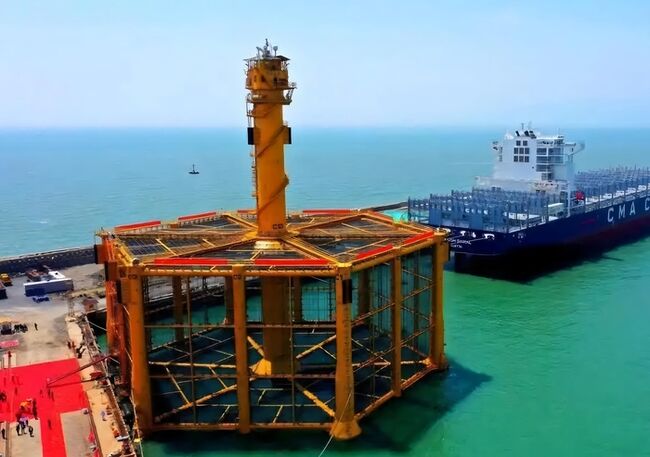 Structures China claims were built for aquaculture purposes
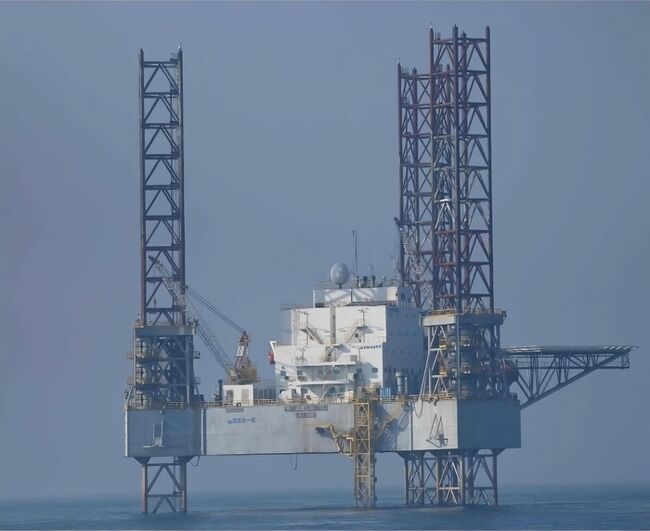 China insists these are for aquaculture development, but can we believe it?
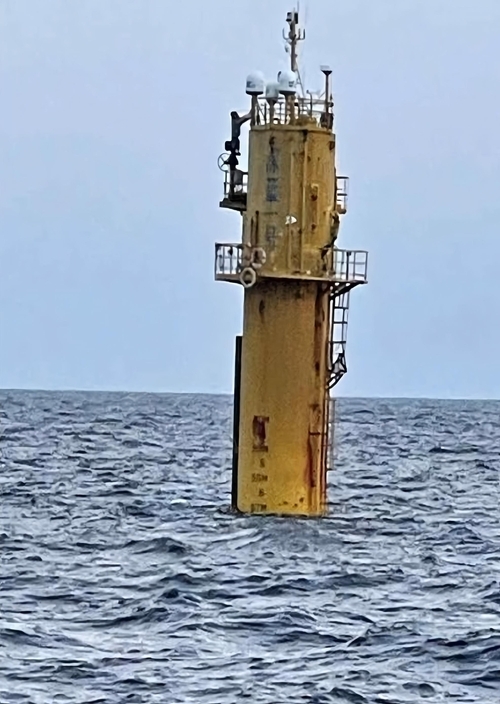 Shenlan 1. China's assertion at the Korea-China meeting on April 23rd that the structures are purely aquaculture facilities unrelated to sovereignty or boundary demarcation issues, and their offer to arrange site visits for South Korean authorities or experts, is judged as a proactive attempt to preemptively explain and dispel the growing controversy in South Korea over China's "land grab" in the Yellow Sea. This was likely intended to alleviate concerns that China was creating grounds to expand its influence and assert sovereignty in the Yellow Sea.
3. Outlook and Our Challenges
The South Korean government appears to place considerable trust in China's statements regarding this incident. Citing the consensus reached by Korea and China on managing relations ahead of President Xi Jinping's expected visit to South Korea for the Asia-Pacific Economic Cooperation (APEC) summit this year, China's adherence to the meeting schedule despite domestic controversy over the Yellow Sea structures, and their unusually earnest explanation through the dispatch of a central delegation including local government officials, the government anticipates that China will not install additional facilities. In short, this is a complacent attitude. Complacency is forbidden. Regardless of the country with whom we negotiate, but especially when negotiating with China, we must not believe their words 100%, even when considering their perspective. Furthermore, given that Xi Jinping is likely to step down from the front lines of power around August-September this year, it would be advisable not to link his potential visit to South Korea for the APEC meeting scheduled for late October with the issue of dismantling China's structures.
Of course, the South Korean government has been demanding that China cease installing facilities in the Yellow Sea provisional zone since 2022. At the Korea-China meeting on April 23rd, it also stated that if moving the three facilities out of the PMZ proved difficult, South Korea might consider proportional countermeasures. However, China is unlikely to easily dismantle the structures in the Yellow Sea. In such a case, it would be advisable for us to set a deadline for dismantling the facilities and, if China fails to comply with its promise, pursue proportional countermeasures, such as installing structures in the provisional zone proportional to the distance of China's installations. This would be the proper course of action.
If South Korea fails to remove China's existing structures and tolerates their installation, China may proceed to expand them without hesitation. We must consider the possibility that China will use these structures as a basis for claiming more territory in boundary demarcation negotiations, using the pretext of fishery facilities to establish the basis for maritime boundary delineation between the two countries. In such a scenario, it is possible that China's actions could pose a threat to South Korea's maritime interests.
In the future, China will likely adhere to the principle of "equi-proportionality," dividing maritime boundaries in proportion to coastline length. It also advocates for dividing the EEZs of Korea and China based on the continental shelf. With a significantly longer coastline than South Korea, and considering the deposition of sediment from the Yellow River and Yangtze River on the seabed of the Yellow Sea and East China Sea, forming the continental shelf, drawing boundary lines based on this would place most of both the Yellow Sea and East China Sea under Chinese jurisdiction. In negotiations with Japan to demarcate maritime boundaries, China also argued for the principle of natural prolongation of the continental shelf based on the underwater topography and structure of the East China Sea, while the Japanese government, like the South Korean government, has been demanding that the median line of the territorial waters of both countries be set as the boundary of the EEZ. Our government should not waver from its existing principle of "equidistance," which proposes the "median line" of the EEZ as the boundary based on the territorial waters baselines of both countries.
Regarding Ieodo, China will never abandon its claims to sovereignty and will continue to assert them. In EEZ negotiations between Korea and China, China will propose including Ieodo in a joint management zone, and if this goal is achieved, it may demand joint development between the two countries. Ultimately, there is a possibility that China will promote its sovereignty over Ieodo during joint development and seek to possess it or expand its development share. This can be predicted from similar actions China has taken in the South China Sea, where it has territorial disputes with the Philippines, Taiwan, and others. If the method of dividing the boundary by the median line is adopted, Ieodo would fall within South Korea's EEZ. However, if Ieodo becomes an internationally disputed area and is submitted for arbitration by the International Tribunal for the Law of the Sea, the matter becomes complex. If precedent is followed, where EEZ boundaries are demarcated in proportion to the coastline length and sea area of the parties involved, Ieodo could be ceded to China. This means that if it becomes an internationally disputed area, it will not be advantageous for us.
In the future, China may organize a "maritime militia," a military force composed of civilians, and deploy them to Ieodo and the Yellow Sea to conduct quasi-combat operations. Just as they have insisted on the absence of government responsibility in past similar incidents, this behavior is likely to continue. This constitutes a part of the "Grey Zone Strategy." It is of the same nature as China's claim that the "People's Volunteer Army" sent to North Korea during the Korean War was a civilian organization, not a state-sponsored military force. The adage "an eye for an eye" is not mere decoration. Peace must be protected during times of peace. We too need to respond with a similar gray zone strategy as China.
Dr. Seo Sang-moon, Historian, Chairman of the Korea Military Commentators Association, Director of the Institute for Future Studies of the Pan-East Sea Region
♦The above article is the original version of an article published on the website of the "Korea Advancement Institute" on April 29, 2025, under a different title below.
Related Link:
https://www.hansun.org/korean/bbs/board_view.php?bbs_code=bbsIdx7&num=8471

 Iranian Foreign Ministry: "Continuing Message Exchanges with the U.S. and Activities of Mediating Countries"
Esmaeil Baghaei, Spokesperson for the Iranian Ministry of Foreign Affairs [Xinhua, Yonhap News file photo]Esmaeil Baghaei, spokesperson for the Iranian Ministry of Foreign Affairs, stated on the 26th
Iranian Foreign Ministry: "Continuing Message Exchanges with the U.S. and Activities of Mediating Countries"
Esmaeil Baghaei, Spokesperson for the Iranian Ministry of Foreign Affairs [Xinhua, Yonhap News file photo]Esmaeil Baghaei, spokesperson for the Iranian Ministry of Foreign Affairs, stated on the 26th
 President Yoon: "Do You Think You Are Safe from the Special Counsel?"... Final Statement Video Released
President Yoon Suk Yeol rebuking the special prosecutor on the 24th. [Court video / @birds_justice X account subtitle GIF] A video of President Yoon Suk Yeol's closing statement at his trial rega
President Yoon: "Do You Think You Are Safe from the Special Counsel?"... Final Statement Video Released
President Yoon Suk Yeol rebuking the special prosecutor on the 24th. [Court video / @birds_justice X account subtitle GIF] A video of President Yoon Suk Yeol's closing statement at his trial rega
 President Yoon, regarding the first-instance ruling on the Public Official Election Act: “An excessive political verdict that distorts the facts… We will appeal immediately.”
The first-instance sentencing hearing for President Yoon Suk Yeol regarding violations of the Public Official Election Act is being broadcast live at Seoul Station on the 27th. [Photo=Yonhap News]Pres
President Yoon, regarding the first-instance ruling on the Public Official Election Act: “An excessive political verdict that distorts the facts… We will appeal immediately.”
The first-instance sentencing hearing for President Yoon Suk Yeol regarding violations of the Public Official Election Act is being broadcast live at Seoul Station on the 27th. [Photo=Yonhap News]Pres
 WSJ: "SK Hynix ADR Premium Is a Sign of AI Trading Overheat"
Advertisement for SK Hynix ADR listing in New York's Times Square [Reuters=Yonhap News file photo]The Wall Street Journal (WSJ) has pointed out that the price of SK Hynix’s American Depositary Recei
WSJ: "SK Hynix ADR Premium Is a Sign of AI Trading Overheat"
Advertisement for SK Hynix ADR listing in New York's Times Square [Reuters=Yonhap News file photo]The Wall Street Journal (WSJ) has pointed out that the price of SK Hynix’s American Depositary Recei
 'Godfather of Japanese Mystery Novels' Keigo Higashino Passes Away After Battle with Cancer at 68
Famous Japanese mystery novelist Keigo Higashino [AFP=Yonhap News]It has been belatedly reported that Keigo Higashino, the "godfather of Japanese mystery novels" and author of bestsellers such as "The
'Godfather of Japanese Mystery Novels' Keigo Higashino Passes Away After Battle with Cancer at 68
Famous Japanese mystery novelist Keigo Higashino [AFP=Yonhap News]It has been belatedly reported that Keigo Higashino, the "godfather of Japanese mystery novels" and author of bestsellers such as "The
 [Park Pil-kyu Security Column] To the Ignorant Trying to Clothe a Beast in Sheep's Clothing
Rep. Kim Byung-joo of the Democratic Party of Korea [Photo=Yonhap News]“The Air Force Academy doesn't teach you how to fly a plane!” “The Army, Navy, and Air Force academies are exactly the
[Park Pil-kyu Security Column] To the Ignorant Trying to Clothe a Beast in Sheep's Clothing
Rep. Kim Byung-joo of the Democratic Party of Korea [Photo=Yonhap News]“The Air Force Academy doesn't teach you how to fly a plane!” “The Army, Navy, and Air Force academies are exactly the
 [Issue Diagnosis] Two Effects of the Election Petition Review
 [Photo] Evidence of Election Fraud Flooding U.S. Media… Trump Had 2.7 Million Votes Stolen
 [Video] U.S. Semiquincentennial Air Show... 'Art in the Sky' streaks across New York
 [Editorial Cartoon] A Draconian Law That Undermines Freedom of Expression

 List
List










