12‧3 비상계엄 논란의 핵심 변수는 곽종근 전 특전사령관의 뒤바뀐 진술이다. 지인과의 통화에서 드러난 압박감, 그 직후 야당 의원들과의 인터뷰에서 강화된 워딩, 그리고 하부 지휘관들의 엇갈린 증언은 내란 프레임의 실체를 다시 점검해야 할 필요성을 제기한다. ②편에서는 곽종근 진술의 변화와 그 배경을 집중적으로 다룬다. <편집자 주>
 Former Army Special Warfare Command Commander Kwak Jong-geun attends the court hearing for former President Yoon Suk-yeol's sedition trial as a witness at the Seoul Central District Court in Seocho-gu, Seoul, on the 3rd. Yonhap News
[Table of Contents]
① Hong Jang-won… The truth that 'Jirongyi' could not tell
② Kwak Jong-geun… The military's judgment on the day of martial law and the actual situation in the National Assembly
③ Arrest team roster… What changed before and after its disclosure
④ Legal structure of sedition… Why it does not constitute a crime
⑤ Comprehensive review… What does the truth of that day reveal?
Kwak Jong-geun's testimony as the former commander of the Special Warfare Command is a key variable that determines the entire flow of events and the judgment on them in the trial of former President Yoon Suk-yeol for sedition and leading martial law on December 3rd. However, more important than what Kwak Jong-geun remembers is a precise analysis of how that memory was formed and changed over time.
In particular, whether "pull out the National Assembly members" was an actual presidential remark or a reconstruction based on Kwak Jong-geun's interpretation, fears, or political pressure is the central axis for the court to determine the possibility of sedition.
Kwak Jong-geun's statement was not so clear from the beginning. The starting point of the change was a video interview with Democratic Party lawmakers Kim Byung-joo and Park Sun-won on December 6, 2024. This interview was embroiled in controversy over whether it was "personnel" or "lawmakers."
However, what quelled this controversy was the subsequent release of recorded phone calls Kwak Jong-geun had with his acquaintances. This is because the content of the calls reveals why and how Kwak Jong-geun's sentiments changed.
The phone call took place on December 5th, the day before the interview with lawmakers Kim Byung-joo and Park Sun-won.
During the call, he repeatedly said, "Someone is trying to frame me for sedition," "They told me to speak if I want to live," and "They are pressuring me to make a declaration of conscience." These were expressions filled with extreme anxiety and fear. Based on the circumstances, it can be easily inferred that the "someone" he referred to was one of those trying to push the emergency martial law into sedition. The content is a complaint to a friend that he is being threatened by these individuals.
The wording in Kwak Jong-geun's interview the next day changed completely. Previously, he had used vague expressions like "control the personnel" and "organize the situation," but in the interview, he said, "Pull out the National Assembly members" and "It was meant to break down the doors if necessary."
His statement changed drastically in just one day. This change is difficult to explain as a simple memory enhancement or difference in expression. The reason for the suspicion that his statement was "aligned" in a certain direction is the combination of the pressure revealed in the previous day's phone call and his fluctuating state of mind up until just before the interview.
In court, Kwak Jong-geun's testimony clashed directly with the testimonies of other military commanders. Kwak Jong-geun claimed that "around 12:30 AM on December 4th, former President Yoon Suk-yeol called on a secure phone and instructed to 'pull out the National Assembly members'." However, the presidential side countered, stating that "Commander Kwak had already conveyed the same content to his subordinates before speaking with the President." This is a conflict regarding the existence and timing of the order. If the timing changes, the structure of the testimony itself collapses.
In other words, if Kwak Jong-geun's order was issued before his call with the President, then the presidential order becomes an afterthought. In this case, the credibility of the testimony is inevitably shaken significantly.
Lee Sang-hyun, commander of the 1st Airborne Brigade, testified that "between 12:50 AM and 1:00 AM, Commander Kwak called on a secure phone and said, 'The President ordered us to pull out the lawmakers, even if we have to break down the doors'." He then confirmed the order as per military protocol by asking, "Did the President give such an order?" and Kwak Jong-geun reportedly replied, "Yes," in an unconfident voice.
The fact that the order to "pull out the lawmakers" was conveyed to the brigade commander is somewhat confirmed. However, it remains unclear where the order originated from, whether it was a direct presidential order, Kwak Jong-geun's own judgment, or an over-interpretation of the phone conversation.
The testimonies of lower-ranking commanders are more complex. Some commanders of the 1st Airborne Brigade testified that they heard the order to "pull out the lawmakers, even if it means breaking down the doors." In contrast, Colonel Kim Hyun-tae, the commander of the 707th Special Mission Battalion, initially stated that he heard words to that effect but later changed his testimony in court, saying, "I never directly heard those exact words." Other officers stated that they understood the mission at the time as "maintaining order in the National Assembly" or "protecting the facilities." Some testified that they understood it as "a deployment to prepare for North Korean propaganda balloons."
The upper echelons' messages are strong and clear, but the perceptions of those at the lower levels are scattered and vary from person to person. This asymmetrical structure is a key clue in determining at which point in the chain of command – 'President → Commander → Brigade Commander → Subordinate Units' – the message was distorted or amplified.
However, even assuming Kwak Jong-geun's testimony is true, whether it directly leads to the elements of sedition is an entirely different matter. Four conditions are necessary for sedition to be established: a clear order for violence with the intent to subvert the constitution, evidence that the order led to actual preparations for execution, the realistic danger of an uprising, and a causal relationship between the order and the execution. These elements must be met sequentially.
When Kwak Jong-geun's testimony is applied to these conditions, none of the elements are met. There is no documentation or communication record to prove a direct presidential order, and the testimonies of the commanders are inconsistent in terms of timing and content. The actual actions of the military were far from executing sedition. There was no large-scale deployment of troops to the National Assembly building, nor was there any armament for violent entry. There was also no evidence of preparations for forceful measures equivalent to the arrest or detention of lawmakers.
The essential chain for establishing sedition – order—execution—uprising – is not connected at any point. Even if there was a presidential order as Kwak Jong-geun claims, there is no trace of that order being conveyed, executed, or leading to an uprising. Conversely, if Kwak Jong-geun's order predated his call with the President, his testimony structure becomes inexplicable and loses credibility. The testimonies of the brigade commander and officers are contradictory, and the actual movements of the units were closer to performing routine control missions.
The video broadcast from in front of the National Assembly building on the day of the martial law further substantiates this. Special Warfare Command personnel were not armed and did not have bayonets attached. They were mostly seen being surrounded, subdued, or pushed back by civilians in front of the National Assembly. It is difficult to conclude that there was a realistic danger of an uprising.
Ultimately, Kwak Jong-geun's testimony can be an important clue showing what conversations took place among military commanders on the day of martial law, and how those conversations were transformed by emotions, pressure, interpretations, and misjudgments. However, that alone creates a clear factual and legal gap to apply the charge of leading sedition to the President. The rapid change in testimony, the reversed timing, the unclear origin of the order, and the absence of actual execution traces are far from meeting the elements of sedition.
In the next installment, we will closely examine the reality of the controversial "arrest team roster" and the National Assembly entry scenario, along with Kwak Jong-geun's testimony, to explore the final link in the sedition scenario.
#KwakJongGeun #Dec3EmergencyMartialLaw #SeditionLeadershipTrial #AcquaintanceCallRecording #PullOutLawmakersControversy #TestimonyChange #SpecialWarfareCommand #MartialLawTroopReality #NationalAssemblySituation #Hankmiilbo

 [Statement by the Seobeokka KMA Patriots Association] ㉛ Recount the ballots openly, as the previous recount covered up election fraud
Recount of the Tongyeong mayoral election [Photo=Yonhap News]South Korea's liberal democracy is dying. The National Election Commission (NEC), which has degraded into a criminal organization through t
[Statement by the Seobeokka KMA Patriots Association] ㉛ Recount the ballots openly, as the previous recount covered up election fraud
Recount of the Tongyeong mayoral election [Photo=Yonhap News]South Korea's liberal democracy is dying. The National Election Commission (NEC), which has degraded into a criminal organization through t
 What is the significance of the "Trump 2028" red hat that keeps reappearing?
It is noteworthy that while it is "highly likely" that President Donald Trump is "seriously considering" a run for the presidency in 2028, he is also "deliberately" fueling speculation regarding wheth
What is the significance of the "Trump 2028" red hat that keeps reappearing?
It is noteworthy that while it is "highly likely" that President Donald Trump is "seriously considering" a run for the presidency in 2028, he is also "deliberately" fueling speculation regarding wheth
 First U.S. Ambassador of Trump's Second Term to Arrive This Week… Will It Provide Momentum to Resolve Pending Issues?
U.S. Ambassador to South Korea Michelle Steel speaks at the opening ceremony of the Korea-U.S. Shipbuilding Cooperation Center held at the Mayflower Hotel in Washington, D.C., on the 23rd (local time)
First U.S. Ambassador of Trump's Second Term to Arrive This Week… Will It Provide Momentum to Resolve Pending Issues?
U.S. Ambassador to South Korea Michelle Steel speaks at the opening ceremony of the Korea-U.S. Shipbuilding Cooperation Center held at the Mayflower Hotel in Washington, D.C., on the 23rd (local time)
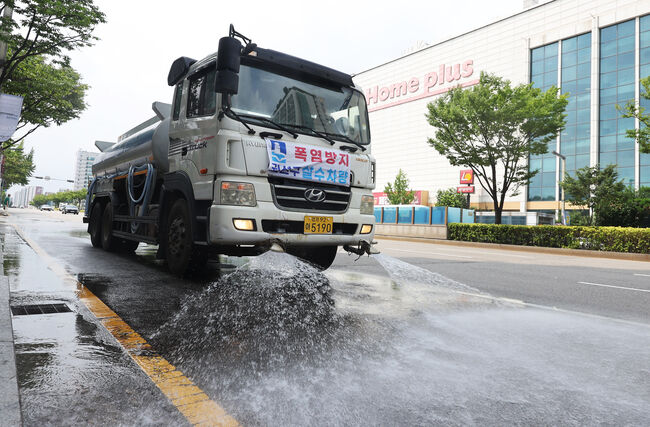 The Korean Peninsula wrapped in a thick blanket of scorching high pressure… Will the 1994 record be broken?
On the 28th, as the heatwave continues, a water sprinkler truck sprays water on Hyowon-ro, Gwonseon-gu, Suwon, Gyeonggi Province. [Photo = Yonhap News]The hottest years on record are considered to be
The Korean Peninsula wrapped in a thick blanket of scorching high pressure… Will the 1994 record be broken?
On the 28th, as the heatwave continues, a water sprinkler truck sprays water on Hyowon-ro, Gwonseon-gu, Suwon, Gyeonggi Province. [Photo = Yonhap News]The hottest years on record are considered to be
 Stock Market Crash 'Black Tuesday'… KOSPI down 10.8%, KOSDAQ down 7.7%
The KOSPI fell by more than 5% in early trading on the 28th, triggering a sell-side sidecar.On the 28th, the KOSPI plunged by more than 10%.Due to the sharp decline, a sell-side sidecar—a temporary
Stock Market Crash 'Black Tuesday'… KOSPI down 10.8%, KOSDAQ down 7.7%
The KOSPI fell by more than 5% in early trading on the 28th, triggering a sell-side sidecar.On the 28th, the KOSPI plunged by more than 10%.Due to the sharp decline, a sell-side sidecar—a temporary
 [World Heritage Committee] 25 New World Heritage Sites Inscribed in Busan… South Korea Successfully Expands 'Getbol' Listing
The Chairperson of the World Heritage Committee speaks at the plenary session of the 48th session of the World Heritage Committee, held at BEXCO in Busan on the 20th. [Photo: Yonhap News]A total of 25
[World Heritage Committee] 25 New World Heritage Sites Inscribed in Busan… South Korea Successfully Expands 'Getbol' Listing
The Chairperson of the World Heritage Committee speaks at the plenary session of the 48th session of the World Heritage Committee, held at BEXCO in Busan on the 20th. [Photo: Yonhap News]A total of 25
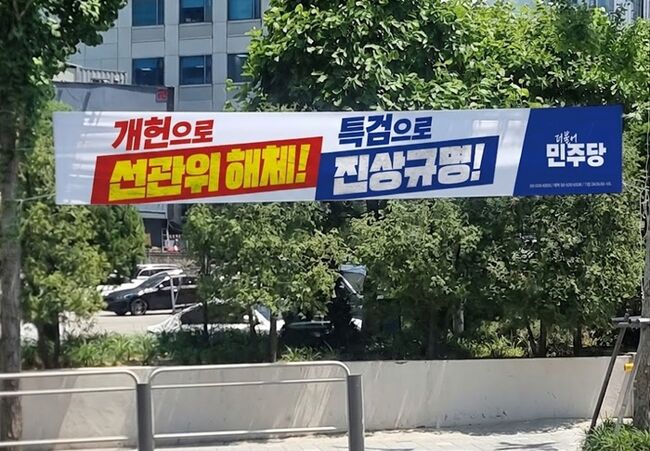 [Cho Yang-geon Column] The NEC: Facing a Fate of "Discarding the Dog After the Hunt"
Banner calling for the "dissolution of the NEC" posted by the Democratic Party. [AI-generated image]Banners calling for the "dissolution of the National Election Commission (NEC)" posted by the Democr
[Cho Yang-geon Column] The NEC: Facing a Fate of "Discarding the Dog After the Hunt"
Banner calling for the "dissolution of the NEC" posted by the Democratic Party. [AI-generated image]Banners calling for the "dissolution of the National Election Commission (NEC)" posted by the Democr
 [Photo] Evidence of Election Fraud Flooding U.S. Media… Trump Had 2.7 Million Votes Stolen
 [Video] U.S. Semiquincentennial Air Show... 'Art in the Sky' streaks across New York
 [Editorial Cartoon] A Draconian Law That Undermines Freedom of Expression

 List
List