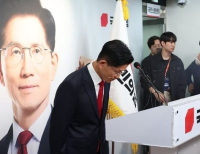
Former President Yoon Suk-yeol testifies as a witness in the rebellion trial of former Prime Minister Han Duck-soo, held at the Seoul Central District Court in Seocho-gu, Seoul, on the 19th, stating that former Prime Minister Han opposed the declaration of martial law. Yonhap News
No scholar equates martial law with rebellion. Emergency martial law is a governing power granted to the president by the constitution, whereas rebellion is a crime under criminal law that suspends the functions of state institutions by force.
Despite this, the special prosecutor, by relying on "intent" and "suspicion" for a case that does not meet the elements of rebellion, appears to be expecting the court to reach a political conclusion. This structure, dependent on frames rather than legal principles and assumptions rather than facts, deviates the trial from its essence.
The reason why the crime of rebellion is not established is actually very simple. What the court examines is not "intent" but "the realistic possibility of suspending state functions by force." The essence of rebellion is an uprising, and an uprising is not a riot or clash, but the exercise of force sufficient to paralyze the functions of state institutions.
However, the troops mobilized in this case were mostly unarmed, and their numbers were absolutely insufficient to halt the functions of the National Assembly or the Election Commission. In reality, no state institution ceased to function, and some troops were pushed back by fire extinguishers deployed by civilians. There were no objective or physical acts that could be evaluated as an attempt to execute the crime.
In short, with only the absence of "no uprising, no force, no suspension of functions, and no attempted execution," rebellion has no room for establishment. This is a conclusion derived from the direct application of the elements of criminal law, not a political interpretation.
And one more point can be added. If there had been enough force and an uprising to constitute rebellion, emergency martial law could not have been overthrown by civilian resistance. The very fact that martial law collapsed immediately is the clearest refutation of the absence of the elements of rebellion.
Therefore, it is necessary to examine why the special prosecutor is focusing on "intent."
It is because the substantive elements of rebellion do not exist. They are attempting to substitute the deficient elements with suspicion and presumption, centering on what the president "intended to do." The trial structure desired by the special prosecutor is not the judgment of a legal expert but mind-reading like that of Gumungye (a character from a historical drama known for his fortune-telling). The reason for emphasizing intent is singular: because there was no uprising or force, no answer can be reached through a legal approach.
The special prosecutor's logic goes further: "The president ordered the suppression, but the military refused, leading to failure, therefore it is rebellion."
However, this is logic that negates rebellion rather than proving it. Rebellion requires execution, not orders; reality, not intent; and the suspension of state functions, not just a decision.
The fact that the military deviated from or refused orders, and that some troops retreated in the face of civilian resistance, is not evidence that "rebellion occurred" but rather proof that "rebellion could not be executed." This means that the realistic danger of an uprising did not exist, which undermines the most crucial element for the establishment of rebellion.
Some are raising the possibility that the special prosecutor may change the indictment to conspiracy to commit rebellion.
However, rebellion (Article 87 of the Criminal Act) and conspiracy (Article 90 of the Criminal Act) are distinct crimes with entirely different underlying factual relationships. Because their identity is not recognized, changing the indictment is not permissible.
The indictment change in the Unified Progressive Party case was possible due to special circumstances such as the existence of an organization for the purpose of rebellion, armed training, and long-term revolutionary plans. This case is structurally and factually entirely different. It is legally unfeasible to reduce the charge to conspiracy on the grounds that "acts occurred, but it was not rebellion."
A transition to incitement to rebellion also does not hold. The crime of incitement requires an objective danger that increases the actual risk of executing a rebellion, not merely the expression of intent.
However, this case involved no armament, no possibility of execution, and no suspension of state functions. There were units that did not follow orders, and the chain of command had, in fact, collapsed. In such circumstances, there is no basis to argue that "the risk of rebellion was increased through incitement."
The same applies to abuse of authority. The invocation of martial law and orders to the military are inherent presidential powers under the constitution, and the duty of a military commander is to obey orders from a superior. Since there was no "legitimate authority" that was obstructed, the elements of the crime of abuse of authority are not met.
To summarize, acts occurred, but the elements of the crime of rebellion were not met. Even so, it cannot be reconstructed as conspiracy, incitement, or abuse of authority. Ultimately, from a purely legal perspective, the conclusion is simple. This case is not rebellion. And no crime equivalent to rebellion is established. It is merely a narrative that is only possible in the realm of politics, not in legal principles.
From a legal standpoint, the conclusion is that it was not rebellion. If so, what actually happened that day? The structure of truth cannot be explained by legal principles alone. In '⑤ Summary... What Does the Truth of That Day Tell Us?', the "reality of that day" will be thoroughly dissected.
※ This article is an analysis based on videos disclosed during the trial and the newspaper's reporting, compiled with advice from professors and lawyers specializing in criminal and constitutional law. We disclose that this article was written after sharing the conclusion, as the participants requested anonymity due to the gravity of the trial.
#Rebellion #MartialLawControversy #SpecialProsecutorTrial #CriminalActArticle87 #RebellionNotEstablished #ConspiracyToRebelNotPossible #IncitementToRebelNotPossible #AbuseOfAuthorityNotEstablished #TrialCenteredOnLegalPrinciples #HBSAnalysis

 [Statement by the Seobeokka KMA Patriots Association] ㉛ Recount the ballots openly, as the previous recount covered up election fraud
Recount of the Tongyeong mayoral election [Photo=Yonhap News]South Korea's liberal democracy is dying. The National Election Commission (NEC), which has degraded into a criminal organization through t
[Statement by the Seobeokka KMA Patriots Association] ㉛ Recount the ballots openly, as the previous recount covered up election fraud
Recount of the Tongyeong mayoral election [Photo=Yonhap News]South Korea's liberal democracy is dying. The National Election Commission (NEC), which has degraded into a criminal organization through t
 What is the significance of the "Trump 2028" red hat that keeps reappearing?
It is noteworthy that while it is "highly likely" that President Donald Trump is "seriously considering" a run for the presidency in 2028, he is also "deliberately" fueling speculation regarding wheth
What is the significance of the "Trump 2028" red hat that keeps reappearing?
It is noteworthy that while it is "highly likely" that President Donald Trump is "seriously considering" a run for the presidency in 2028, he is also "deliberately" fueling speculation regarding wheth
 First U.S. Ambassador of Trump's Second Term to Arrive This Week… Will It Provide Momentum to Resolve Pending Issues?
U.S. Ambassador to South Korea Michelle Steel speaks at the opening ceremony of the Korea-U.S. Shipbuilding Cooperation Center held at the Mayflower Hotel in Washington, D.C., on the 23rd (local time)
First U.S. Ambassador of Trump's Second Term to Arrive This Week… Will It Provide Momentum to Resolve Pending Issues?
U.S. Ambassador to South Korea Michelle Steel speaks at the opening ceremony of the Korea-U.S. Shipbuilding Cooperation Center held at the Mayflower Hotel in Washington, D.C., on the 23rd (local time)
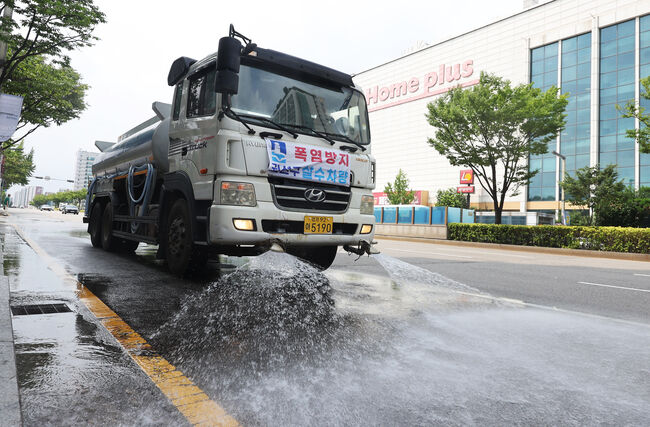 The Korean Peninsula wrapped in a thick blanket of scorching high pressure… Will the 1994 record be broken?
On the 28th, as the heatwave continues, a water sprinkler truck sprays water on Hyowon-ro, Gwonseon-gu, Suwon, Gyeonggi Province. [Photo = Yonhap News]The hottest years on record are considered to be
The Korean Peninsula wrapped in a thick blanket of scorching high pressure… Will the 1994 record be broken?
On the 28th, as the heatwave continues, a water sprinkler truck sprays water on Hyowon-ro, Gwonseon-gu, Suwon, Gyeonggi Province. [Photo = Yonhap News]The hottest years on record are considered to be
 Stock Market Crash 'Black Tuesday'… KOSPI down 10.8%, KOSDAQ down 7.7%
The KOSPI fell by more than 5% in early trading on the 28th, triggering a sell-side sidecar.On the 28th, the KOSPI plunged by more than 10%.Due to the sharp decline, a sell-side sidecar—a temporary
Stock Market Crash 'Black Tuesday'… KOSPI down 10.8%, KOSDAQ down 7.7%
The KOSPI fell by more than 5% in early trading on the 28th, triggering a sell-side sidecar.On the 28th, the KOSPI plunged by more than 10%.Due to the sharp decline, a sell-side sidecar—a temporary
 [World Heritage Committee] 25 New World Heritage Sites Inscribed in Busan… South Korea Successfully Expands 'Getbol' Listing
The Chairperson of the World Heritage Committee speaks at the plenary session of the 48th session of the World Heritage Committee, held at BEXCO in Busan on the 20th. [Photo: Yonhap News]A total of 25
[World Heritage Committee] 25 New World Heritage Sites Inscribed in Busan… South Korea Successfully Expands 'Getbol' Listing
The Chairperson of the World Heritage Committee speaks at the plenary session of the 48th session of the World Heritage Committee, held at BEXCO in Busan on the 20th. [Photo: Yonhap News]A total of 25
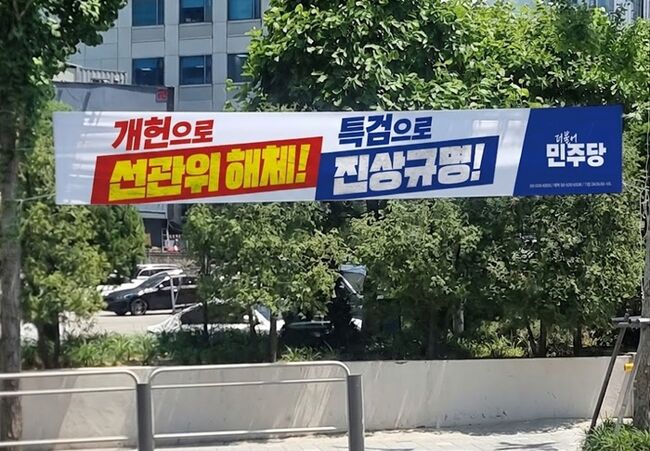 [Cho Yang-geon Column] The NEC: Facing a Fate of "Discarding the Dog After the Hunt"
Banner calling for the "dissolution of the NEC" posted by the Democratic Party. [AI-generated image]Banners calling for the "dissolution of the National Election Commission (NEC)" posted by the Democr
[Cho Yang-geon Column] The NEC: Facing a Fate of "Discarding the Dog After the Hunt"
Banner calling for the "dissolution of the NEC" posted by the Democratic Party. [AI-generated image]Banners calling for the "dissolution of the National Election Commission (NEC)" posted by the Democr
 [Photo] Evidence of Election Fraud Flooding U.S. Media… Trump Had 2.7 Million Votes Stolen
 [Video] U.S. Semiquincentennial Air Show... 'Art in the Sky' streaks across New York
 [Editorial Cartoon] A Draconian Law That Undermines Freedom of Expression

 List
List