이번 원고는 서상문 박사가 지난 5월 작성한 것입니다. 일부 국민이 대한민국 대통령으로 뽑은 이재명이 어떤 '인간형'인지 다시 한번 제대로 인식하길 바라며 6.3 대선을 앞둔 기간에 쓴 서 박사의 원고를 다시 게재합니다. <편집자 주>
 Kim Moon-soo, presidential candidate for the People Power Party, pays his respects at the tomb of former President Kim Young-sam at the Seoul National Cemetery in Dongjak-gu, Seoul, on May 4. Yonhap News
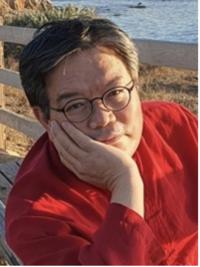 Dr. Seo Sang-moon, Historian, Chairman of the Korea Military Critics Association, Director of the East Sea Future Research InstituteOn May 4, Kim Moon-soo, the presidential candidate for the People Power Party (hereinafter referred to as Kim Moon-soo), criticized Lee Jae-myung, the presidential candidate for the Democratic Party of Korea (hereinafter referred to as Lee Jae-myung), by comparing him to Hitler and Stalin. He retorted to Lee Jae-myung, who criticized him for "going against the constitutional order," by calling it "the pot calling the kettle black" and "shameless." Kim Moon-soo also criticized Lee Jae-myung and the Democratic Party for again attempting to impeach Supreme Court Chief Justice Cho Hee-dae, stating, "This is worse than Hitler, and even Kim Jong-un wouldn't do such a thing." He added, "Have you ever heard of Kim Jong-un impeaching a Supreme Court Chief Justice? Has Xi Jinping ever experienced this? Stalin has never heard of such a thing."
Hearing this, I thought that perhaps due to his intuition, Kim Moon-soo accurately pinpointed the core issue in his concise remarks. As he said, it is true that Lee Jae-myung and the Democratic Party are trying to "lead the country to a worse state than the countries of Hitler, Kim Jong-un, Stalin, and Xi Jinping." I agree with Kim Moon-soo 100%.
However, I believe some further explanation is needed. Kim Moon-soo likely couldn't speak at length due to the verbal sparring. Furthermore, he was busy with the presidential election and wouldn't have had time to elaborate on his claims. Therefore, although I am an individual, I felt compelled to come forward and state the historical facts, so I decided to take some time to do so.
While Hitler devastated not only German society but all of European society, his methods did not involve frequent impeachment. In this regard, Kim Moon-soo's statement that the Democratic Party is worse than Hitler is not deviating from a sound evaluation within the larger framework. The grounds for my view are as follows, with a more detailed explanation provided below. Simultaneously, I will demonstrate that Lee Jae-myung has many similarities to Stalin and Hitler.
It is not clear whether it was due to his lifelong hatred of Jews or his strong animosity towards bourgeois society that rejected him, but Hitler lived with intense hostility towards Jews. Hitler also expressed resentment towards the Habsburg dynasty. The Habsburg dynasty was a state that Marxists, according to Marx's historical materialism, should oppose along with the bourgeoisie. However, Hitler diverged from the Marxist line and became an enemy, yet in the early stages, he acted as if he were a communist.
Perhaps because Lee Jae-myung anchors his political ideology in socialist ideals, his contradictory words and actions, often resembling a politically naive person unable to distinguish between theory and reality, are frequently observed. Like Hitler, Lee Jae-myung has also expressed strong animosity towards the wealthy and affluent. A prime example of this is when he was the first to call for the arrest of Samsung Chairman Lee Jae-yong during the state affairs corruption situation and repeatedly urged the full recovery of approximately 10 trillion won in profits Lee Jae-yong gained through illegal management succession.
Also, about eight years ago, Lee Jae-myung emphasized his commitment to "stake his political life on the dissolution of chaebols" when targeting Samsung. At that time, he likely judged that such statements would help him form an image as a bold and decisive leftist leader among those in the leftist camp, enhancing his political clarity.
However, in this presidential election, he has transformed as if he never made such statements. When meeting with Lee Jae-yong, Lee Jae-myung offered his blessings, saying, "When Samsung thrives, Samsung investors thrive." While Lee Jae-myung explained his sudden change as "flexible thinking and pragmatism" and "support for businesses during difficult times," no one would fail to see that these were words spoken to gain votes from conservative and centrist voters in a suddenly competitive presidential race. His words change frequently depending on the time and situation, so it's truly unpredictable how he might change them again. Lee Jae-myung's "pragmatism" is, in name only, pragmatism; for those with keen insight who can discern the quality of the contents by merely looking at the packaging, it is nothing more than a defective product wrapped in a flashy exterior. His "basic society," which disregards the nation's future, and his "hotel economics," the height of absurd sophistry, exemplify this. Insightful voters likely had the opportunity to understand the exact content and form of his pragmatism this time.
Despite this, Hitler had military experience, serving as a corporal, while Lee Jae-myung never even went near the military. He did not serve in the military because his left arm was bent from being crushed by a press during his youth as a young factory worker. Upon closer examination, there are too many inconsistencies in this explanation as well. Hitler, who joined the military by chance, served as a messenger and was discharged in 1920. Until his discharge, he supported the German Workers' Party from behind the scenes, demonstrating an extraordinary talent for clearly expressing vulgar populist prejudices, which proved effective. Although by chance, it was during this period that Hitler began to recognize and gain confidence as a political propagandist. It was during this time that he learned to utter confident lies and feign honesty.
Hitler's distrust of German society and Germans was mixed with contempt. Realizing that people are driven by fear, greed, lust for power, and jealousy, and sometimes by means or minor motivations, Hitler concluded that politics is the art of knowing how to exploit these human weaknesses for one's own ends, perhaps having been aware of Machiavelli's classic political philosophy.
In the previous presidential election, Lee Jae-myung caused considerable backlash from voters by promoting a frivolous, populist policy targeted at bald "patients." In this presidential election as well, he boasted about populist policies such as "basic society" and handouts, which he initially removed from his "Top 10 Pledges" and then reinserted, indicating either an impromptu idea or an unreliable promise that could change at any moment. While it's unclear if these were conceived by his aides, Lee Jae-myung seems to possess some talent for articulating ideas clearly, even if it leads to the ruin of national finances, much like Stalin.
From the late 1920s, Hitler renamed the National Socialist German Workers' Party in Munich to the Nazis and recruited and operated an assassination squad called the "Sturmabteilung" (SA). The objective was to spread terror, intimidation, and violence throughout the city streets to achieve his political goals. At every meeting of this organization, the members acted as Hitler's bodyguards, and if anyone opposed or questioned Hitler's words during a meeting, he would be mercilessly beaten. Violence was indeed employed. While orchestrating ruthless gangs to control the streets from behind the scenes, Hitler also launched campaigns to promote the dream of a desirable society.
Does this not feel like a sense of déjà vu, or a premonition of what could happen in Korean society in the future? Lee Jae-myung also hurled accusations and curses at citizens who opposed his policies during his tenure as mayor of Seongnam. Furthermore, photographs of him with a notorious gangster boss from the Seongnam region have circulated. It is also widely known that at least six individuals connected to his criminal cases have died under mysterious circumstances, with the exact cause of death unknown. While the professors, scholars, journalists, and politicians who publicly support him are well-known, it is also widely reported in the media that behind the scenes, organizations like the Eastern Gyeonggi Alliance, the Seongnam International Mafia, and the Jeonju gangsters (Night Party) associated with Kim Sung-tae of Ssangbangul, who was involved in the $8 million remittance to North Korea, are covertly involved.
Therefore, Lee Jae-myung possesses both carrots and sticks, making it clear what would happen to judges, politicians, and journalists who have accepted money from him and are suspected of being involved if they were to betray him. In other words, like Hitler, Lee Jae-myung seems to intuitively understand that humans are driven by fear, greed, lust for power, and jealousy, and has adeptly utilized greed and fear as means of control. Just as Hitler understood and utilized the power of combining propaganda and terror, it is unknown whether Lee Jae-myung studied this or received expert advice, but he seems to possess an innate understanding of this secret "ultimate weapon."
Hitler had a peculiar power to captivate the masses. Of course, this was a result of the masses being foolish enough to be drawn in by a feast of dazzling words! In any case, Hitler appealed to the lower classes with a kind of underdog persona and a common sincerity, frequenting Munich's social salons and using his masked charm to gain their support. He also portrayed himself as an ascetic or ascetic who devoted all his energy to Germany's national interest or good, stimulating women's desire to support him. All of these images were, of course, false and fabricated.
Lee Jae-myung also has a peculiar talent for making the masses ecstatic about him. Of course, this too is merely a collective hallucination dancing on the foolishness of the masses! It is also something that prevents people from breaking free, as if they were under the influence of drugs, from the manipulation and packaging techniques! Lee Jae-myung also appears to be skilled at portraying himself as an honest person with a sense of justice, who rose from a poor family through immense hardship, even if it involves mixing in lies. Of course, these are flimsy and can be easily dismantled by those with strong mental fortitude. Nevertheless, those who are socially dissatisfied, struggling people, or those disappointed or angered by the failures of the previous administration find hope in Lee Jae-myung's words, unaware of the hidden abyss. There are now too many moths in Korean society who blindly follow one side, thus ruining the country.
Just as Hitler dominated the emotions of the masses in the early 1930s, Lee Jae-myung has been manipulating the emotions of some foolish Koreans in the 2010s and 2020s. Both utilized the fact that power combined with success exerts a great attraction. This is a common denominator that arises in an era where the incompetence of political leaders, coupled with a precarious and hopeless social situation, allows the unconventional to establish itself as the norm and madness to take the place of reason.
Four years after the end of World War I, Germany, as a defeated nation, was unable to pay war reparations to the victors and was in a state of helplessness, chaos, and division. With hyperinflation soaring to 130 billion marks per dollar, businesses and households went bankrupt, unemployment surged, the economy collapsed, and people lacked hope and solace due to food shortages. In this era, Hitler stole the hearts of the masses with his eloquence, making the German people enthusiastic about him as their newly emerged political leader.
The situation in Germany in the 1920s and 1930s partially overlaps with today's Korean society, with both differences and similarities. In the 1930s, a global recession also hit Germany, with unemployment exceeding 6 million, and the foundations of many Germans' lives began to crumble. In this situation, Hitler penetrated the hearts of the German masses who were suffering and in dire straits. His fantastical populist rhetoric captivated the masses. The masses, longing for fundamental solutions, were deceived by terrifying fear and Hitler's absurd vision, welcoming him with open arms and becoming enthusiastic. Ultimately, the masses made the grave mistake of choosing Hitler and the Nazi Party in the elections. By the summer of 1933, Hitler had become the complete ruler of the German government, leading the German people down the path to ruin.
This part also coincidentally overlaps with some aspects of Korea's current situation. In Korea, there is a growing sense of disappointment among the people towards incompetent political leaders whose terms end in failure. On the surface, Korea is a middle power, ranking among the top 10 economies and 5th to 6th in military strength globally. However, Lee Jae-myung is coloring the psychology of the masses, who are facing accumulated problems hidden beneath the surface—economic recession, difficulty finding jobs, soaring youth unemployment, loss of growth engines, declining income, worsening polarization, population decline, intergenerational and gender conflicts, and deepening mutual distrust—with unsubstantiated rosy hues.
Just as Hitler portrayed himself as a messiah who would lead the German people to paradise in his election rallies, Lee Jae-myung is portraying himself as a messiah who will overcome Korea's economic stagnation, misleading people into believing that "the real Republic of Korea" will begin if he is elected president and completely severing the past 80 years of our modern history, which achieved the status of a top 10 global economy. This is truly an act that will be recorded in history!
A shared trait between Hitler and Lee Jae-myung is their cold-blooded humanity, devoid of pity or tears, in pursuit of their goals. Hitler established concentration camps before the war to detain opponents of the German regime as a preventive measure. During the war, countless Jews and resistance members were transported to these camps, where they became subjects of human experimentation, and the number of deaths from starvation, murder, and suffocation in the large gas chambers of Auschwitz, Poland, was immeasurable.
However, Hitler showed not even a speck of interest in the suffering of these victims, let alone sympathy. Instead, he argued that all Jews, without exception, must be exterminated.
During his tenure as mayor of Seongnam, Lee Jae-myung not only hospitalized critical citizen activists who did not comply with him but also did the same to his own brother, Lee Jae-seon. The deceased's wife testified that her husband was functioning normally as a tax accountant and had no mental issues. Nevertheless, Lee Jae-myung proudly stated that he was exercising his authority as mayor without any remorse. (The reason why Lee Jae-seon, who seemed to know all of his brother's secrets, had to be administratively hospitalized could be a separate topic that provides significant clues for understanding the kind of person Lee Jae-myung is!)
In response to the third "Day of National Action for Demanding a Special Prosecutor for Kim Keon-hee" and the emergency action sparked by Lee Jae-myung's first-instance conviction for violating the Public Official Election Act, Lee Jae-myung and Park Chan-dae, the floor leader of the Democratic Party, respectively shouted, "Lee Jae-myung will not die!" and "The people will protect him!" and "No matter how much they try to end Representative Lee's political life, Representative Lee will never die."
That's right! The people may die, but Lee Jae-myung himself did not. This issue also has a deep correlation with human conscience. This is evident in the fact that he has not offered a single word of apology, remorse, or regret, even though six people connected to his cases, whom he knew or didn't know, have died. A cold-blooded individual! He can be seen as a ruthless person who discards all pretense when faced with anything that hinders the achievement of his goals.
A lack of remorse is another trait commonly observed in both Hitler and Lee Jae-myung. Just as Hitler, who became a government official through Machiavellian schemes after serving as a soldier and a sign painter loitering in village cafes, lacked conscience, Lee Jae-myung also appears to lack remorse. Having not imposed any psychological self-restraint, he seems to wield power without hesitation.
For example, in 1934, Hitler initiated a series of events leading to the purge of the German military and the SA, resulting in the deaths of many people. The number of deaths is estimated to be at least 500. When asked why these individuals were executed without trial, Hitler retorted, "I am responsible for the fate of the German people. I am the highest justice. And everyone must know that anyone who attempts anything detrimental to the future of the state faces only death."
On August 19, 1934, in an election where 46 million voters chose the German Führer, Hitler swept nearly 90% of the votes. In the first round of the Democratic Party's presidential primary selection held last April, Lee Jae-myung also secured a similar percentage of votes. With the three candidates receiving votes in a "90:5:5" ratio, Lee Jae-myung achieved an overwhelming victory with a cumulative vote share of 89.56%, close to 90%. A vote share nearing 90%, as I pointed out previously, suggests a high probability of South Korea moving towards a fascist state, just as Germany did.
The absence of scandals with women is also a commonality. Around the age of 37, Hitler began having sexual relations with many teenage girls, starting with Maria Reiter, the 16-year-old daughter of the proprietress of the inn in Berchtesgaden where he stayed.
Among these was a 16-year-old girl named Geli Raubal, who was the daughter of Angela, Adolf Hitler's stepsister. In other words, Hitler kept his underage niece as his mistress and used her as a sex toy. Later, several of Hitler's mistresses died, and Geli was the first to die under mysterious circumstances.
Actress Renate Müller, another of Hitler's mistresses, threw herself out of a window and died in 1937. Eva Braun, whom Hitler once loved and with whom he married in the underground bunker of the Führerbunker in Berlin, then a ruin, on April 29, 1945, had attempted suicide once before marrying Hitler.
While many people associated with Lee Jae-myung's various cases have committed suicide or died under mysterious circumstances, no woman has died due to them. However, a scandal involving a certain actress is already widely known in Korean society. Although it happened a long time ago, according to the angry complaints of an actress who claimed to be involved, Lee Jae-myung deceived her by saying he was single and maintained an inappropriate relationship with her while avoiding public attention. Lee Jae-myung vehemently denies it, and though he no longer speaks of it, this scandal has become common knowledge. Given his fiery temper, if the actress's claims were truly fabrications, would he have let it slide?
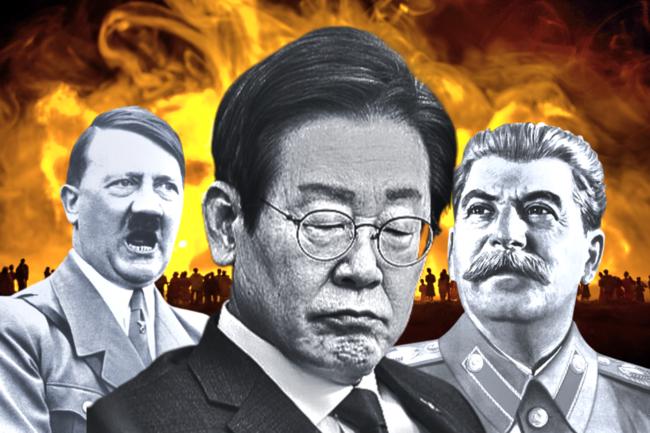
Then, what are Lee Jae-myung's commonalities with Stalin? What are the similarities and differences in the outcomes resulting from their commonalities?
At one time, Stalin was perceived by Russians as a great leader (Великий Лидер) who saved the country and its people from Hitler's threat and prevented Americans from entering Russia. However, he also has a reputation as a murderer who killed millions of his own citizens, more than all the tsars combined over four centuries. In this regard, Stalin is a murderer on par with Hitler.
However, the future is unknown. Throughout human history, there have been many cases where mild-mannered, indecisive, and soft individuals suddenly turn into murderers or criminals depending on the situation. Lee Jae-myung, rather than being mild and indecisive, appears to be very decisive.
Like Stalin, Lee Jae-myung also grew up in an unfortunate family environment. Born on December 21, 1879, in the small town of Gori in the Georgian Caucasus region, 'Iosif Vissarionovich Dzhugashvili' (Stalin's real name, Ио́сиф Виссарио́нович Ста́лин) was the only surviving son among four children born to a cobbler father.
Stalin grew up enduring abuse from his alcoholic father, who frequently beat his wife and son. When he was eleven years old, his father was killed in a fight with someone. After that, Stalin was raised by his single mother, who worked as a seamstress and laundress to support him. This was also similar to Hitler. In his childhood, Stalin contracted smallpox, leaving scars on his face, and had difficulty using his left arm due to sepsis.
Although Lee Jae-myung was born into a poor family and had an unfortunate childhood like Stalin, his parents, family, upbringing, and academic pursuits, including his preparations for the GED, are not precisely known. I have read almost all of the autobiographical accounts he claims to have written himself, as well as books about Lee Jae-myung written by others. This is because his family history, as revealed by him, varies depending on the time and place, leading to suspicions that much has been concealed.
Even, as he himself has stated, if he was born in 1964, the exact month and day of his birth are unknown. While it is known that his birthplace was a rural village called Jetong-ri, Dogan-myeon, Andong-gun, near Bonghwa, the reasons for Lee Jae-myung's father coming to Seongnam from the countryside are not known in detail. Even the occupations Lee Jae-myung has stated for his father—ranging from police officer, public servant, and coal miner, all after graduating from Cheonggu University—exceed five or six, making his father's actual profession still unknown.
His father is depicted differently in Lee Jae-myung's early books and later publications. In the former, he is negatively described as a miserly person who begrudged money to the point of disliking his son's studies. However, in his later autobiography, written perhaps when he began to think he could be president while serving as governor, his father is portrayed as a caring father who even bought Lee Jae-myung used English tapes to help him study.
Furthermore, the domestic life and family relationships Lee Jae-myung experienced in Seongnam, the fact that his left arm became "crippled" after being injured at a factory during his youth as a factory worker, and his admission to the law department of Chung-Ang University through the GED process are still not precisely known. This is because he has offered various accounts of the same events in his own books, leaving questions unanswered. Therefore, it is difficult to easily determine the truthfulness or exaggeration in his accounts of passing the bar exam, his career as a lawyer, and his provincial administration activities as Seongnam mayor and governor.
In any case, in his upbringing, Lee Jae-myung shows many similarities to Stalin, but there are also discrepancies. For instance, as mentioned earlier, Stalin had difficulty using his left arm due to an injury, while Lee Jae-myung initially claimed he couldn't use his left arm at all, thus being unable to serve in the military. However, photographs of him tying a tie and playing golf with his left hand have circulated online. The exact truth of this is also unknown.
Like Hitler, Stalin also exaggerated his abilities and promoted himself to the Russian people. After the so-called Bolshevik Revolution (Большевистская революция) in October 1917, Stalin entered the center of the new government's activities at the Petrograd Soviet. This was a reward for the considerable hardships he endured before that, such as being imprisoned or exiled to the Siberian wilderness for resisting the Tsarist regime. From then on, he began using the name "Stalin" (Сталин), meaning "Man of Steel" (Еловек из стали), and depicted himself as a key figure in the "October Revolution." Stalin also manipulated photographs, leaning with Lenin on the wall of Lenin's country villa in Kuntsevo, to utilize the authority and fame of Vladimir Lenin, the supreme leader of the Bolshevik Revolution.
In June 1904, Stalin married Ekaterina Svanidze (Екатерина Сванидзе), a naive and devoted rural village girl. Three years later, she died of typhus, leaving behind their son Yakov (Яков). Unhappy with his family environment, including his mother's early death and his father's lack of affection for him, Yakov later attempted suicide, and Stalin even mocked his son's failed suicide attempt. Like Hitler, Stalin also exhibits a cold-blooded demeanor.
In modern medical terms, Stalin seems to have had psychopathic tendencies or a mental disorder. As historian Miranda Twist, who evaluated Stalin, stated, he was characterized by career-oriented behavior, a persistent personality with a tendency towards compromise and anxiety, emotionality, vanity, cynicism, and a deep-seated resentment.
On the other hand, Stalin mimicked Lenin, who was then the highest authority and a renowned leader. He appeared to possess qualities such as personal asceticism, composure, competence, and fatherly affection by dressing modestly and behaving humbly in front of party members and the people. Stalin's great success in terms of power stemmed from consistently portraying himself to party members as the embodiment of the will of the majority.
Not only that. Stalin executed many people in extremely brutal ways until 1937 and caused 30 million people to suffer from famine, leading to cannibalism in some areas. The horrific terror of the 1930s was Stalin's primary means of consolidating his power and eliminating his rivals. More than 25 million people were forcibly evicted, and over 3 million were murdered. The military also underwent purges, with approximately 40,000 officers arrested, of whom 15,000 were shot, and the rest sent to camps where they died.
Furthermore, his rival, Trotsky (Лев Тро́цкий), who fled to Mexico in 1928 to escape Stalin's death threats, was pursued by assassins sent by Stalin, who relentlessly murdered him in August 1940 with an ice pick. (Although rumors of an axe have circulated, it was an ice pick!)
The fact that Lee Jae-myung exhibits psychopathic tendencies is already widely recognized not only by domestic psychologists and psychiatrists but also by the public. Having read almost all the books about Lee Jae-myung, whether written by himself or other authors, and having given four public lectures on the topic of what type of person Lee Jae-myung is, I too have long agreed with this assessment. According to the concepts researched by experts in psychology and psychopathology, he is indeed a psychopathic patient. Psychopathy is considered a type of mental disorder, characterized by a certain psychological state and behavior. Its main features include antisocial behavior, narcissistic self-absorption, superficial charm, impulsivity, a cold and unemotional personality, and a lack of guilt and empathy towards others in speech and behavior. The inability to feel remorse or guilt after lying or committing crimes is also a major characteristic of psychopaths.
Antisocial behavior refers to unusual patterns of behavior and meanings that deviate from the way ordinary people live, and such actions and speech harm society and its members. In this context, reflecting on his various words and actions shown to the public so far—such as lying, changing his statements, denying having said or done something as if he were a slippery eel, shifting blame, applying double standards to others, and engaging in accusatory verbal attacks—might reveal something.
For example, in an interview with a public broadcasting station after being elected governor of Gyeonggi Province, Lee Jae-myung stated that he would approach his duties as the new governor with a "stance of taking responsibility if there is something to be responsible for." When the interviewer asked him to elaborate on what that meant, he completely denied having said so, even though he had just said it. Instead, he retorted that perhaps the interviewer was asking such a question because he himself thought so. Furthermore, he initially boasted about the Daejang-dong development project as his greatest achievement, which he had designed. However, as parts of the truth emerged and public opinion turned unfavorable, he immediately changed his story, claiming it was the opposition party's doing, not his. There are so many such instances that it is quite annoying and tedious to detail them all.
Meanwhile, like Hitler and Stalin, Lee Jae-myung also possesses a manufactured charm, albeit artificial, for achieving his goals, which leads many supporters to follow him without knowing his true face. Although detailed in the book "Goodbye! Lee Jae-myung," when one considers the extreme insults and profanity he directed at his own brother and sister-in-law, and his statement that "power must be used cruelly" while criticizing President Moon Jae-in for using power weakly, his cruelty and impulsivity can be discerned.
During his "free relationship" with a certain actress, he displayed behavior that could be seen as romantic and affectionate, but when the issue arose, he showed a coldness and a calm, determined personality, devoid of emotion, to protect himself by denying any such involvement.
Just as Stalin had a cruel side to his personality, Lee Jae-myung also clearly appears to have a cruel side. This does not mean that Lee Jae-myung is a murderer like Stalin. It is not about him being a murderer who has killed countless people as a result of his actions, but rather a comparison of their temperaments as a possibility. In that sense, Lee Jae-myung also has a cruel aspect to his personality. As mentioned earlier, this judgment is based on his statement that power must be used cruelly. In addition to this, as discussed in comparison with Hitler, the fact that Lee Jae-myung branded his mentally sound brother as mentally ill and had him hospitalized, and that he showed no remorse or even a hint of regret despite the deaths of six people connected to his cases, provides grounds for judging Lee Jae-myung's personality as cruel.
While acts of murder can occur impulsively, they are fundamentally more likely when the perpetrator's personality has a cruel aspect. This is highly unlikely without a cruel personality, especially in cases of mass genocide, such as that of Mao Zedong, who watched tens of millions die from starvation and persecution; Pol Pot, the leader of Cambodia's Khmer Rouge regime, who murdered about 2 million people through imprisonment, execution, and forced labor; Idi Amin, who led large-scale massacres in the Ugandan civil war; and Slobodan Milošević in the Yugoslav Wars.
Like Hitler, Stalin also exhibited a strong obsession with power, and Lee Jae-myung appears to have the same tendency. Towards the end of the Russian Civil War in 1921, Stalin led state ownership of economic policies such as industry and land. Politically, this led to the establishment of a one-party rule system, brutal and merciless suppression of dissenters, abolition of fundamental rights such as freedom of expression and association, and strengthening of the bureaucracy of the centralized Russian Communist Party.
As can be seen from the extensive examples provided so far, Kim Moon-soo succinctly and concisely stated the resemblances between Lee Jae-myung, Hitler, and Stalin without explicitly detailing them. If I may add a point in place of the busy Kim Moon-soo, in my opinion, Lee Jae-myung is a unique human type, rarely found throughout Eastern and Western history, seemingly composed of three personality types. It is as if he is a composite with one-third each of Hitler, Stalin, and Lee Jae-myung's own personality within him. The proportion of components would be a matter of debate, but he would also have other unique characteristics.
Dr. Seo Sang-moon, Historian, Chairman of the Korea Military Critics Association, Director of the East Sea Future Research Institute

 Iranian Foreign Ministry: "Continuing Message Exchanges with the U.S. and Activities of Mediating Countries"
Esmaeil Baghaei, Spokesperson for the Iranian Ministry of Foreign Affairs [Xinhua, Yonhap News file photo]Esmaeil Baghaei, spokesperson for the Iranian Ministry of Foreign Affairs, stated on the 26th
Iranian Foreign Ministry: "Continuing Message Exchanges with the U.S. and Activities of Mediating Countries"
Esmaeil Baghaei, Spokesperson for the Iranian Ministry of Foreign Affairs [Xinhua, Yonhap News file photo]Esmaeil Baghaei, spokesperson for the Iranian Ministry of Foreign Affairs, stated on the 26th
 President Yoon: "Do You Think You Are Safe from the Special Counsel?"... Final Statement Video Released
President Yoon Suk Yeol rebuking the special prosecutor on the 24th. [Court video / @birds_justice X account subtitle GIF] A video of President Yoon Suk Yeol's closing statement at his trial rega
President Yoon: "Do You Think You Are Safe from the Special Counsel?"... Final Statement Video Released
President Yoon Suk Yeol rebuking the special prosecutor on the 24th. [Court video / @birds_justice X account subtitle GIF] A video of President Yoon Suk Yeol's closing statement at his trial rega
 President Yoon, regarding the first-instance ruling on the Public Official Election Act: “An excessive political verdict that distorts the facts… We will appeal immediately.”
The first-instance sentencing hearing for President Yoon Suk Yeol regarding violations of the Public Official Election Act is being broadcast live at Seoul Station on the 27th. [Photo=Yonhap News]Pres
President Yoon, regarding the first-instance ruling on the Public Official Election Act: “An excessive political verdict that distorts the facts… We will appeal immediately.”
The first-instance sentencing hearing for President Yoon Suk Yeol regarding violations of the Public Official Election Act is being broadcast live at Seoul Station on the 27th. [Photo=Yonhap News]Pres
 WSJ: "SK Hynix ADR Premium Is a Sign of AI Trading Overheat"
Advertisement for SK Hynix ADR listing in New York's Times Square [Reuters=Yonhap News file photo]The Wall Street Journal (WSJ) has pointed out that the price of SK Hynix’s American Depositary Recei
WSJ: "SK Hynix ADR Premium Is a Sign of AI Trading Overheat"
Advertisement for SK Hynix ADR listing in New York's Times Square [Reuters=Yonhap News file photo]The Wall Street Journal (WSJ) has pointed out that the price of SK Hynix’s American Depositary Recei
 'Godfather of Japanese Mystery Novels' Keigo Higashino Passes Away After Battle with Cancer at 68
Famous Japanese mystery novelist Keigo Higashino [AFP=Yonhap News]It has been belatedly reported that Keigo Higashino, the "godfather of Japanese mystery novels" and author of bestsellers such as "The
'Godfather of Japanese Mystery Novels' Keigo Higashino Passes Away After Battle with Cancer at 68
Famous Japanese mystery novelist Keigo Higashino [AFP=Yonhap News]It has been belatedly reported that Keigo Higashino, the "godfather of Japanese mystery novels" and author of bestsellers such as "The
 [Park Pil-kyu Security Column] To the Ignorant Trying to Clothe a Beast in Sheep's Clothing
Rep. Kim Byung-joo of the Democratic Party of Korea [Photo=Yonhap News]“The Air Force Academy doesn't teach you how to fly a plane!” “The Army, Navy, and Air Force academies are exactly the
[Park Pil-kyu Security Column] To the Ignorant Trying to Clothe a Beast in Sheep's Clothing
Rep. Kim Byung-joo of the Democratic Party of Korea [Photo=Yonhap News]“The Air Force Academy doesn't teach you how to fly a plane!” “The Army, Navy, and Air Force academies are exactly the
 [Issue Diagnosis] Two Effects of the Election Petition Review
 [Photo] Evidence of Election Fraud Flooding U.S. Media… Trump Had 2.7 Million Votes Stolen
 [Video] U.S. Semiquincentennial Air Show... 'Art in the Sky' streaks across New York
 [Editorial Cartoon] A Draconian Law That Undermines Freedom of Expression

 List
List









