Naver Headquarters in Seongnam City, Gyeonggi Province. Yonhap News
The stock swap mega-deal executed on the 26th by Naver Financial, a fintech subsidiary of Naver, and Dunamu, which operates Upbit, South Korea's largest virtual asset exchange, is being hailed as a "once-in-a-decade event" that will fundamentally reshape the landscape of Korean digital finance.
While on the surface it appears that Naver Financial has absorbed Dunamu as a subsidiary, the market consensus is that "the form is an acquisition, but the substance is a reverse merger for Dunamu."
Naver Financial and Dunamu have finalized a comprehensive stock swap. The exchange ratio is 2.54 shares of Naver Financial (172,000 KRW per share) for one share of Dunamu (439,000 KRW per share).
Although the enterprise values calculated by the companies are approximately 4.9 trillion KRW for Naver Financial and 15.1 trillion KRW for Dunamu, a ratio of about 1:3, Dunamu has been incorporated as a 100% subsidiary of Naver Financial, making it a grandchild company of Naver.
Regarding this structure, the financial investment industry offers the interpretation: "Although Dunamu, with its higher enterprise value, appears to be absorbed into the Naver system in reverse, it is closer to a reverse merger where Dunamu can take the lead in terms of technology, business model (BM), and growth drivers."
Naver Pay, operated by Naver Financial, is the largest payment platform in Korea, with an estimated annual transaction volume of approximately 90 trillion KRW and 34 million users by 2025. However, as the global market rapidly shifts towards on-chain payments based on stablecoins, concerns about a "gap in virtual asset technology" have grown within Naver.
Indeed, major global big tech companies are already transitioning their business direction towards on-chain payment methods utilizing stablecoins.
PayPal has issued its stablecoin PYUSD, Visa continues its global payment experiments using USDC, and the United States and the European Union (EU) are focusing on establishing regulations for stablecoin payment systems.
Major blockchain networks have entered an era where they can process hundreds to thousands of transactions per second (TPS), thanks to continuous innovation in TPS performance (Transaction Per Second—a unit for measuring processing speed and capacity per second).
In this context, Naver's merger with Dunamu is an endeavor to secure "stablecoins, the future means of payment."
Naver lacked core competencies in areas such as token economy design, on-chain settlement, blockchain infrastructure, and asset tokenization technology. However, the acquisition of Dunamu allows them to fill these gaps at once. The industry evaluates this as: "Naver has absorbed the development of the 'future payment system' as an in-house capability rather than outsourcing it."
Conversely, Dunamu secures stable customer channels, brand credibility, financial regulatory responsiveness, and a global expansion platform through Naver. For Dunamu, which had limited B2C (Business-to-Consumer) channels, incorporation into the Naver ecosystem alone significantly enhances future business expansion potential and provides access to 'legitimate channels.'
Some predict that "the combined entity of the two companies could be at a level to consider direct listing on Nasdaq, not just KOSPI (Korea Composite Stock Price Index)."
The combination of Naver and Dunamu also signals various changes in actual services.
First, it is analyzed that transaction costs could be reduced by 50-70% compared to the current level if shopping, content, subscriptions, and remittances are integrated into a single on-chain payment infrastructure through a stablecoin payment integrated API (Application Programming Interface).
Second, if users can access everything from shopping to payments, finance, stocks, and virtual asset wallets all at once through a single Naver app, it raises the possibility of the emergence of Korea's first 'super app.'
Third, if Naver Webtoon, Webnovel, and Zepeto IP are connected with NFTs, tokens, and micro-payment models, it enables the on-chain expansion of K-content.
For this transaction to yield actual effects, it must navigate three regulatory issues: the Fair Trade Commission's (FTC) review of business combinations, potential conflicts with the financial-virtual asset separation convention, and the direction of stablecoin regulations. In particular, the allowance of issuing Korean-style stablecoins is expected to be a key variable determining the platform's success.
Market experts assess that this transaction is more than just a merger and acquisition (M&A); it will be a 'turning point in the industry paradigm.'
A global venture capital (VC) investment specialist stated, "This merger is the first case in Korea where virtual assets, big tech, and payments have been comprehensively integrated," adding, "It is a inflection point that preemptively shows the direction of Korean digital finance for the next decade." Another financial industry official analyzed, "Naver has bought the future of payments, and Dunamu has secured its ticket to the regulated sector. It's a deal where the interests of both companies align perfectly."
Key checkpoints for future investment perspectives include the speed of stablecoin-related legislation passage, the timing of applying Naver Pay's on-chain payment experiments, and the launch of a joint Naver-Dunamu brand. The period when these factors move in sync is expected to be the 'actual starting point' for the restructuring of the Korean financial landscape.
The merger of Naver and Dunamu is not merely a corporate combination. It is an event that redraws the map for the next decade in Korea's digital finance, blockchain, and big tech industries. A key industry insider commented, "Those who understand this landscape first will be at the forefront of the next investment cycle. This mega-deal is not news, but the starting point of an era's change."
Reporter Lim Yo-hee

 [Statement by the Seobeokka KMA Patriots Association] ㉛ Recount the ballots openly, as the previous recount covered up election fraud
Recount of the Tongyeong mayoral election [Photo=Yonhap News]South Korea's liberal democracy is dying. The National Election Commission (NEC), which has degraded into a criminal organization through t
[Statement by the Seobeokka KMA Patriots Association] ㉛ Recount the ballots openly, as the previous recount covered up election fraud
Recount of the Tongyeong mayoral election [Photo=Yonhap News]South Korea's liberal democracy is dying. The National Election Commission (NEC), which has degraded into a criminal organization through t
 What is the significance of the "Trump 2028" red hat that keeps reappearing?
It is noteworthy that while it is "highly likely" that President Donald Trump is "seriously considering" a run for the presidency in 2028, he is also "deliberately" fueling speculation regarding wheth
What is the significance of the "Trump 2028" red hat that keeps reappearing?
It is noteworthy that while it is "highly likely" that President Donald Trump is "seriously considering" a run for the presidency in 2028, he is also "deliberately" fueling speculation regarding wheth
 First U.S. Ambassador of Trump's Second Term to Arrive This Week… Will It Provide Momentum to Resolve Pending Issues?
U.S. Ambassador to South Korea Michelle Steel speaks at the opening ceremony of the Korea-U.S. Shipbuilding Cooperation Center held at the Mayflower Hotel in Washington, D.C., on the 23rd (local time)
First U.S. Ambassador of Trump's Second Term to Arrive This Week… Will It Provide Momentum to Resolve Pending Issues?
U.S. Ambassador to South Korea Michelle Steel speaks at the opening ceremony of the Korea-U.S. Shipbuilding Cooperation Center held at the Mayflower Hotel in Washington, D.C., on the 23rd (local time)
 The Korean Peninsula wrapped in a thick blanket of scorching high pressure… Will the 1994 record be broken?
On the 28th, as the heatwave continues, a water sprinkler truck sprays water on Hyowon-ro, Gwonseon-gu, Suwon, Gyeonggi Province. [Photo = Yonhap News]The hottest years on record are considered to be
The Korean Peninsula wrapped in a thick blanket of scorching high pressure… Will the 1994 record be broken?
On the 28th, as the heatwave continues, a water sprinkler truck sprays water on Hyowon-ro, Gwonseon-gu, Suwon, Gyeonggi Province. [Photo = Yonhap News]The hottest years on record are considered to be
 Stock Market Crash 'Black Tuesday'… KOSPI down 10.8%, KOSDAQ down 7.7%
The KOSPI fell by more than 5% in early trading on the 28th, triggering a sell-side sidecar.On the 28th, the KOSPI plunged by more than 10%.Due to the sharp decline, a sell-side sidecar—a temporary
Stock Market Crash 'Black Tuesday'… KOSPI down 10.8%, KOSDAQ down 7.7%
The KOSPI fell by more than 5% in early trading on the 28th, triggering a sell-side sidecar.On the 28th, the KOSPI plunged by more than 10%.Due to the sharp decline, a sell-side sidecar—a temporary
 [World Heritage Committee] 25 New World Heritage Sites Inscribed in Busan… South Korea Successfully Expands 'Getbol' Listing
The Chairperson of the World Heritage Committee speaks at the plenary session of the 48th session of the World Heritage Committee, held at BEXCO in Busan on the 20th. [Photo: Yonhap News]A total of 25
[World Heritage Committee] 25 New World Heritage Sites Inscribed in Busan… South Korea Successfully Expands 'Getbol' Listing
The Chairperson of the World Heritage Committee speaks at the plenary session of the 48th session of the World Heritage Committee, held at BEXCO in Busan on the 20th. [Photo: Yonhap News]A total of 25
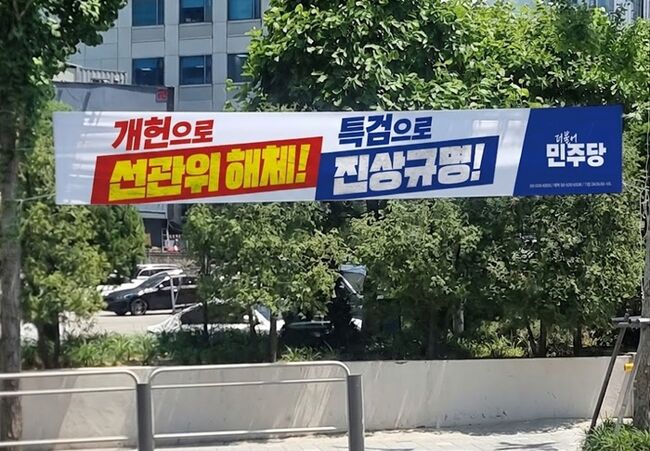 [Cho Yang-geon Column] The NEC: Facing a Fate of "Discarding the Dog After the Hunt"
Banner calling for the "dissolution of the NEC" posted by the Democratic Party. [AI-generated image]Banners calling for the "dissolution of the National Election Commission (NEC)" posted by the Democr
[Cho Yang-geon Column] The NEC: Facing a Fate of "Discarding the Dog After the Hunt"
Banner calling for the "dissolution of the NEC" posted by the Democratic Party. [AI-generated image]Banners calling for the "dissolution of the National Election Commission (NEC)" posted by the Democr
 [Photo] Evidence of Election Fraud Flooding U.S. Media… Trump Had 2.7 Million Votes Stolen
 [Video] U.S. Semiquincentennial Air Show... 'Art in the Sky' streaks across New York
 [Editorial Cartoon] A Draconian Law That Undermines Freedom of Expression

 List
List