The ruling and opposition parties initiated discussions through their floor leaders on November 30th, two days before the deadline for processing next year's budget (December 2nd), but failed to reach an agreement due to significant differences in their views. [Graphic=Hanmiilbo]
As the government's budget bill for 2026, totaling 728 trillion won in total expenditure, has been submitted to the National Assembly, debates surrounding what are dubbed "Lee Jae-myung-style budgets," such as the National Growth Fund, AI Innovation Fund, and Local Love Gift Certificates, are intensifying.
While the ruling and opposition parties are focusing on itemized increases and decreases and the authenticity of "note-based budget allocations," the fundamental issues lie elsewhere from a structural perspective. The core concerns are △ the design structure of the 150 trillion won National Growth Fund △ the effectiveness of AI and Public AX budgets △ the possibility of regional and welfare packages becoming a permanent expenditure △ and the issue of the "speed of debt increase" repeatedly warned about by the IMF and BIS.
National Growth Fund: From 100 Trillion to 150 Trillion Won… Structural Controversy Amid Claims of an "AI Expressway"
The Lee Jae-myung administration announced plans to launch a 100 trillion won National Growth Fund and expand it to 150 trillion won. It is described as a "mega fund" to pool public and private capital for advanced industries such as semiconductors, AI, and biotechnology.
While the ruling party emphasizes it as a "super-large growth engine for industrial structure transformation," structural questions such as "How does it differ from the Korea Development Bank, Korea Growth Investment Fund, and Innovation Fund?" have been raised during the National Assembly's budget review.
A particular point of contention is who will bear the losses if they occur. If pension funds, policy financial institutions, and local government finances are involved, it could essentially create a structure where the public, pension funds, and public enterprises shoulder the investment risks. The Budget and Accounts Committee criticized it as "grand in rhetoric but empty in design."
The Era of 1 Trillion Won in 'AI Budgets'… Innovation or Rebranding?
With the simultaneous emergence of the AI Innovation Fund (100 billion won), Public AX (Digital Transformation) Project (100 billion won), and AI projects by various ministries, a "1 trillion won era of AI budgets" has begun. However, these projects face criticism for overlapping purposes with the National Growth Fund. The opposition party has labeled this as "AI washing," pointing out that "budgets have been expanded by merely changing the title to AI."
The government argues it is for "administrative efficiency and building the foundation for future industries," but the debate over its effectiveness continues due to a lack of performance indicators and the high possibility of duplication across ministries.
Local Love Gift Certificates, Basic Income, 4.5-Day Work Week… Possibility of Solidifying into a "Permanent Expenditure Structure"
The budget for Local Love Gift Certificates is 1.15 trillion won, with a national issuance scale reaching up to 24 trillion won. With the passage of a bill mandating national government support, the possibility of its permanent inclusion in the budget has increased.
The pilot project for rural basic income (approx. 170-200 billion won), subsidies for labor costs of companies introducing a 4.5-day work week (27.7 billion won), and the Youth Future Savings plan (744.6 billion won) are also being allocated, forming what is known as the "Lee Jae-myung package."
While the ruling party explains this as "investment-oriented welfare for regional balance and support for youth and labor," economists differentiate it by stating it is an "expansion of fixed costs centered on items that are politically difficult to withdraw." In particular, basic income and gift certificates are pointed out as "shadow expenditures" that can erode fiscal soundness if accumulated.
IMF and BIS's Common Warning… The Issue is "Speed," Not "Scale"
National debt is projected to be 1,415.2 trillion won next year, with the managed fiscal balance at -4.0%.
The National Assembly Budget Office's medium-term forecast projects national debt to increase to 1,779.2 trillion won by 2029 (58.2% of GDP).
The IMF forecasts Korea's general government debt to rise to 64.3% by 2030.
The BIS has pointed out that Korea's private credit gap has remained in a risky zone for several years.
Experts state, "The problem is not the absolute scale of debt but its speed of increase and structure." They warn that fiscal burden could become layered if the National Growth Fund, AI projects, and regional welfare packages are expanded simultaneously.
Look at the Structure, Not Just the Amount, of the Budget
While the ruling and opposition parties focus on the increase and decrease of each item and a battle of figures, the real issues lie in four structural questions: △ the loss-sharing structure of policy funds △ the effectiveness of AI budgets △ the risk of regional and welfare budgets becoming permanent expenditures △ and the speed of debt increase.
The core risk of the Lee Jae-myung-style budgets lies not in "how much is spent," but in "in what structure, at what speed, and based on whose risk it is spent."
For detailed information on each issue, please refer to the related articles below.
#LeeJaeMyungBudget #2026Budget #NationalGrowthFund #AIBudget #LocalLoveGiftCertificate #BasicIncomeDebate #FiscalSustainability #IMFWarning #BISIndicator #Hanmiilbo

 [Statement by the Seobeokka KMA Patriots Association] ㉛ Recount the ballots openly, as the previous recount covered up election fraud
Recount of the Tongyeong mayoral election [Photo=Yonhap News]South Korea's liberal democracy is dying. The National Election Commission (NEC), which has degraded into a criminal organization through t
[Statement by the Seobeokka KMA Patriots Association] ㉛ Recount the ballots openly, as the previous recount covered up election fraud
Recount of the Tongyeong mayoral election [Photo=Yonhap News]South Korea's liberal democracy is dying. The National Election Commission (NEC), which has degraded into a criminal organization through t
 What is the significance of the "Trump 2028" red hat that keeps reappearing?
It is noteworthy that while it is "highly likely" that President Donald Trump is "seriously considering" a run for the presidency in 2028, he is also "deliberately" fueling speculation regarding wheth
What is the significance of the "Trump 2028" red hat that keeps reappearing?
It is noteworthy that while it is "highly likely" that President Donald Trump is "seriously considering" a run for the presidency in 2028, he is also "deliberately" fueling speculation regarding wheth
 First U.S. Ambassador of Trump's Second Term to Arrive This Week… Will It Provide Momentum to Resolve Pending Issues?
U.S. Ambassador to South Korea Michelle Steel speaks at the opening ceremony of the Korea-U.S. Shipbuilding Cooperation Center held at the Mayflower Hotel in Washington, D.C., on the 23rd (local time)
First U.S. Ambassador of Trump's Second Term to Arrive This Week… Will It Provide Momentum to Resolve Pending Issues?
U.S. Ambassador to South Korea Michelle Steel speaks at the opening ceremony of the Korea-U.S. Shipbuilding Cooperation Center held at the Mayflower Hotel in Washington, D.C., on the 23rd (local time)
 The Korean Peninsula wrapped in a thick blanket of scorching high pressure… Will the 1994 record be broken?
On the 28th, as the heatwave continues, a water sprinkler truck sprays water on Hyowon-ro, Gwonseon-gu, Suwon, Gyeonggi Province. [Photo = Yonhap News]The hottest years on record are considered to be
The Korean Peninsula wrapped in a thick blanket of scorching high pressure… Will the 1994 record be broken?
On the 28th, as the heatwave continues, a water sprinkler truck sprays water on Hyowon-ro, Gwonseon-gu, Suwon, Gyeonggi Province. [Photo = Yonhap News]The hottest years on record are considered to be
 Stock Market Crash 'Black Tuesday'… KOSPI down 10.8%, KOSDAQ down 7.7%
The KOSPI fell by more than 5% in early trading on the 28th, triggering a sell-side sidecar.On the 28th, the KOSPI plunged by more than 10%.Due to the sharp decline, a sell-side sidecar—a temporary
Stock Market Crash 'Black Tuesday'… KOSPI down 10.8%, KOSDAQ down 7.7%
The KOSPI fell by more than 5% in early trading on the 28th, triggering a sell-side sidecar.On the 28th, the KOSPI plunged by more than 10%.Due to the sharp decline, a sell-side sidecar—a temporary
 [World Heritage Committee] 25 New World Heritage Sites Inscribed in Busan… South Korea Successfully Expands 'Getbol' Listing
The Chairperson of the World Heritage Committee speaks at the plenary session of the 48th session of the World Heritage Committee, held at BEXCO in Busan on the 20th. [Photo: Yonhap News]A total of 25
[World Heritage Committee] 25 New World Heritage Sites Inscribed in Busan… South Korea Successfully Expands 'Getbol' Listing
The Chairperson of the World Heritage Committee speaks at the plenary session of the 48th session of the World Heritage Committee, held at BEXCO in Busan on the 20th. [Photo: Yonhap News]A total of 25
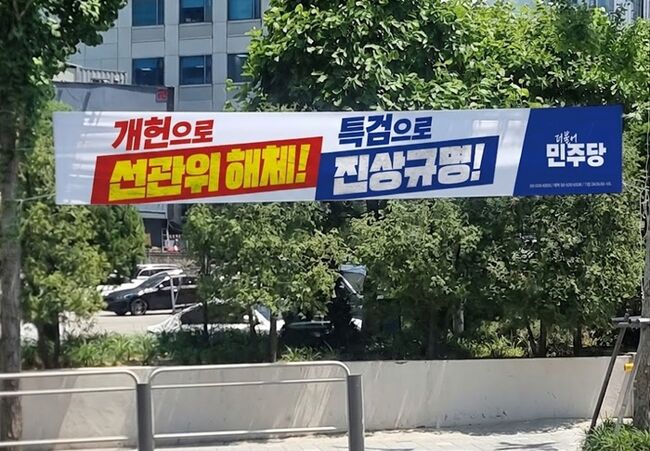 [Cho Yang-geon Column] The NEC: Facing a Fate of "Discarding the Dog After the Hunt"
Banner calling for the "dissolution of the NEC" posted by the Democratic Party. [AI-generated image]Banners calling for the "dissolution of the National Election Commission (NEC)" posted by the Democr
[Cho Yang-geon Column] The NEC: Facing a Fate of "Discarding the Dog After the Hunt"
Banner calling for the "dissolution of the NEC" posted by the Democratic Party. [AI-generated image]Banners calling for the "dissolution of the National Election Commission (NEC)" posted by the Democr
 [Photo] Evidence of Election Fraud Flooding U.S. Media… Trump Had 2.7 Million Votes Stolen
 [Video] U.S. Semiquincentennial Air Show... 'Art in the Sky' streaks across New York
 [Editorial Cartoon] A Draconian Law That Undermines Freedom of Expression

 List
List