내란죄는 의도나 계획이 아니라 실행된 폭동 여부로 판단된다는 것이 대법원의 확립된 기준이다. ⑤편에서는 지금까지 확인된 영상·증언·문서 기록을 종합해 “계엄은 있었으나 폭동은 없었다”는 판단의 근거를 정리하고, 특검이 제기한 내란 구성요건이 실제로 충족되는지 여부를 법리 중심으로 점검한다. <편집자 주>
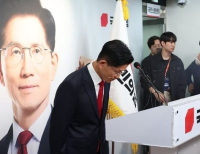
 The image on the left shows martial law troops retreating after being blocked by National Assembly officials in front of the main building on the day martial law was declared. The image on the right depicts about 10 martial law soldiers who entered the main building retreating to avoid fire extinguishers deployed by National Assembly staff. This graphic is a reconstruction based on video footage broadcast at the time. [Graphic=Hanmi Ilbo]
[Table of Contents]
① Hong Jang-won… The truth the 'worm' couldn't tell
② Kwak Jong-geun… The military's judgment on the day of martial law and the actual situation in the National Assembly
③ Arrest team list… What changed before and after the announcement?
④ Legal structure of rebellion… Why it doesn't apply
⑤ Conclusion… What does the truth of that day tell us
When considering the trial videos, testimonies, and facts confirmed through reporting that have been released so far, the doubt deepens as to whether the crime alleged by the special prosecutor is indeed a 'rebellion'.
The statements of former NIS Deputy Director Hong Jang-won and former Special Warfare Commander Kwak Jong-geun, who have garnered attention throughout the case, were at a level that demonstrated 'controversy over the legality of the martial law process' and were far from the 'realistic commencement of a riot,' a key element for establishing a rebellion.
It is not a rebellion simply because soldiers stood guard with their weapons, just as a police officer blocking protestors cannot be defined as a riot. Ultimately, the standard that the Supreme Court has consistently maintained is to judge rebellion not by intent or plan, but by the existence of an executed riot.
When the President declares martial law, the military acting according to the martial law protocol is adhering to the law. If military commanders are to individually judge what is right and wrong, it would be a denial of the constitutional value of martial law. The right to lift martial law rests with the National Assembly, and the final judgment on its legitimacy is made by the Constitutional Court, which is our constitutional order.
The Constitutional Court excluded rebellion from its judgment because rebellion is a matter to be debated within criminal law. While I do not agree with the procedural legitimacy or the basis of the Constitutional Court's decision regarding the impeachment of the President, the equation 'martial law was wrong, therefore it is rebellion' would be difficult for any legal professional to agree with.
Rebellion is judged by the 'realistic commencement of a riot,' not by the 'plan.'
The Supreme Court has repeatedly affirmed the standard in cases such as the December 12th incident (Supreme Court 1997do2420), the Southern Korean National Liberation Front incident (1990do2958), and the Lee Seok-ki rebellion and incitement case (2015do3260) that "rebellion is established when there is an 'execution of a riot' that stops the functions of state organs by coercion."
This means that mere conspiracy, planning, or confusion in the reporting system cannot constitute a rebellion, and it clarifies that 'execution of a riot' requires the 'result of effectively stopping or excluding the authority of state organs' due to realistic and objective coercive acts.
Applying this to the facts of this case, the scenes that actually occurred in places like the National Assembly and the Election Commission between December 3rd and 4th are difficult to consider as a riot. Only unarmed troops moved in a limited manner, and there were no clashes, arrests, occupations, or destruction. Furthermore, the functions of organs like the National Assembly and the Election Commission were not actually suspended.
Martial Law Existed, but No Riot Did
Reconstructing the flow of events, while martial law clearly existed, no riot that would satisfy the conditions for rebellion was confirmed anywhere.
The testimonies of Hong Jang-won and Kwak Jong-geun are merely about whether the president ordered the arrest of key figures. Since no actual arrests were made, it has no direct relevance to whether a rebellion occurred. Legally, it is closer to a dispute over the abuse of authority rather than rebellion, but it has become a fiercely contested issue because it is difficult to ignore 'public opinion'.
The establishment of a rebellion is based on execution, not purpose, and execution must involve realistic coercion. However, what was recorded at the scene at that time was a situation with no deaths, no arrests or detentions, no clashes, and no occupation of buildings. The testimony of the deployed martial law troops clarifies that it was an 'securing' operation, not an occupation for the purpose of paralyzing functions.
If the 707th Special Mission Group had entered into an operation to occupy the National Assembly building to paralyze its functions, there would have been countless casualties and sacrifices from the execution of the operation. Even if they had received such an order, the crime of rebellion would not be established because it was not executed, which is the mainstream interpretation in legal circles.
Former Counter-Intelligence Commander Yeo In-hyeong emphasized in court that "what the prosecution is asking about is just my memo, and what's important is how my subordinates actually acted and what the results were," stressing the decisive point that there was no riot, which precisely aligns with the core of criminal judgment.
The National Assembly and the Election Commission… The actual scene that makes it difficult to view as 'rebellion execution'
The special prosecutor claims that the deployment of troops around the National Assembly and access to the Election Commission's server room are grounds for the execution of a rebellion. However, this does not meet the 'realistic commencement of a riot' requirement that is essential for legal evaluation.
At the National Assembly, the troops maintained a waiting posture on the outskirts, and there was no entry into the plenary session hall or any clashes, nor was the functioning of the National Assembly ever suspended. At the Election Commission, while there was an action to check the vicinity of the server room, there was no use of force, occupation, or destruction of systems, and the Election Commission's election management functions also did not cease.
The repeated judgments of the Supreme Court state that simply carrying a weapon or checking a building cannot constitute the execution of a riot. A riot must involve realistic coercive actions, accompanied by physical clashes and results.
Kim Yong-hyun and Han Duck-soo Cases, Subordinate Crimes Requiring Prior Judgment of Principal Offender
The charges applied to former Prime Minister Han Duck-soo were aiding and abetting rebellion and engaging in important duties for rebellion, and in the case of former Minister of National Defense Kim Yong-hyun, the charges were aiding and abetting rebellion and engaging in important duties for rebellion. In both cases, these are subordinate crimes where aiding and abetting or assisting rebellion can only be recognized if the principal offender's rebellion is first established. Therefore, if the principal offender's rebellion is not established, the subordinate crimes also cannot be legally established.
Despite this, the reason some media outlets predict that "Han Duck-soo's sentencing will come first" is based on the general practice of "sentencing 4-6 weeks after sentencing request" in ordinary cases, but this does not apply to cases with a principal and subordinate offender structure.
Presiding Judge Lee Jin-kwan, who is presiding over former Prime Minister Han's case, is known for his tendency to prioritize the consolidation of cases and legal stability. Therefore, it is unlikely that a judgment will be made that prematurely concludes subordinate crimes without first judging the principal offense.
This is because it is widely accepted that if the principal offender is found not guilty and the subordinate offender is found guilty, the guilty verdict for the subordinate offender will be overturned by the Supreme Court. Based on our investigation, the outlook is that he is not a judge who would make an unreasonable move.
Ultimately, Han Duck-soo's sentencing will inevitably be postponed until after the first-instance verdict in the Yoon Suk-yeol rebellion leader case, and a reasonable timeframe would be after mid-February.
What Does the Truth of That Day Tell Us
When the records of December 3rd and 4th are rearranged and placed in their proper context, the conclusion is simple.
Martial law actually existed, but there was no riot, and the purpose of subverting the constitution was not realized through objective actions. The Supreme Court's standard of judging rebellion based on an executed riot, not intent, applies equally to this case.
Video records, courtroom testimonies of military and police commanders, and the actual outcomes at the scene all point to the same conclusion: there was no realistic execution of a rebellion.
Therefore, what the special prosecutor and the Democratic Party desire is closer to overturning the current Supreme Court precedents and creating new legal principles for rebellion.
This inevitably transcends the scope of legal interpretation and becomes a political judgment, and the criticism that the trial is becoming politicized is an anticipated outcome.
Ultimately, the conclusion derived from legal principles is clear. On that day, no rebellion was executed.
Predicting the outcome of a trial is, in a way, easy.
The reason for predicting this trial is difficult is due to the variable of 'power'.
#ReconstructionOfRebellion #December3rdIncident #RiotRequirements #MartialLawAndRebellion #SupremeCourtPrecedents #SpecialProsecutorLogic #FactualVerification #PoliticizationOfJudiciary #HanDuckSooTrial #YoonSukYeolRebellionLeader

 [Statement by the Seo-beo-kka Korea Military Academy Save-the-Nation Comrades Association] ㉛ Recount the Votes Publicly, as the Previous Recount Concealed Election Fraud
Tongyeong Mayoral Election Recount [Photo=Yonhap News]South Korea's liberal democracy is dying. The National Election Commission (NEC) and the judiciary, which have plummeted into criminal syndicates
[Statement by the Seo-beo-kka Korea Military Academy Save-the-Nation Comrades Association] ㉛ Recount the Votes Publicly, as the Previous Recount Concealed Election Fraud
Tongyeong Mayoral Election Recount [Photo=Yonhap News]South Korea's liberal democracy is dying. The National Election Commission (NEC) and the judiciary, which have plummeted into criminal syndicates
 What is the significance of the "Trump 2028" red hats that keep making a comeback?
It is noteworthy that President Donald Trump is "intentionally" fueling controversy over whether he can actually run in the 2028 presidential election, even though it is "highly likely he is seriously
What is the significance of the "Trump 2028" red hats that keep making a comeback?
It is noteworthy that President Donald Trump is "intentionally" fueling controversy over whether he can actually run in the 2028 presidential election, even though it is "highly likely he is seriously
 Jin Cummings: “North Korea says it will increase the number of spies, so what is the government doing?”
U.S. political columnist Gene Cummings has publicly questioned the South Korean government, asking, "North Korea is declaring that it will increase its number of spies, so what is the South Kore
Jin Cummings: “North Korea says it will increase the number of spies, so what is the government doing?”
U.S. political columnist Gene Cummings has publicly questioned the South Korean government, asking, "North Korea is declaring that it will increase its number of spies, so what is the South Kore
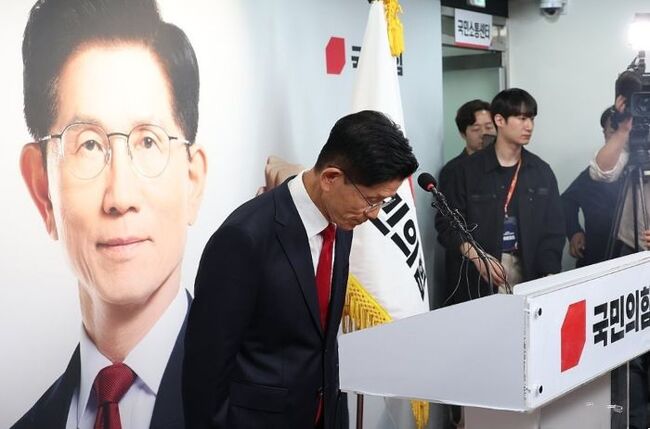 “Too little, too late?…” Kim Moon-soo, who previously conceded his presidential election defeat, now demands a special counsel investigation into ‘allegations of election fraud in the 2025 presidential election’
People Power Party presidential candidate Kim Moon-soo concedes defeat during a press conference at the party headquarters in Yeouido, Seoul, on June 4, 2025. [Joint Press Corps]As allegations emerge
“Too little, too late?…” Kim Moon-soo, who previously conceded his presidential election defeat, now demands a special counsel investigation into ‘allegations of election fraud in the 2025 presidential election’
People Power Party presidential candidate Kim Moon-soo concedes defeat during a press conference at the party headquarters in Yeouido, Seoul, on June 4, 2025. [Joint Press Corps]As allegations emerge
 Stock Market Crash 'Black Tuesday'… KOSPI down 10.8%, KOSDAQ down 7.7%
The KOSPI fell by more than 5% in early trading on the 28th, triggering a sell-side sidecar.On the 28th, the KOSPI plunged by more than 10%.Due to the sharp decline, a sell-side sidecar—a temporary
Stock Market Crash 'Black Tuesday'… KOSPI down 10.8%, KOSDAQ down 7.7%
The KOSPI fell by more than 5% in early trading on the 28th, triggering a sell-side sidecar.On the 28th, the KOSPI plunged by more than 10%.Due to the sharp decline, a sell-side sidecar—a temporary
 [World Heritage Committee] 25 New World Heritage Sites Inscribed in Busan… South Korea Successfully Expands 'Getbol' Listing
The Chairperson of the World Heritage Committee speaks at the plenary session of the 48th session of the World Heritage Committee, held at BEXCO in Busan on the 20th. [Photo: Yonhap News]A total of 25
[World Heritage Committee] 25 New World Heritage Sites Inscribed in Busan… South Korea Successfully Expands 'Getbol' Listing
The Chairperson of the World Heritage Committee speaks at the plenary session of the 48th session of the World Heritage Committee, held at BEXCO in Busan on the 20th. [Photo: Yonhap News]A total of 25
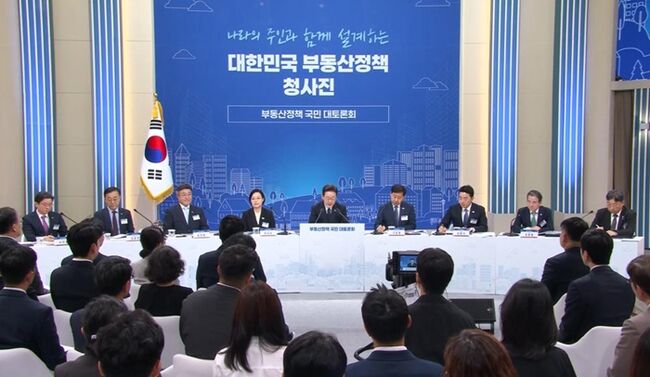 [Liberal Democratic Party Statement] Calling it a Grand Real Estate Debate… It Was Nothing More Than a Private Party Among Themselves
The 'National Grand Debate on Real Estate Policy' held on July 23rd and 27th. [Photo=Yonhap News]The 'National Grand Debate on Real Estate Policy,' hosted by the Lee Jae-myung administration under the
[Liberal Democratic Party Statement] Calling it a Grand Real Estate Debate… It Was Nothing More Than a Private Party Among Themselves
The 'National Grand Debate on Real Estate Policy' held on July 23rd and 27th. [Photo=Yonhap News]The 'National Grand Debate on Real Estate Policy,' hosted by the Lee Jae-myung administration under the
 [Photo] Evidence of Election Fraud Flooding U.S. Media… Trump Had 2.7 Million Votes Stolen
 [Video] U.S. Semiquincentennial Air Show... 'Art in the Sky' streaks across New York
 [Editorial Cartoon] A Draconian Law That Undermines Freedom of Expression

 List
List