Image of the new submarine. Captured from Saab's homepage
 Hanmi Ilbo ColumnistSweden's ultimate victory in Poland's 'Orka Project,' not Korea's, is more than just a lost bid.
It demonstrates that Europe's security landscape, NATO's solidarity, Baltic Sea strategy, and global supply chain alliances carried more decisive weight than Hanwha Ocean's technological prowess. The core of this defeat was not technology, but 'integration with the European security ecosystem.'
While Sweden's A26 submarine is undoubtedly an excellent platform, the more significant point is that Poland is building a new pillar of European security. Facing Russian threats, the Nordic and Baltic countries are constructing a 'Baltic defense alliance,' integrating their defense industries into a single system. Within this structure, Korea failed to overcome the 'European security bloc barrier.' Even the extraordinary offer of the Jang Bogo-class submarine's free transfer proved ineffective against European cohesion.
For Korea to challenge the European defense market again, technology and price alone are no longer sufficient. To succeed in Canada's Future Canada Submarine Project (CPSP), Hanwha Ocean requires three strategic shifts.
First, it needs an 'alliance-based package strategy.'
Korea's submarine technology is recognized. The issue is the competitiveness of a package that encompasses 'vessels + training + base construction + local maintenance + long-term partnership.' Sweden's strategy of temporarily providing existing submarines (gap-filler) to Poland and investing in Polish shipyard maintenance capabilities is textbook. Korea must also propose an alliance-based 'strategic bundle,' including joint exercises with Canada, MRO investments, and Arctic route operational solutions.
Second, consistency in defense diplomacy is necessary.
While Korea's defense industry is gaining global attention for its technological and price competitiveness, risks stemming from wavering diplomatic stances quickly spill over into defense. The Lee Jae-myung administration's 'pro-China tilt' is already perceived as a subject of concern by the US and NATO countries.
Defense industries in the US, Canada, and Europe are 'value-based alliance industries.' Under a government that closely aligns with China, the Korean defense industry loses credibility in the security alliance market. In Poland's case, 'coordination with the European security network' was key. When the Korean government's strategic messaging is unclear, it naturally puts Korea at a disadvantage.
Third, it is time to create a global ecosystem for Korean defense industries.
Sweden is purchasing Polish rescue vessels, and Poland is importing Swedish weapons, creating a 'reciprocal procurement system.' In contrast, Korea remains stuck in an 'export-oriented structure.'
For the Canadian project, it must be possible to build a 'triangular ecosystem' connected to the Canadian shipbuilding industry, Arctic naval strategy, and the joint defense system with the US. The strategy should not be merely about selling submarines, but about making Canada a partner in Korea's Arctic and North Atlantic defense network.
Poland's choice this time is not a 'failure, but a message' for Korea.
The world does not look only at technology.
It looks at national strategy, alliance structures, and security philosophy together.
In that sense, Korea's biggest risk right now is not its submarine technology, but the 'absence of a diplomatic and security strategy that stabilizes the nation's central axis.'
The ambiguous diplomatic stance and anti-Western sentiment of the Lee Jae-myung administration are ultimately eroding national interests. Defense is an industry where diplomatic and defense strategies manifest in outcomes. If leaning towards China and eroding trust with NATO, the Polish incident will be repeated in the future.
For the Korean defense industry to regain its momentum, rebuilding trust with NATO, the US, Canada, and Europe must come first.
The technology is already ready.
What is lacking is answering the question of whether Canada can trust Korea and build an alliance front together.
Canada can be another opportunity for Korea.
However, there is a prerequisite.
“Whose side is Korea on?”
Only when this question is clearly answered will Hanwha Ocean be able to open the door to the 60 trillion won market, and Korean defense industries will establish themselves as major players in the global security order.
Hanmi Ilbo Columnist

 [Statement by the Seobeokka KMA Patriots Association] ㉛ Recount the ballots openly, as the previous recount covered up election fraud
Recount of the Tongyeong mayoral election [Photo=Yonhap News]South Korea's liberal democracy is dying. The National Election Commission (NEC), which has degraded into a criminal organization through t
[Statement by the Seobeokka KMA Patriots Association] ㉛ Recount the ballots openly, as the previous recount covered up election fraud
Recount of the Tongyeong mayoral election [Photo=Yonhap News]South Korea's liberal democracy is dying. The National Election Commission (NEC), which has degraded into a criminal organization through t
 What is the significance of the "Trump 2028" red hat that keeps reappearing?
It is noteworthy that while it is "highly likely" that President Donald Trump is "seriously considering" a run for the presidency in 2028, he is also "deliberately" fueling speculation regarding wheth
What is the significance of the "Trump 2028" red hat that keeps reappearing?
It is noteworthy that while it is "highly likely" that President Donald Trump is "seriously considering" a run for the presidency in 2028, he is also "deliberately" fueling speculation regarding wheth
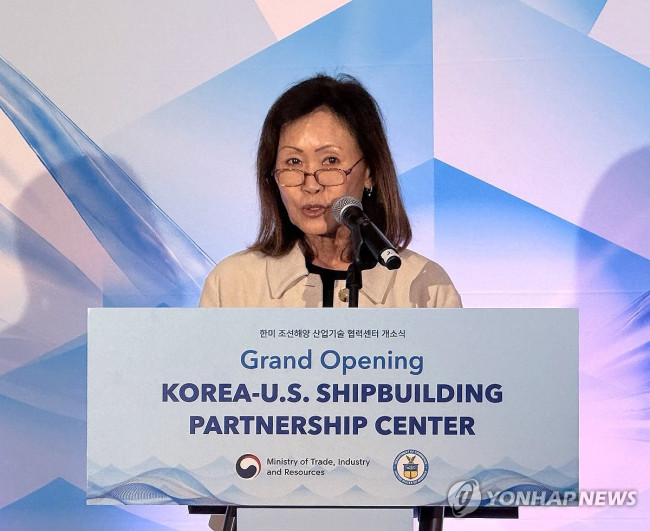 First U.S. Ambassador of Trump's Second Term to Arrive This Week… Will It Provide Momentum to Resolve Pending Issues?
U.S. Ambassador to South Korea Michelle Steel speaks at the opening ceremony of the Korea-U.S. Shipbuilding Cooperation Center held at the Mayflower Hotel in Washington, D.C., on the 23rd (local time)
First U.S. Ambassador of Trump's Second Term to Arrive This Week… Will It Provide Momentum to Resolve Pending Issues?
U.S. Ambassador to South Korea Michelle Steel speaks at the opening ceremony of the Korea-U.S. Shipbuilding Cooperation Center held at the Mayflower Hotel in Washington, D.C., on the 23rd (local time)
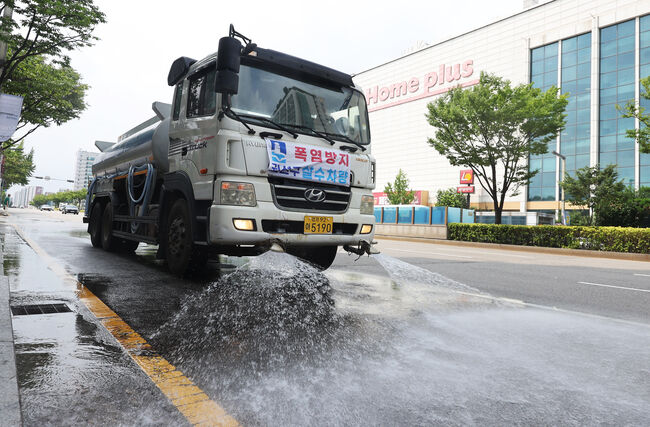 The Korean Peninsula wrapped in a thick blanket of scorching high pressure… Will the 1994 record be broken?
On the 28th, as the heatwave continues, a water sprinkler truck sprays water on Hyowon-ro, Gwonseon-gu, Suwon, Gyeonggi Province. [Photo = Yonhap News]The hottest years on record are considered to be
The Korean Peninsula wrapped in a thick blanket of scorching high pressure… Will the 1994 record be broken?
On the 28th, as the heatwave continues, a water sprinkler truck sprays water on Hyowon-ro, Gwonseon-gu, Suwon, Gyeonggi Province. [Photo = Yonhap News]The hottest years on record are considered to be
 Stock Market Crash 'Black Tuesday'… KOSPI down 10.8%, KOSDAQ down 7.7%
The KOSPI fell by more than 5% in early trading on the 28th, triggering a sell-side sidecar.On the 28th, the KOSPI plunged by more than 10%.Due to the sharp decline, a sell-side sidecar—a temporary
Stock Market Crash 'Black Tuesday'… KOSPI down 10.8%, KOSDAQ down 7.7%
The KOSPI fell by more than 5% in early trading on the 28th, triggering a sell-side sidecar.On the 28th, the KOSPI plunged by more than 10%.Due to the sharp decline, a sell-side sidecar—a temporary
 [World Heritage Committee] 25 New World Heritage Sites Inscribed in Busan… South Korea Successfully Expands 'Getbol' Listing
The Chairperson of the World Heritage Committee speaks at the plenary session of the 48th session of the World Heritage Committee, held at BEXCO in Busan on the 20th. [Photo: Yonhap News]A total of 25
[World Heritage Committee] 25 New World Heritage Sites Inscribed in Busan… South Korea Successfully Expands 'Getbol' Listing
The Chairperson of the World Heritage Committee speaks at the plenary session of the 48th session of the World Heritage Committee, held at BEXCO in Busan on the 20th. [Photo: Yonhap News]A total of 25
 [Cho Yang-geon Column] The NEC: Facing a Fate of "Discarding the Dog After the Hunt"
Banner calling for the "dissolution of the NEC" posted by the Democratic Party. [AI-generated image]Banners calling for the "dissolution of the National Election Commission (NEC)" posted by the Democr
[Cho Yang-geon Column] The NEC: Facing a Fate of "Discarding the Dog After the Hunt"
Banner calling for the "dissolution of the NEC" posted by the Democratic Party. [AI-generated image]Banners calling for the "dissolution of the National Election Commission (NEC)" posted by the Democr
 [Photo] Evidence of Election Fraud Flooding U.S. Media… Trump Had 2.7 Million Votes Stolen
 [Video] U.S. Semiquincentennial Air Show... 'Art in the Sky' streaks across New York
 [Editorial Cartoon] A Draconian Law That Undermines Freedom of Expression

 List
List