Yonhap News.
 Hanmi Ilbo ColumnistWhile South Korea's exports are on the cusp of surpassing $700 billion for the first time this year, there are assessments that the structural imbalance of over-reliance on semiconductors has worsened behind this impressive record. According to the cumulative export statistics for January-November announced by the Ministry of Trade, Industry and Energy on December 7, total exports reached $640.2 billion, a 2.9% increase compared to the same period last year, marking the highest figure since 2022.
The main driving force behind this robust performance is attributed to a significant increase in exports of memory semiconductors such as HBM, SSD, and high-performance server DRAM and NAND flash, boosted by the spread of artificial intelligence (AI) led by US big tech and the boom in data center expansion. Cumulative semiconductor exports reached $152.6 billion by November of this year. This figure already surpasses the total annual semiconductor exports of $141.9 billion from last year, as of November.
However, excluding semiconductors, South Korea's exports actually contracted this year. Cumulative exports excluding semiconductors from January to November amounted to $487.6 billion, a 1.5% decrease from $494.8 billion in the same period last year. Among the top 15 key export items, exports increased for semiconductors (+19.8%), automobiles (+2.0%), ships (+28.6%), bio-health (+7.0%), and computers (+0.4%). However, exports of key items such as general machinery (-8.9%), petroleum products (-11.1%), petrochemicals (-11.7%), steel (-8.8%), auto parts (-6.3%), wireless communication devices (-1.6%), displays (-10.3%), textiles (-8.1%), home appliances (-9.4%), and secondary batteries (-11.8%) were sluggish.
In particular, the prolonged triple blow of high interest rates, high exchange rates, and high oil prices due to the fallout from the Russia-Ukraine war has increased cost burdens, while external uncertainties have further heightened amidst the controversy over the US's "Trump tariffs" policy. In this environment, Korea's export structure has increasingly intensified its tendency to be excessively dependent on specific items, specific countries, and specific companies. Concerns are rising that if the semiconductor market enters a period of adjustment again without effective export diversification, the shock will not only be a simple decline in exports but could also spread to the entire domestic manufacturing industry, employment, investment, and regional economies.
The government has recently announced plans to strengthen mid- to long-term competitiveness through strategies such as a specialized semiconductor development strategy, expansion of the advanced packaging ecosystem, and the establishment of semiconductor mega-clusters in areas like Yongin, Pyeongtaek, and Hwaseong. Furthermore, the Ministry of Trade, Industry and Energy emphasized in an analysis released at the end of November that "for the export recovery trend to continue sustainably with an overall improvement in industrial structure, a structure of concurrent growth between key and new industries is essential."
However, the reality is not straightforward. The secondary battery industry, for instance, has rapidly entered a phase of slowdown after aggressive investment over the past two years, facing global oversupply and being pushed back by the overwhelming price competitiveness of Chinese companies. The petrochemical and steel industries have been directly hit by a global slowdown in demand and a contraction in facility investment due to high interest rates. While the automotive industry is doing well in terms of finished vehicles, the parts industry is struggling to escape a structural downturn. There are also ongoing criticisms that the innovation foundation of Korea's manufacturing industry has weakened.
While it is undeniable that South Korea's exports have been boosted by the sustained record boom in semiconductors, the fact that concurrent growth has not been achieved in other industries can directly translate into structural risks. Therefore, cautious views are gaining traction, suggesting that it is still premature to judge economic recovery based solely on an increase in export value. Experts point out that "there is a need to shift focus from viewing only the quantitative growth of South Korea's exports to qualitative balance and industrial diversification."
As domestic and international economic conditions rapidly change, South Korea's exports stand at a new crossroads. The advent of the AI era signifies both a tremendous opportunity and the beginning of intense competition, and the sluggishness of major manufacturing industries demands a fundamental transformation of the existing growth structure. Even if exports achieve the symbolic record of $700 billion this year, the reality of deepening over-reliance on semiconductors behind it is becoming the starting line for new challenges, clearly showing a facet of the trials that the Korean economy will face in the future.
Hanmi Ilbo Columnist

 [Statement by the Seo-beo-kka Korea Military Academy Save-the-Nation Comrades Association] ㉛ Recount the Votes Publicly, as the Previous Recount Concealed Election Fraud
Tongyeong Mayoral Election Recount [Photo=Yonhap News]South Korea's liberal democracy is dying. The National Election Commission (NEC) and the judiciary, which have plummeted into criminal syndicates
[Statement by the Seo-beo-kka Korea Military Academy Save-the-Nation Comrades Association] ㉛ Recount the Votes Publicly, as the Previous Recount Concealed Election Fraud
Tongyeong Mayoral Election Recount [Photo=Yonhap News]South Korea's liberal democracy is dying. The National Election Commission (NEC) and the judiciary, which have plummeted into criminal syndicates
 What is the significance of the "Trump 2028" red hats that keep making a comeback?
It is noteworthy that President Donald Trump is "intentionally" fueling controversy over whether he can actually run in the 2028 presidential election, even though it is "highly likely he is seriously
What is the significance of the "Trump 2028" red hats that keep making a comeback?
It is noteworthy that President Donald Trump is "intentionally" fueling controversy over whether he can actually run in the 2028 presidential election, even though it is "highly likely he is seriously
 Jin Cummings: “North Korea says it will increase the number of spies, so what is the government doing?”
U.S. political columnist Gene Cummings has publicly questioned the South Korean government, asking, "North Korea is declaring that it will increase its number of spies, so what is the South Kore
Jin Cummings: “North Korea says it will increase the number of spies, so what is the government doing?”
U.S. political columnist Gene Cummings has publicly questioned the South Korean government, asking, "North Korea is declaring that it will increase its number of spies, so what is the South Kore
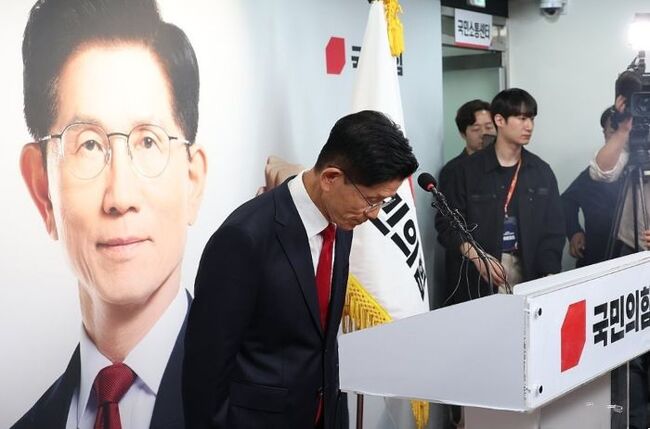 “Too little, too late?…” Kim Moon-soo, who previously conceded his presidential election defeat, now demands a special counsel investigation into ‘allegations of election fraud in the 2025 presidential election’
People Power Party presidential candidate Kim Moon-soo concedes defeat during a press conference at the party headquarters in Yeouido, Seoul, on June 4, 2025. [Joint Press Corps]As allegations emerge
“Too little, too late?…” Kim Moon-soo, who previously conceded his presidential election defeat, now demands a special counsel investigation into ‘allegations of election fraud in the 2025 presidential election’
People Power Party presidential candidate Kim Moon-soo concedes defeat during a press conference at the party headquarters in Yeouido, Seoul, on June 4, 2025. [Joint Press Corps]As allegations emerge
 Stock Market Crash 'Black Tuesday'… KOSPI down 10.8%, KOSDAQ down 7.7%
The KOSPI fell by more than 5% in early trading on the 28th, triggering a sell-side sidecar.On the 28th, the KOSPI plunged by more than 10%.Due to the sharp decline, a sell-side sidecar—a temporary
Stock Market Crash 'Black Tuesday'… KOSPI down 10.8%, KOSDAQ down 7.7%
The KOSPI fell by more than 5% in early trading on the 28th, triggering a sell-side sidecar.On the 28th, the KOSPI plunged by more than 10%.Due to the sharp decline, a sell-side sidecar—a temporary
 [World Heritage Committee] 25 New World Heritage Sites Inscribed in Busan… South Korea Successfully Expands 'Getbol' Listing
The Chairperson of the World Heritage Committee speaks at the plenary session of the 48th session of the World Heritage Committee, held at BEXCO in Busan on the 20th. [Photo: Yonhap News]A total of 25
[World Heritage Committee] 25 New World Heritage Sites Inscribed in Busan… South Korea Successfully Expands 'Getbol' Listing
The Chairperson of the World Heritage Committee speaks at the plenary session of the 48th session of the World Heritage Committee, held at BEXCO in Busan on the 20th. [Photo: Yonhap News]A total of 25
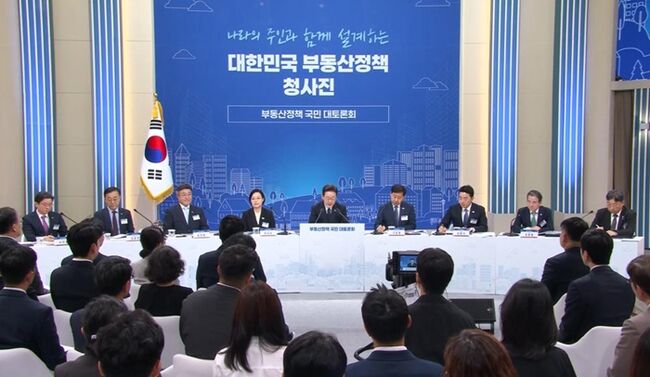 [Liberal Democratic Party Statement] Calling it a Grand Real Estate Debate… It Was Nothing More Than a Private Party Among Themselves
The 'National Grand Debate on Real Estate Policy' held on July 23rd and 27th. [Photo=Yonhap News]The 'National Grand Debate on Real Estate Policy,' hosted by the Lee Jae-myung administration under the
[Liberal Democratic Party Statement] Calling it a Grand Real Estate Debate… It Was Nothing More Than a Private Party Among Themselves
The 'National Grand Debate on Real Estate Policy' held on July 23rd and 27th. [Photo=Yonhap News]The 'National Grand Debate on Real Estate Policy,' hosted by the Lee Jae-myung administration under the
 [Photo] Evidence of Election Fraud Flooding U.S. Media… Trump Had 2.7 Million Votes Stolen
 [Video] U.S. Semiquincentennial Air Show... 'Art in the Sky' streaks across New York
 [Editorial Cartoon] A Draconian Law That Undermines Freedom of Expression

 List
List