Sam Altman, CEO of OpenAI, sits next to Tim Cook, CEO of Apple, at a dinner hosted by President Donald Trump at the White House on September 4th (local time). UPI=Yonhap News
It seems like just yesterday that ChatGPT surprised everyone, and now, as GPT-5 is being piloted almost instantaneously, humanity stands at a turning point of civilization, beyond the boundaries of technology. While artificial intelligence (AI) up to GPT-4 was a high-performance tool for quickly processing specific tasks, GPT-5 is evaluated as the first step towards artificial general intelligence (AGI), encompassing human reasoning, interpretation, and judgment.
AGI refers to AI that performs reasoning, learning, and problem-solving in various fields at a human level or beyond. The next stage of AGI is ASI (artificial super intelligence), which signifies intelligence that surpasses human capabilities.
Categorized by operational form, GPT-4 is passive, answering questions. AGI is slightly more advanced, semi-passive, while ASI is active, understanding the direction of the questioner and leading the conversation accordingly.
Experts say, "Technological evolution is not difficult." However, at this point, there is one question we must ask.
"Technology is ready, but is society ready?"
Recent documents released by OpenAI contain philosophical warnings rather than showcasing technology.
In a November 6th announcement, OpenAI pointed out, "AGI has immense benefits but also carries potential risks of catastrophic proportions."
This is not mere pessimism but a confession that "our civilization system is not prepared to handle the shock." The fundamental risk lies not in the AI technology (algorithm) itself, but in society's failure to reach a consensus on how to use that technology.
The point OpenAI repeatedly emphasized is the disclosure method of AGI.
"New AI models should be released cautiously and incrementally, and improvements should be made by addressing issues encountered in actual usage experience."
This statement shows that what is needed in the AGI era is not technological breakthroughs but social adaptation. What's important is not the speed of technology but the risk associated with 'social discord.'
Furthermore, OpenAI stated that 'safety' should be an element of the 'structure,' not a feature.
"It is true that AI brings immense benefits but is also dangerous. We must embed safety throughout the entire system."
This means "safety should be incorporated into the social system (Social Operating System · SOS) itself, rather than as a technical measure."
In summary, the core task of the AGI era is not technological development but securing social trust.
However, currently, no country in the world has a unified social system or international standards to address the trust issues of the AGI era.
The establishment of these standards, or norms, means that "risk factors that may arise in the process of humans collaborating with AI will be eliminated."
This can be easily understood by drawing an analogy with the case of ARM, a British semiconductor company. Just as ARM dominated the market with 'technological standards,' in the future, determining who creates the 'social standards (SOS)' for safely managing AGI will determine victory or defeat.
The concepts of ALO and ACV, proposed in Korea, hold special significance in offering a new direction for humanity in a situation where there are no unified global standards.
ALO (AI-Linked Optimization) is a kind of framework that aligns AI's judgment with the ethical standards of human society. This can be described as a mutually complementary structure where AI development and social verification occur together.
ACV (Accumulated Trust Value) is a method of representing the entire process of information being verified, contested, and reconfirmed in 'objective units' such as scores or numerical values.
In other words, this is a way to represent the trust relationship between AI and humans in an objective 'mathematical language.' The core of this method is 'continuously building and developing' trust.
If the advent of AGI is a 'technological event,' then ALO and ACV can be called 'civilizational events' that change the rules of human society.
OpenAI warned of social chaos in the AI era, and ALO and ACV are the first steps to solve that problem. This can be highly appreciated for being the first instance of analyzing the abstract concept of human trust from the perspectives of science and philosophy to create 'objectively measurable metrics.'
If AI expands human intelligence, ALO and ACV expand the intelligence of society as a whole. And in that sense, this is closer to civilization design than technology design.
This can be summarized in one sentence.
"ALO and ACV are 'civilizational operating systems (OS)' that will broaden the coexistence domain of AI and humanity, and are new rules and systems that will safely lead the AGI era."
AGI has the potential to change the structure of human civilization. However, the essential prerequisite here is not technology, but social trust. Active AI cannot emerge without consensus with human civilization.
A developer interviewed by says this:
"ALO and ACV are the first systems devised to ensure smooth agreement between AI and humans. As technology advances, the importance of 'trust' grows, and human civilization can only be sustained on the foundation of this trust. ALO and ACV are the first concrete attempts to expand the intersection points where humans and AI meet and evolve together."

 [Statement by the Seo-beo-kka Korea Military Academy Save-the-Nation Comrades Association] ㉛ Recount the Votes Publicly, as the Previous Recount Concealed Election Fraud
Tongyeong Mayoral Election Recount [Photo=Yonhap News]South Korea's liberal democracy is dying. The National Election Commission (NEC) and the judiciary, which have plummeted into criminal syndicates
[Statement by the Seo-beo-kka Korea Military Academy Save-the-Nation Comrades Association] ㉛ Recount the Votes Publicly, as the Previous Recount Concealed Election Fraud
Tongyeong Mayoral Election Recount [Photo=Yonhap News]South Korea's liberal democracy is dying. The National Election Commission (NEC) and the judiciary, which have plummeted into criminal syndicates
 What is the significance of the "Trump 2028" red hats that keep making a comeback?
It is noteworthy that President Donald Trump is "intentionally" fueling controversy over whether he can actually run in the 2028 presidential election, even though it is "highly likely he is seriously
What is the significance of the "Trump 2028" red hats that keep making a comeback?
It is noteworthy that President Donald Trump is "intentionally" fueling controversy over whether he can actually run in the 2028 presidential election, even though it is "highly likely he is seriously
 Jin Cummings: “North Korea says it will increase the number of spies, so what is the government doing?”
U.S. political columnist Gene Cummings has publicly questioned the South Korean government, asking, "North Korea is declaring that it will increase its number of spies, so what is the South Kore
Jin Cummings: “North Korea says it will increase the number of spies, so what is the government doing?”
U.S. political columnist Gene Cummings has publicly questioned the South Korean government, asking, "North Korea is declaring that it will increase its number of spies, so what is the South Kore
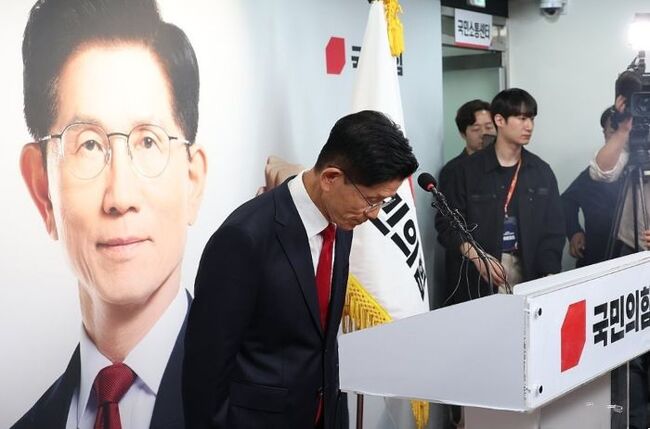 “Too little, too late?…” Kim Moon-soo, who previously conceded his presidential election defeat, now demands a special counsel investigation into ‘allegations of election fraud in the 2025 presidential election’
People Power Party presidential candidate Kim Moon-soo concedes defeat during a press conference at the party headquarters in Yeouido, Seoul, on June 4, 2025. [Joint Press Corps]As allegations emerge
“Too little, too late?…” Kim Moon-soo, who previously conceded his presidential election defeat, now demands a special counsel investigation into ‘allegations of election fraud in the 2025 presidential election’
People Power Party presidential candidate Kim Moon-soo concedes defeat during a press conference at the party headquarters in Yeouido, Seoul, on June 4, 2025. [Joint Press Corps]As allegations emerge
 Stock Market Crash 'Black Tuesday'… KOSPI down 10.8%, KOSDAQ down 7.7%
The KOSPI fell by more than 5% in early trading on the 28th, triggering a sell-side sidecar.On the 28th, the KOSPI plunged by more than 10%.Due to the sharp decline, a sell-side sidecar—a temporary
Stock Market Crash 'Black Tuesday'… KOSPI down 10.8%, KOSDAQ down 7.7%
The KOSPI fell by more than 5% in early trading on the 28th, triggering a sell-side sidecar.On the 28th, the KOSPI plunged by more than 10%.Due to the sharp decline, a sell-side sidecar—a temporary
 [World Heritage Committee] 25 New World Heritage Sites Inscribed in Busan… South Korea Successfully Expands 'Getbol' Listing
The Chairperson of the World Heritage Committee speaks at the plenary session of the 48th session of the World Heritage Committee, held at BEXCO in Busan on the 20th. [Photo: Yonhap News]A total of 25
[World Heritage Committee] 25 New World Heritage Sites Inscribed in Busan… South Korea Successfully Expands 'Getbol' Listing
The Chairperson of the World Heritage Committee speaks at the plenary session of the 48th session of the World Heritage Committee, held at BEXCO in Busan on the 20th. [Photo: Yonhap News]A total of 25
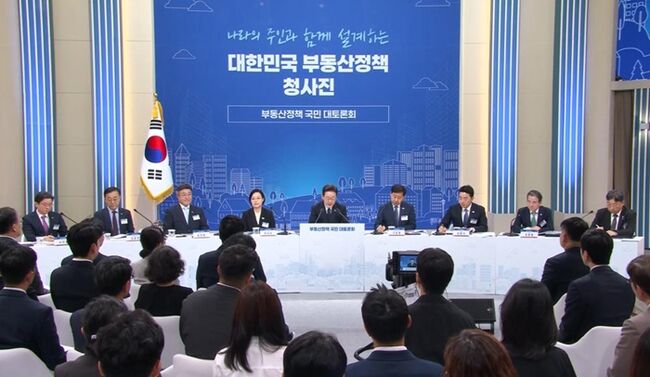 [Liberal Democratic Party Statement] Calling it a Grand Real Estate Debate… It Was Nothing More Than a Private Party Among Themselves
The 'National Grand Debate on Real Estate Policy' held on July 23rd and 27th. [Photo=Yonhap News]The 'National Grand Debate on Real Estate Policy,' hosted by the Lee Jae-myung administration under the
[Liberal Democratic Party Statement] Calling it a Grand Real Estate Debate… It Was Nothing More Than a Private Party Among Themselves
The 'National Grand Debate on Real Estate Policy' held on July 23rd and 27th. [Photo=Yonhap News]The 'National Grand Debate on Real Estate Policy,' hosted by the Lee Jae-myung administration under the
 [Photo] Evidence of Election Fraud Flooding U.S. Media… Trump Had 2.7 Million Votes Stolen
 [Video] U.S. Semiquincentennial Air Show... 'Art in the Sky' streaks across New York
 [Editorial Cartoon] A Draconian Law That Undermines Freedom of Expression

 List
List