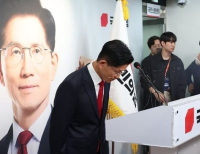
Kwack Gyu-taek (from left), Cho Bae-sook, and Kim Ki-yoon, Vice Chairman of the People Power Party's Legal Advisory Committee, head to the civil affairs office at the Seoul Metropolitan Police Agency in Jongno-gu on the 11th to file a complaint against Special Prosecutor Min Jung-ki, former Minister of Oceans and Fisheries Jeon Jae-soo, and current and former Democratic Party lawmakers on charges of dereliction of duty, violation of the Political Funds Act, and bribery, respectively, in connection with alleged illicit monetary dealings with the Unification Church. Yonhap News
Since the founding of the Republic of Korea, religious circles have been consistently intertwined with politics, leading to numerous controversies. This is due to the complex web of practical interests involved. For politicians, the reality is that they cannot ignore the vast number of followers that religious organizations command, essentially "that bloc" of voters. Furthermore, their nationwide organizational networks and systematic structures, characterized by strong mobilization capabilities and connections, enable efficient mobilization of personnel and resources during election campaigns, and their influence on local communities cannot be overlooked.
The significant financial mobilization power can also critically impact election outcomes, making it imperative for politicians to perceive religious organizations as key partners and to continuously strive for their interest and relationship maintenance. This is a common phenomenon not only in Korea but in most countries worldwide.
At times, when religious groups are perceived as a risky element due to being too close to the opposing party, or when they do not cooperate as expected, leading to displeasure, political factions have indeed exerted relentless pressure on them.
A prime example of religious persecution by political power is the "October 27th Incident," where the Shinseon military regime under Chun Doo-hwan suppressed Jogye Order of Korean Buddhism in an attempt to control the Buddhist community in the early days of their rule. During this period, the Buddhist community was slandered as a criminal organization, and it is true that they were under the control of the regime for a certain period. However, that period ended with the regime's demise. Such is the power of a regime.
History repeats itself.
Special Prosecutor Park Young-soo attempted to implicate President Park Geun-hye in bribery charges, but later Park Young-soo himself was convicted of bribery. Special Prosecutor Min Jung-ki, while investigating First Lady Kim Keon-hee for stock manipulation allegations, became entangled in stock manipulation himself.
And now, it is the Unification Church special prosecution. The investigation began with the intent to link the People Power Party with the Unification Church, but as it progressed, dark connections between the Democratic Party and the Unification Church have been steadily revealed.
A bombshell testimony has emerged from Yoon Young-ho, former head of the Unification Church World Headquarters. He stated that during the 20th presidential election, they approached not only the People Power Party but also the Democratic Party. The audio recordings secured by the special prosecutor contain attempts to contact key figures within then-candidate Lee Jae-myung's camp, mentions of the line of former Deputy Secretary-General for Political Affairs, Jung Jin-sang, and a desire from Lee Jae-myung's side to directly meet with Chairman Han Hak-ja. Statements have also emerged alleging that tens of millions of won and high-end watches were provided to Democratic Party lawmakers during the Moon Jae-in administration.
Yet, despite securing all these testimonies and recordings, the special prosecutor is drawing a line, stating, "The Unification Church's support for the Democratic Party is outside the scope of our investigation." This is manipulation of information. The recordings were reviewed with the intention of linking the People Power Party and the Unification Church, but they revealed more content about the Democratic Party's approach. This was then omitted from the deposition. What is this if not abuse of power?
The deeper the investigation into the Unification Church, the more the Democratic Party's scandals are exposed. With further revelations anticipated at the final trial for Yoon Young-ho, former head of the Unification Church, Lee Jae-myung's risks have been further amplified. However, at the final trial held on the afternoon of the 10th, there were no additional revelations. Lee Jae-myung's threat to "dissolve the cult" had worked. The expectation of truth being revealed, which was initially a glimmer of hope, has been dashed.
However, we know. It is unlikely that Lee Jae-myung, who is suspected of aiming for re-election as Seongnam Mayor with the support of Daesoon Jinrihoe, did not approach the Unification Church. The Democratic Party will resort to any means necessary if it serves their electoral interests. Are they not the ones who embrace everything, regardless of whether it's a heretical religion or not?
The Democratic Party is the originator of lobbying politicians by the Unification Church. And its beginning traces back to Kim Dae-jung. Lee Jae-myung's call for the dissolution of the Unification Church was a desperate threat to prevent his scandals from being exposed, a show to erase his past. History will surely remember and record this hypocrisy. The public demands a special investigation into the 'Democratic Party-Unification Church Gate'!

 [Statement by the Seo-beo-kka Korea Military Academy Save-the-Nation Comrades Association] ㉛ Recount the Votes Publicly, as the Previous Recount Concealed Election Fraud
Tongyeong Mayoral Election Recount [Photo=Yonhap News]South Korea's liberal democracy is dying. The National Election Commission (NEC) and the judiciary, which have plummeted into criminal syndicates
[Statement by the Seo-beo-kka Korea Military Academy Save-the-Nation Comrades Association] ㉛ Recount the Votes Publicly, as the Previous Recount Concealed Election Fraud
Tongyeong Mayoral Election Recount [Photo=Yonhap News]South Korea's liberal democracy is dying. The National Election Commission (NEC) and the judiciary, which have plummeted into criminal syndicates
 What is the significance of the "Trump 2028" red hats that keep making a comeback?
It is noteworthy that President Donald Trump is "intentionally" fueling controversy over whether he can actually run in the 2028 presidential election, even though it is "highly likely he is seriously
What is the significance of the "Trump 2028" red hats that keep making a comeback?
It is noteworthy that President Donald Trump is "intentionally" fueling controversy over whether he can actually run in the 2028 presidential election, even though it is "highly likely he is seriously
 Jin Cummings: “North Korea says it will increase the number of spies, so what is the government doing?”
U.S. political columnist Gene Cummings has publicly questioned the South Korean government, asking, "North Korea is declaring that it will increase its number of spies, so what is the South Kore
Jin Cummings: “North Korea says it will increase the number of spies, so what is the government doing?”
U.S. political columnist Gene Cummings has publicly questioned the South Korean government, asking, "North Korea is declaring that it will increase its number of spies, so what is the South Kore
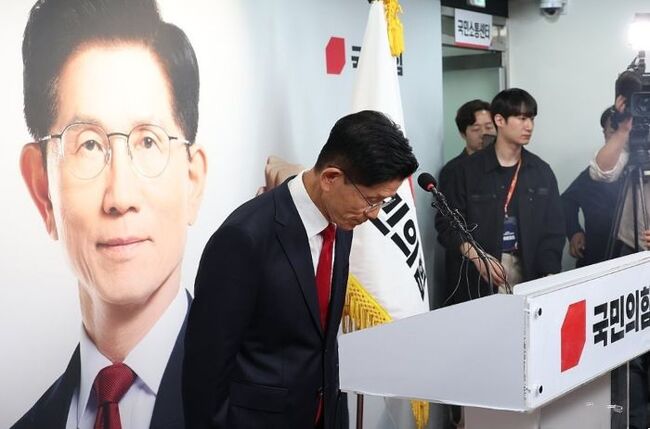 “Too little, too late?…” Kim Moon-soo, who previously conceded his presidential election defeat, now demands a special counsel investigation into ‘allegations of election fraud in the 2025 presidential election’
People Power Party presidential candidate Kim Moon-soo concedes defeat during a press conference at the party headquarters in Yeouido, Seoul, on June 4, 2025. [Joint Press Corps]As allegations emerge
“Too little, too late?…” Kim Moon-soo, who previously conceded his presidential election defeat, now demands a special counsel investigation into ‘allegations of election fraud in the 2025 presidential election’
People Power Party presidential candidate Kim Moon-soo concedes defeat during a press conference at the party headquarters in Yeouido, Seoul, on June 4, 2025. [Joint Press Corps]As allegations emerge
 Stock Market Crash 'Black Tuesday'… KOSPI down 10.8%, KOSDAQ down 7.7%
The KOSPI fell by more than 5% in early trading on the 28th, triggering a sell-side sidecar.On the 28th, the KOSPI plunged by more than 10%.Due to the sharp decline, a sell-side sidecar—a temporary
Stock Market Crash 'Black Tuesday'… KOSPI down 10.8%, KOSDAQ down 7.7%
The KOSPI fell by more than 5% in early trading on the 28th, triggering a sell-side sidecar.On the 28th, the KOSPI plunged by more than 10%.Due to the sharp decline, a sell-side sidecar—a temporary
 [World Heritage Committee] 25 New World Heritage Sites Inscribed in Busan… South Korea Successfully Expands 'Getbol' Listing
The Chairperson of the World Heritage Committee speaks at the plenary session of the 48th session of the World Heritage Committee, held at BEXCO in Busan on the 20th. [Photo: Yonhap News]A total of 25
[World Heritage Committee] 25 New World Heritage Sites Inscribed in Busan… South Korea Successfully Expands 'Getbol' Listing
The Chairperson of the World Heritage Committee speaks at the plenary session of the 48th session of the World Heritage Committee, held at BEXCO in Busan on the 20th. [Photo: Yonhap News]A total of 25
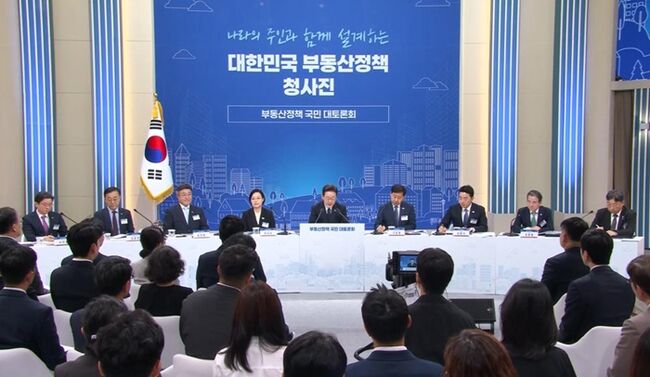 [Liberal Democratic Party Statement] Calling it a Grand Real Estate Debate… It Was Nothing More Than a Private Party Among Themselves
The 'National Grand Debate on Real Estate Policy' held on July 23rd and 27th. [Photo=Yonhap News]The 'National Grand Debate on Real Estate Policy,' hosted by the Lee Jae-myung administration under the
[Liberal Democratic Party Statement] Calling it a Grand Real Estate Debate… It Was Nothing More Than a Private Party Among Themselves
The 'National Grand Debate on Real Estate Policy' held on July 23rd and 27th. [Photo=Yonhap News]The 'National Grand Debate on Real Estate Policy,' hosted by the Lee Jae-myung administration under the
 [Photo] Evidence of Election Fraud Flooding U.S. Media… Trump Had 2.7 Million Votes Stolen
 [Video] U.S. Semiquincentennial Air Show... 'Art in the Sky' streaks across New York
 [Editorial Cartoon] A Draconian Law That Undermines Freedom of Expression

 List
List