Yonhap News
The allegations of lobbying by the Unification Church within the political sphere were not a matter of religion from the outset. It was an issue of institutional vulnerability, involving the religious group's provision of political funds and its exercise of informal influence. However, with the direct intervention of the President, the matter transformed into a constitutional issue.
The President's remarks and responses, invoking Article 20 of the Constitution and the principle of separation of church and state, expanded the focus of the debate beyond the legal question of 'who lobbied whom' to include the President's understanding of 'how the Constitution is being interpreted.'
While the legal issues will be clarified through investigation, the President's understanding of the law is a matter of a different dimension.
The meaning of Article 20, Clause 2 of the Constitution, as mentioned by the President, is clear.
“No state religion shall be recognized, and religion and politics shall be separated.”
This provision is not a regulation for managing or pressuring religion. It is a principle of self-restraint, prohibiting state power from aligning with any particular religion, and a clause that regulates power to guarantee freedom of religion. The separation of church and state is not a regulation directed at religion, but a limitation on power.
The key to understanding this point lies in Montesquieu's philosophy of law.
The 18th-century Enlightenment thinker Charles-Louis de Secondat, Baron de La Brède et de Montesquieu, in his work "The Spirit of the Laws," did not view laws as mere collections of commands or sentences. For him, laws represented the inherent relationship between power and freedom within a social structure. Therefore, when interpreting laws, he always posed one question: "Does this interpretation limit power, or expand it?" For Montesquieu, the spirit of the law was not a language for persuading power, but a mechanism for stopping power.
viewed from this standard, President Lee Jae-myung's recent response to the church-state separation controversy is a typical case of constitutional misinterpretation. The foundation of the principle of separation of church and state is to make power distance itself from religion, but President Lee's remarks functioned as language of pressure, drawing lines and demanding restraint towards a specific religious group. The constitutional provision was used not as a standard for public discourse, but as a means to reinforce the message of power.
The way President Lee mentioned the separation of church and state is difficult to consider as based on discussion or constitutional interpretation. While the political format might have been a discussion, the content spoken from the position of power was essentially a warning. The moment a constitutional provision is invoked to target a specific group, it appears not as an interpretation but as an exercise of power. Suppressing religion in the name of separation of church and state is a logical contradiction. It is not separation of church and state, but state intervention in religion.
This interpretive approach is repeated in the definition of 'rebellion' concerning the 12.3 martial law. Rebellion is not a concept judged by simple conflict or chaos. It presupposes a grave legal concept that combines the purpose and execution of seizing power and subverting constitutional order. However, by defining rebellion through a separation of the word 'martial law,' troop movements, and political tension, the analysis of purpose and structure disappeared. Instead of considering the spirit of the law, only the potential for expansion of legal terminology was mobilized.
Whether it's church-state separation or rebellion, the fundamental problem is the same. It is the tendency to interpret laws not as relationships and structures, but as word effects. From Montesquieu's standard, this is not interpretation but an act of subverting the function of legal language. The moment laws that exist to regulate power are reduced to tools to legitimize power or to push opponents, the spirit of the law disappears, leaving only the language.
The President is not an individual. He is a constitutional organ and the apex of state power. Therefore, the President's interpretation of the Constitution is not a personal opinion but a standard for state operation. The moment the Constitution is read backward, the separation of church and state transforms not into a principle that limits power, but into a justification for releasing power.
What is needed now is not a warning to religion, but a re-establishment of the President's own understanding of the Constitution.
When a president who speaks of democracy begins to read the Constitution backward, the danger is greater than overt abuse of power. Incompetent power is subject to criticism, but 'justified misinterpretation' does not check itself.

 [Statement by the Seo-beo-kka Korea Military Academy Save-the-Nation Comrades Association] ㉛ Recount the Votes Publicly, as the Previous Recount Concealed Election Fraud
Tongyeong Mayoral Election Recount [Photo=Yonhap News]South Korea's liberal democracy is dying. The National Election Commission (NEC) and the judiciary, which have plummeted into criminal syndicates
[Statement by the Seo-beo-kka Korea Military Academy Save-the-Nation Comrades Association] ㉛ Recount the Votes Publicly, as the Previous Recount Concealed Election Fraud
Tongyeong Mayoral Election Recount [Photo=Yonhap News]South Korea's liberal democracy is dying. The National Election Commission (NEC) and the judiciary, which have plummeted into criminal syndicates
 What is the significance of the "Trump 2028" red hats that keep making a comeback?
It is noteworthy that President Donald Trump is "intentionally" fueling controversy over whether he can actually run in the 2028 presidential election, even though it is "highly likely he is seriously
What is the significance of the "Trump 2028" red hats that keep making a comeback?
It is noteworthy that President Donald Trump is "intentionally" fueling controversy over whether he can actually run in the 2028 presidential election, even though it is "highly likely he is seriously
 Jin Cummings: “North Korea says it will increase the number of spies, so what is the government doing?”
U.S. political columnist Gene Cummings has publicly questioned the South Korean government, asking, "North Korea is declaring that it will increase its number of spies, so what is the South Kore
Jin Cummings: “North Korea says it will increase the number of spies, so what is the government doing?”
U.S. political columnist Gene Cummings has publicly questioned the South Korean government, asking, "North Korea is declaring that it will increase its number of spies, so what is the South Kore
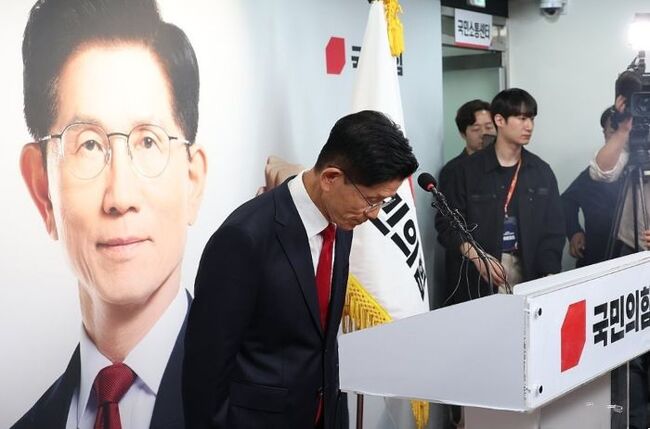 “Too little, too late?…” Kim Moon-soo, who previously conceded his presidential election defeat, now demands a special counsel investigation into ‘allegations of election fraud in the 2025 presidential election’
People Power Party presidential candidate Kim Moon-soo concedes defeat during a press conference at the party headquarters in Yeouido, Seoul, on June 4, 2025. [Joint Press Corps]As allegations emerge
“Too little, too late?…” Kim Moon-soo, who previously conceded his presidential election defeat, now demands a special counsel investigation into ‘allegations of election fraud in the 2025 presidential election’
People Power Party presidential candidate Kim Moon-soo concedes defeat during a press conference at the party headquarters in Yeouido, Seoul, on June 4, 2025. [Joint Press Corps]As allegations emerge
 Stock Market Crash 'Black Tuesday'… KOSPI down 10.8%, KOSDAQ down 7.7%
The KOSPI fell by more than 5% in early trading on the 28th, triggering a sell-side sidecar.On the 28th, the KOSPI plunged by more than 10%.Due to the sharp decline, a sell-side sidecar—a temporary
Stock Market Crash 'Black Tuesday'… KOSPI down 10.8%, KOSDAQ down 7.7%
The KOSPI fell by more than 5% in early trading on the 28th, triggering a sell-side sidecar.On the 28th, the KOSPI plunged by more than 10%.Due to the sharp decline, a sell-side sidecar—a temporary
 [World Heritage Committee] 25 New World Heritage Sites Inscribed in Busan… South Korea Successfully Expands 'Getbol' Listing
The Chairperson of the World Heritage Committee speaks at the plenary session of the 48th session of the World Heritage Committee, held at BEXCO in Busan on the 20th. [Photo: Yonhap News]A total of 25
[World Heritage Committee] 25 New World Heritage Sites Inscribed in Busan… South Korea Successfully Expands 'Getbol' Listing
The Chairperson of the World Heritage Committee speaks at the plenary session of the 48th session of the World Heritage Committee, held at BEXCO in Busan on the 20th. [Photo: Yonhap News]A total of 25
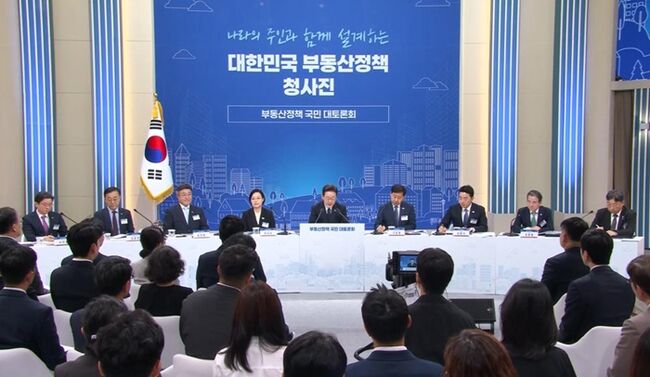 [Liberal Democratic Party Statement] Calling it a Grand Real Estate Debate… It Was Nothing More Than a Private Party Among Themselves
The 'National Grand Debate on Real Estate Policy' held on July 23rd and 27th. [Photo=Yonhap News]The 'National Grand Debate on Real Estate Policy,' hosted by the Lee Jae-myung administration under the
[Liberal Democratic Party Statement] Calling it a Grand Real Estate Debate… It Was Nothing More Than a Private Party Among Themselves
The 'National Grand Debate on Real Estate Policy' held on July 23rd and 27th. [Photo=Yonhap News]The 'National Grand Debate on Real Estate Policy,' hosted by the Lee Jae-myung administration under the
 [Photo] Evidence of Election Fraud Flooding U.S. Media… Trump Had 2.7 Million Votes Stolen
 [Video] U.S. Semiquincentennial Air Show... 'Art in the Sky' streaks across New York
 [Editorial Cartoon] A Draconian Law That Undermines Freedom of Expression

 List
List