Nvidia logo. AFP=Yonhap News
While U.S. President Donald Trump has decided to allow Nvidia's advanced artificial intelligence (AI) chip, the 'H200,' to be exported to China, voices of concern are growing in the U.S. Congress that this decision will harm the nation's strategic interests, the Financial Times (FT) reported on the 12th (local time).
In a recent letter to Secretary of Commerce Howard Rutnik, Chairman John Moolenaar (Republican, Michigan) of the House Select Committee on the Strategic Competition Between the United States and the Chinese Communist Party expressed concern that "approving the sale of cutting-edge chips to Chinese companies risks undermining the significant strategic advantage achieved during President Trump's first term," adding, "Allowing China to purchase millions of chips that are more advanced than their domestic alternatives will hinder President Trump's efforts to maintain U.S. dominance in the AI industry."
Moolenaar questioned the basis for the decision to allow the export of the H200 to China and demanded an explanation from Secretary Rutnik.
Nvidia, which has long hoped to expand semiconductor exports to China, argued that China is making breakthroughs, such as Huawei developing an AI chip comparable in performance to Nvidia's, the '910C,' despite U.S. export restrictions. Nvidia is reported to have persuaded President Trump by arguing that it would be more beneficial for maintaining U.S. AI superiority to make China dependent on advanced U.S. semiconductor chips, thus obtaining this export approval.
However, Moolenaar asserted that Nvidia had exaggerated the performance of Huawei's AI chip for lobbying purposes, suggesting that the premise for the decision to approve H200 exports was flawed.
He emphasized that while Huawei's 910C chip was produced by Taiwan's TSMC and not in mainland China, this fact was not adequately reflected in the current judgment.
Due to the U.S. Department of Commerce's export control violation ruling, Huawei can no longer commission TSMC to produce its next-generation chip, the 910D.
Consequently, Huawei will have to produce the 910D chip in mainland China, which means the 910D chip will inevitably be less powerful than its predecessor, the 910C, Moolenaar pointed out.
Although Huawei is recognized globally as a company with excellent semiconductor design capabilities, it relies on foundry companies for semiconductor manufacturing.
Moolenaar also cited recent reports that DeepSeek, a leading Chinese AI company, relies on smuggled Nvidia chips for AI model training as evidence that China's 'AI semiconductor rise' is being overestimated.
Voices of concern regarding the approval of H200 exports to China are emerging across the U.S. Congress, spanning both Democrats and Republicans.
Six senators, including Republican Pete Ricketts, Chairman of the Senate Foreign Relations Subcommittee on East Asia, the Pacific, and International Cybersecurity Policy, and Democratic Whip Chris Coons, recently introduced a bill to ban the export of the H200 to China for 30 months.
If this bill is enacted, exports of the H200 and the most advanced AI chip, Blackwell, to China will be prohibited.
While concerns about the approval of H200 exports to China are also high within the ruling Republican party, public criticism is being restrained to avoid appearing to oppose President Trump.
The FT reported, "According to several individuals familiar with discussions within Congress, Republicans are also greatly disappointed with this decision but are hesitant to criticize it, fearing a backlash from President Trump."

 [Statement by the Seo-beo-kka Korea Military Academy Save-the-Nation Comrades Association] ㉛ Recount the Votes Publicly, as the Previous Recount Concealed Election Fraud
Tongyeong Mayoral Election Recount [Photo=Yonhap News]South Korea's liberal democracy is dying. The National Election Commission (NEC) and the judiciary, which have plummeted into criminal syndicates
[Statement by the Seo-beo-kka Korea Military Academy Save-the-Nation Comrades Association] ㉛ Recount the Votes Publicly, as the Previous Recount Concealed Election Fraud
Tongyeong Mayoral Election Recount [Photo=Yonhap News]South Korea's liberal democracy is dying. The National Election Commission (NEC) and the judiciary, which have plummeted into criminal syndicates
 What is the significance of the "Trump 2028" red hats that keep making a comeback?
It is noteworthy that President Donald Trump is "intentionally" fueling controversy over whether he can actually run in the 2028 presidential election, even though it is "highly likely he is seriously
What is the significance of the "Trump 2028" red hats that keep making a comeback?
It is noteworthy that President Donald Trump is "intentionally" fueling controversy over whether he can actually run in the 2028 presidential election, even though it is "highly likely he is seriously
 Jin Cummings: “North Korea says it will increase the number of spies, so what is the government doing?”
U.S. political columnist Gene Cummings has publicly questioned the South Korean government, asking, "North Korea is declaring that it will increase its number of spies, so what is the South Kore
Jin Cummings: “North Korea says it will increase the number of spies, so what is the government doing?”
U.S. political columnist Gene Cummings has publicly questioned the South Korean government, asking, "North Korea is declaring that it will increase its number of spies, so what is the South Kore
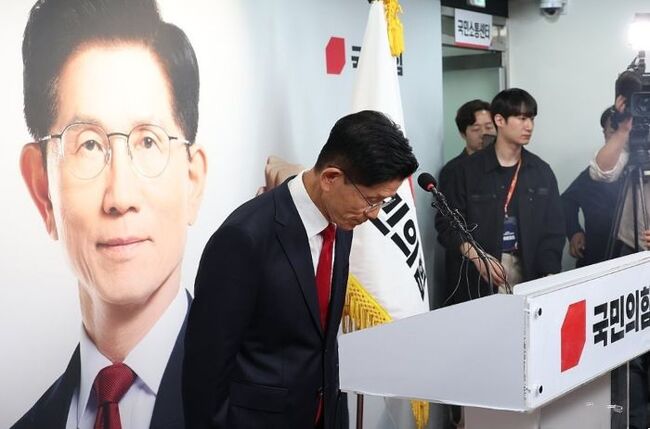 “Too little, too late?…” Kim Moon-soo, who previously conceded his presidential election defeat, now demands a special counsel investigation into ‘allegations of election fraud in the 2025 presidential election’
People Power Party presidential candidate Kim Moon-soo concedes defeat during a press conference at the party headquarters in Yeouido, Seoul, on June 4, 2025. [Joint Press Corps]As allegations emerge
“Too little, too late?…” Kim Moon-soo, who previously conceded his presidential election defeat, now demands a special counsel investigation into ‘allegations of election fraud in the 2025 presidential election’
People Power Party presidential candidate Kim Moon-soo concedes defeat during a press conference at the party headquarters in Yeouido, Seoul, on June 4, 2025. [Joint Press Corps]As allegations emerge
 Stock Market Crash 'Black Tuesday'… KOSPI down 10.8%, KOSDAQ down 7.7%
The KOSPI fell by more than 5% in early trading on the 28th, triggering a sell-side sidecar.On the 28th, the KOSPI plunged by more than 10%.Due to the sharp decline, a sell-side sidecar—a temporary
Stock Market Crash 'Black Tuesday'… KOSPI down 10.8%, KOSDAQ down 7.7%
The KOSPI fell by more than 5% in early trading on the 28th, triggering a sell-side sidecar.On the 28th, the KOSPI plunged by more than 10%.Due to the sharp decline, a sell-side sidecar—a temporary
 [World Heritage Committee] 25 New World Heritage Sites Inscribed in Busan… South Korea Successfully Expands 'Getbol' Listing
The Chairperson of the World Heritage Committee speaks at the plenary session of the 48th session of the World Heritage Committee, held at BEXCO in Busan on the 20th. [Photo: Yonhap News]A total of 25
[World Heritage Committee] 25 New World Heritage Sites Inscribed in Busan… South Korea Successfully Expands 'Getbol' Listing
The Chairperson of the World Heritage Committee speaks at the plenary session of the 48th session of the World Heritage Committee, held at BEXCO in Busan on the 20th. [Photo: Yonhap News]A total of 25
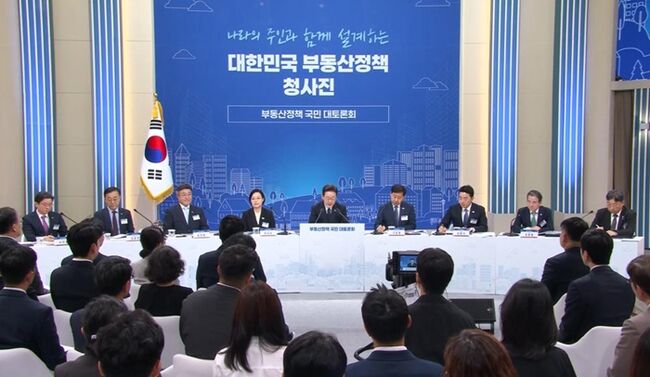 [Liberal Democratic Party Statement] Calling it a Grand Real Estate Debate… It Was Nothing More Than a Private Party Among Themselves
The 'National Grand Debate on Real Estate Policy' held on July 23rd and 27th. [Photo=Yonhap News]The 'National Grand Debate on Real Estate Policy,' hosted by the Lee Jae-myung administration under the
[Liberal Democratic Party Statement] Calling it a Grand Real Estate Debate… It Was Nothing More Than a Private Party Among Themselves
The 'National Grand Debate on Real Estate Policy' held on July 23rd and 27th. [Photo=Yonhap News]The 'National Grand Debate on Real Estate Policy,' hosted by the Lee Jae-myung administration under the
 [Photo] Evidence of Election Fraud Flooding U.S. Media… Trump Had 2.7 Million Votes Stolen
 [Video] U.S. Semiquincentennial Air Show... 'Art in the Sky' streaks across New York
 [Editorial Cartoon] A Draconian Law That Undermines Freedom of Expression

 List
List