Trump's First Term: Reshaping the International Political Landscape to 'Great Power Competition'
Biden institutionalizes alliances as partners for joint response and burden sharing
Trump's Second Term: Less Persuasion of Allies, More Transactional and Demanding Language
이 시리즈는 지난 8년간 발표된 미국 국가안보전략(NSS) 문서를 바탕으로, 미국 안보전략이 어떤 단계적 변화를 거쳐 왔는지를 구조적으로 해설하기 위해 기획됐다. 해법을 제시하기보다, 무엇이 이미 바뀌었는지를 문서와 정책 신호를 통해 정리하는 데 초점을 맞췄다. 판단의 근거가 된 국가안보전략 원문은 독자가 직접 확인할 수 있도록 참조 문서로 함께 제시한다. <편집자 주>
The National Security Strategy (NSS) report, a top-tier US foreign and security policy guidance document, released on December 5, 2025 (local time). The cover of the NSS report.
[Table of Contents]
① Continuity from Trump to Biden to Trump through the NSS
② Policy Signals from Trump's Second Term Security Strategy
③ Where Does the Crisis Management Deterrence Strategy Lead?
④ What Changes Apply to the Korean Peninsula?
Continuity from Trump → Biden → Trump as Read Through the US National Security Strategy (NSS) Document
Although the US National Security Strategy appears to be a document rewritten with each change of administration, it is an area with strong continuity rather than discontinuity due to the change of administration.
In particular, reading the National Security Strategy reports published since 2017 consecutively reveals that the uncertainties surrounding Northeast Asia and the Korean Peninsula are not the result of spontaneous policy changes but are products of a structure that has accumulated incrementally.
The strategic shift initiated during Donald Trump's first administration was codified into institutional and alliance language by the Biden administration, and in Trump's second term, it is moving into a phase of transferring the costs to the allies.
◇ Declaration of a Shift in Direction: Trump's First NSS (2017)
The National Security Strategy published by the Trump administration in 2017 was a document that altered the fundamental premises of US foreign and security policy. If the report from Trump's second term is the general outline, this document is the foundational paper for projecting the specific details.
This report effectively declared the end of America's role as the "manager of the liberal international order" that had been maintained since the Cold War, and it redefined the basic structure of international politics as "Great Power Competition."
China and Russia were no longer objects of cooperation and integration but were explicitly designated as strategic competitors structurally challenging US interests and values.
A particularly noteworthy aspect is the change in the perception of alliances.
While Trump's first NSS did not deny alliances, it did not consider alliances as objects of moral responsibility that the US had to unilaterally protect. It clearly presented the logic that alliances are a means to amplify US power, and to maintain their effectiveness, allies must bear greater responsibility. This signaled that the Cold War-era notion of automatic intervention in case of contingencies, such as war, was no longer valid, going beyond defense cost-sharing or expanded roles.
This document did not presuppose war.
Instead, what was repeatedly emphasized was "deterrence," "maintaining superiority," and "victory in competition." The US made it clear that while it would maintain order, it had no intention of unconditionally bearing the costs. The essence of Trump's first NSS lay not in the detailed policy content but in the shift of direction.
◇ Institutionalization and Alliance-Building: Biden's NSS (2022)
The National Security Strategy published by the Biden administration in 2022 presented a stark contrast to the Trump era in terms of language and format. It placed the confrontation between democracy and authoritarianism at the forefront, with democratic values, a rules-based order, and alliance restoration as its core tenets. On the surface, this appeared to be an attempt to correct the unilateral diplomacy of the Trump administration and steer the international community back onto a normal course.
However, upon closer examination of the substantive content, the Biden administration's security strategy did not reverse the fundamental shifts initiated in Trump's first term.
China was still the central axis of competition, defined as "the only competitor with both the intent and the capability," while Russia was classified as an immediate threat. Military conflict was to be deterred, but the long-term nature of competition between nations was taken as a given.
Most importantly, the nature of the commitment to alliances.
While the Biden NSS declared the restoration of alliances, it did not codify automatic intervention or unconditional defense in case of contingencies. Instead, alliances were defined as entities for joint response and as partners who must share burdens. Although the rhetoric emphasizing alliances increased, the actual decision-making power remained with the United States. All judgments regarding the timing, method, and intensity of intervention were the US's prerogative, and allies were incorporated into a structure where they performed roles according to those decisions.
In this process, the strategic status of the Korean Peninsula was also redefined.
If, during Trump's first term, the Korean Peninsula was a "strategic battlefield" open to negotiation and transaction regarding North Korean nuclear issues, during the Biden era, it transformed into an "object of management" integrated into the Indo-Pacific strategy. While tensions on the Korean Peninsula were deterred, it is difficult to say that South Korea's strategic autonomy expanded. Rather, as the Korean Peninsula issue was absorbed into the broader US regional strategy, the structure of subordination to US decisions deepened.
◇ Transactionalization and Cost Transfer: Trump's Second Term NSS (2025)
As the title of the introduction, "What is American Strategy?", suggests, this report paradoxically emphasizes the need for strategic space and presents Trump's first National Security Strategy (NSS) as the basis for analysis. It implies that the answer lies there.
In Trump's second term, US strategic rhetoric is returning to a more overt and direct approach.
Defense cost-sharing, expanded roles for allies, the linkage between tariffs and security, and the quantification of contributions are prominently featured. However, this is more accurately viewed as the next phase of an already established structure rather than a shift in direction. The direction changed in the first term, and the system was completed during the Biden era. The remaining issue now is the cost.
A characteristic of Trump's second term is the reduction of strategic debate.
What needs to be done has already been decided; the core issue now is who will bear how much of the burden. This explains why persuasion of allies is decreasing and the language of transactions and demands is increasing. This is not about denying the alliances themselves but rather a process of reordering alliances from the perspective of costs and benefits.
◇ A Structure Traversing Three Periods
Looking more closely reveals a single structural formula that permeates these three phases.
Trump's first term declared a shift in the direction of US security strategy, Biden codified that shift into the language of institutions and alliances, and Trump's second term has entered a phase of transferring the costs of that to the allies.
Despite differences in expression, the core strategic axis of the United States has remained consistent. The promise of automatic intervention in case of contingencies has not been restored, and the option still rests with the United States.
◇ Korea's Time Lag and Illusion
Korea has paid the price for failing to read these strategic intentions of the United States.
The Moon Jae-in administration interpreted the Trump administration as a temporary and exceptional case and did not respond adequately. During the Biden era, it mistook the rhetoric of "restoring values and alliances" for an actual change in strategy.
Even with the Lee Jae-myung administration, the tendency to perceive US strategy as a manageable variable has not significantly changed. However, US strategy had already moved to the next stage, and Korea's perception was always one step behind.
This can be seen not as a problem of the administration's disposition but as a result of failing to read the phased nature of US security strategy. The United States did not act capriciously. It moved in sequence: first changing direction, then institutionalizing that direction, and finally demanding the costs.
◇ Why is "Interpretation" Necessary Now?
The purpose of this analysis is not to provide a prescription. What Korea needs now is accurate comprehension rather than immediate decision-making. The US National Security Strategy document is not a declaration but more akin to a gradually accumulated blueprint. Before agreeing or disagreeing, it is paramount to understand what this document has enshrined and what gaps it has left. Choices made without sufficient understanding will ultimately incur greater costs.

 [Statement by the Seo-beo-kka Korea Military Academy Save-the-Nation Comrades Association] ㉛ Recount the Votes Publicly, as the Previous Recount Concealed Election Fraud
Tongyeong Mayoral Election Recount [Photo=Yonhap News]South Korea's liberal democracy is dying. The National Election Commission (NEC) and the judiciary, which have plummeted into criminal syndicates
[Statement by the Seo-beo-kka Korea Military Academy Save-the-Nation Comrades Association] ㉛ Recount the Votes Publicly, as the Previous Recount Concealed Election Fraud
Tongyeong Mayoral Election Recount [Photo=Yonhap News]South Korea's liberal democracy is dying. The National Election Commission (NEC) and the judiciary, which have plummeted into criminal syndicates
 What is the significance of the "Trump 2028" red hats that keep making a comeback?
It is noteworthy that President Donald Trump is "intentionally" fueling controversy over whether he can actually run in the 2028 presidential election, even though it is "highly likely he is seriously
What is the significance of the "Trump 2028" red hats that keep making a comeback?
It is noteworthy that President Donald Trump is "intentionally" fueling controversy over whether he can actually run in the 2028 presidential election, even though it is "highly likely he is seriously
 Jin Cummings: “North Korea says it will increase the number of spies, so what is the government doing?”
U.S. political columnist Gene Cummings has publicly questioned the South Korean government, asking, "North Korea is declaring that it will increase its number of spies, so what is the South Kore
Jin Cummings: “North Korea says it will increase the number of spies, so what is the government doing?”
U.S. political columnist Gene Cummings has publicly questioned the South Korean government, asking, "North Korea is declaring that it will increase its number of spies, so what is the South Kore
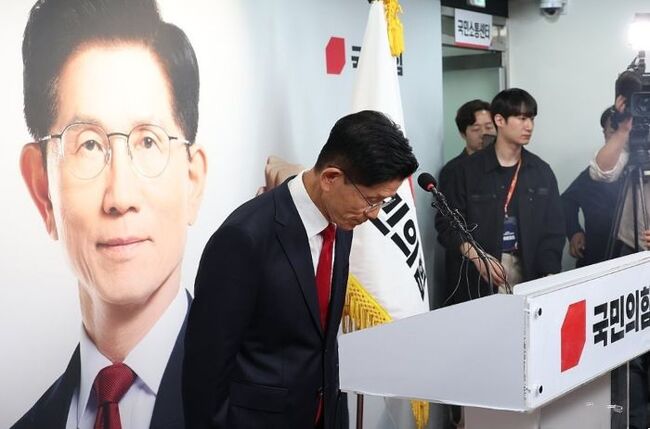 “Too little, too late?…” Kim Moon-soo, who previously conceded his presidential election defeat, now demands a special counsel investigation into ‘allegations of election fraud in the 2025 presidential election’
People Power Party presidential candidate Kim Moon-soo concedes defeat during a press conference at the party headquarters in Yeouido, Seoul, on June 4, 2025. [Joint Press Corps]As allegations emerge
“Too little, too late?…” Kim Moon-soo, who previously conceded his presidential election defeat, now demands a special counsel investigation into ‘allegations of election fraud in the 2025 presidential election’
People Power Party presidential candidate Kim Moon-soo concedes defeat during a press conference at the party headquarters in Yeouido, Seoul, on June 4, 2025. [Joint Press Corps]As allegations emerge
 Stock Market Crash 'Black Tuesday'… KOSPI down 10.8%, KOSDAQ down 7.7%
The KOSPI fell by more than 5% in early trading on the 28th, triggering a sell-side sidecar.On the 28th, the KOSPI plunged by more than 10%.Due to the sharp decline, a sell-side sidecar—a temporary
Stock Market Crash 'Black Tuesday'… KOSPI down 10.8%, KOSDAQ down 7.7%
The KOSPI fell by more than 5% in early trading on the 28th, triggering a sell-side sidecar.On the 28th, the KOSPI plunged by more than 10%.Due to the sharp decline, a sell-side sidecar—a temporary
 [World Heritage Committee] 25 New World Heritage Sites Inscribed in Busan… South Korea Successfully Expands 'Getbol' Listing
The Chairperson of the World Heritage Committee speaks at the plenary session of the 48th session of the World Heritage Committee, held at BEXCO in Busan on the 20th. [Photo: Yonhap News]A total of 25
[World Heritage Committee] 25 New World Heritage Sites Inscribed in Busan… South Korea Successfully Expands 'Getbol' Listing
The Chairperson of the World Heritage Committee speaks at the plenary session of the 48th session of the World Heritage Committee, held at BEXCO in Busan on the 20th. [Photo: Yonhap News]A total of 25
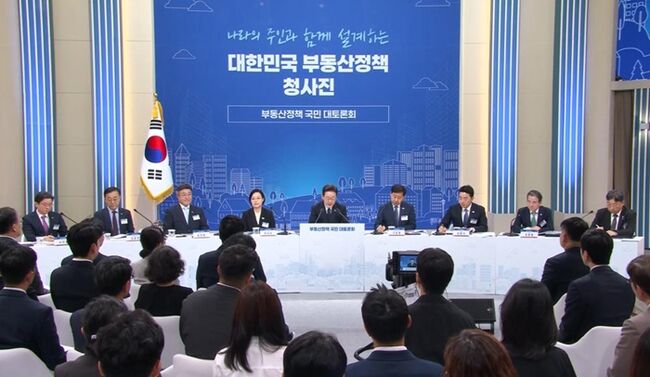 [Liberal Democratic Party Statement] Calling it a Grand Real Estate Debate… It Was Nothing More Than a Private Party Among Themselves
The 'National Grand Debate on Real Estate Policy' held on July 23rd and 27th. [Photo=Yonhap News]The 'National Grand Debate on Real Estate Policy,' hosted by the Lee Jae-myung administration under the
[Liberal Democratic Party Statement] Calling it a Grand Real Estate Debate… It Was Nothing More Than a Private Party Among Themselves
The 'National Grand Debate on Real Estate Policy' held on July 23rd and 27th. [Photo=Yonhap News]The 'National Grand Debate on Real Estate Policy,' hosted by the Lee Jae-myung administration under the
 [Photo] Evidence of Election Fraud Flooding U.S. Media… Trump Had 2.7 Million Votes Stolen
 [Video] U.S. Semiquincentennial Air Show... 'Art in the Sky' streaks across New York
 [Editorial Cartoon] A Draconian Law That Undermines Freedom of Expression

 List
List