The National Center for Cultural Spaces, a public institution under the Ministry of Culture, Sports and Tourism, was established in May with the goal of transforming the Dangin-ri Thermal Power Plant in Seoul into a cultural space. National Center for Cultural Spaces
The Democratic Party of Korea is facing backlash from the arts and culture community for pushing forward with the complete abolition of a newly established public institution and a full cut to the representative's salary, solely because a former government official was appointed as the first representative.
The arts and culture community issued a statement titled "Halt the Dissolution of the National Center for Cultural Spaces and Guarantee the Representative's Term" demanding that "the reduced budget for the National Center for Cultural Spaces for next year be restored to normal, that the representative be allowed to complete their term without undue pressure, and that the innocent employees be guaranteed employment stability."
The statement expressed shock at the dissolution process of the National Center for Cultural Spaces, stating that "a bill to dissolve the National Center for Cultural Spaces, established in 2025, and cut the representative's salary passed the National Assembly's Culture, Sports and Tourism Committee on November 19."
The National Center for Cultural Spaces, a public institution under the Ministry of Culture, Sports and Tourism, was established in May with the aim of transforming the Dangin-ri Thermal Power Plant in Mapo-gu, Seoul, into a cultural space.
This decision, which targets the representative's salary for full elimination from the 3 billion won budget of a public institution launched just six months ago, effectively constitutes an 'organizational dissolution plan' and can be considered a 'second Korea Communications Standards Commission incident'.
One figure from the arts and culture community commented, "Just as the Korea Communications Standards Commission was abolished after the impeachment of Chairperson Lee Jin-sook failed, this is an attempt at a 'targeted' dissolution of a public institution established only half a year ago through next year's government budget proposal." They added, "The next day, the Ministry of Culture, Sports and Tourism's budget proposal also passed the subcommittee of the National Assembly's Special Committee on Budget and Accounts. Since the budget proposals, amounting to tens of trillions of won, are included in the budget proposals of all standing committees, including the Culture, Sports and Tourism Committee, it seems to exploit the difficulty committee members face in verifying each item individually."
The statement concluded, "As seen in the case of the Korea Communications Standards Commission, which was disguised as a new institution after undergoing a dissolution process, and the National Center for Cultural Spaces, which is currently undergoing dissolution procedures, President Lee Jae-myung and the ruling Democratic Party of Korea, now in power, will either hastily create new laws, amend existing laws to favor their factional interests, or eliminate them entirely if they become an obstacle. We will watch to see the ultimate fate of those who engage in such manipulation through methods that lack public consensus."
Meanwhile, the budget proposal for the first year of the Lee Jae-myung administration is a record 728 trillion won.
Below is the joint statement from artists and cultural figures.
Immediately Halt the Dissolution of the National Center for Cultural Spaces and Guarantee the Representative's Term
The dissolution process of the National Center for Cultural Spaces is shocking. It has been revealed that a bill stating, "There is a need to dissolve the National Center for Cultural Spaces, established in 2025, transfer its projects to similar public institutions, and cut the representative's salary," passed the National Assembly's Culture, Sports and Tourism Committee on November 19.
Without a budget, an institution cannot function. It is, in effect, being starved to death. Dissolving an institution that launched in May and is actively pursuing various projects simply because its representative is a figure disliked by the left is akin to letting a newborn baby die out of dislike.
Such a heinous act of completely eliminating an institution because of a disliked individual was not even seen during the military authoritarian political era, which the leftists so vehemently criticized.
When a group that clamored for democratization seizes power, does it aim to create a just world, or does it seek to consolidate power and engage in financial gains for its core members? They portray their democratization movement as if it were an independence struggle, but was it not merely a deceptive strategy solely aimed at seizing power?
The National Center for Cultural Spaces, tasked with converting part of the inactive Dangin-ri Thermal Power Plant into a complex cultural space, is a newly established organization that launched in May of this year.
However, the Democratic Party of Korea and other leftist factions are garnering opposition, claiming that the appointed representative spearheaded the 'blacklist' operations during their tenure at the Ministry of Culture, Sports and Tourism. Despite intimidation and comprehensive pressure to resign, when the representative continued their duties, they resorted to the extreme measure of dissolving the entire center.
Ultimately, as seen in the case of the Korea Communications Standards Commission, which was disguised as a new institution after undergoing a dissolution process, and the National Center for Cultural Spaces, which is currently undergoing dissolution procedures, President Lee Jae-myung and the ruling Democratic Party of Korea, now in power, will either hastily create new laws, amend existing laws to favor their factional interests, or eliminate them entirely if they become an obstacle.
In society, when disputes cannot be resolved, people say, "Let's leave it to the law," trusting that the law will judge fairly and justly. This is because there is a belief that the law will always render a fair and just judgment.
However, in today's South Korea, the law is torn apart and trampled upon, as if it were the private property of a specific group. When criticizing adversarial forces, legal provisions are cited, and when defending themselves, they argue that the law is being unfairly applied. It is common for them to criticize prosecutors for being blamed for their crimes and even reject court rulings, claiming their actions are not criminal. The law, which should be fair to everyone, is being manipulated according to the needs of a particular faction.
If the law is being twisted from a tool that protects individuals into a means of attacking specific people, can it be called a society governed by law? We are witnessing a reality where the law has become a weapon and serves as a tool for dictatorship.
Besides the representative, 14 other employees work at the National Center for Cultural Spaces. What fault do they bear for participating in the center's work based on their beliefs and judgments? Should innocent employees be sacrificed absurdly simply because the representative becomes a target of political attacks?
As concerning as the safety of the 14 employees is the cowardice of the Democratic Party of Korea and the Lee Jae-myung administration, which is leading this dissolution effort. I will watch to see the ultimate fate of those who hide behind the pretense of ignorance, engaging in petty, malicious manipulation through methods that lack public consensus.
We demand the following:
- Restore the reduced budget for the National Center for Cultural Spaces for next year to normal.
- Cease baseless accusations and pressure against the specific individual and allow them to complete their designated term.
- Guarantee employment stability for the innocent employees. The majority of the employees are experienced professionals who left their previous jobs with enthusiasm for the work at the Dangin-ri Cultural Creation and Development Center and joined with confidence in the center's establishment. The dissolution of the center is a betrayal by the government and a massacre for the employees who joined believing in its future. Guarantee the employment stability of the employees.
Kwak Tae-soo, Director, Daegu Sports Council
Kwon Sang-ju, Secretary-General, Gwon Clan Association
Kim Kwang-dong, Former Chairman, Truth and Reconciliation Commission
Kim Gyu-na, Novelist
Kim Myung-hee, Representative, Hanatour Seongju Branch
Kim Yu-han, Representative, Gridal
Kim Jong-seong, Representative, Godo Art Planning
Baek Eun-gil, Representative, GVS Co., Ltd.
Son Hyung-ki, Former Chairman, Media Solidarity
Shin Sung-dae, Representative, Dongmunseon Publishing
Shim Chae-ryung, Vice Chairwoman, Women's Affairs Committee, People Power Party
Yang Eun-ji, Head of AI Education Division, Korea Digital Convergence Promotion Agency
Yang Hye-sook, President, Korea Performing Arts Institute & Former Professor, Ewha Womans University
Lee Jang-ho, Film Director
Lee Jin-sook, Former Chairperson, Korea Communications Standards Commission
Lee Tae-hyun, Representative, Polo Yacht Co., Ltd.
Jung Joon-mo, Art Curator
Jung Hae-eun, Former Representative, Changsarang
Cho Woo-seok, Cultural Critic & Former KBS Director
Choi Hee-moon, Film Critic & Former Chairman, Korean Film Council
Pyo Byung-kwan, Chairman, Body and Culture Association
Heo Eun-do, Senior Programmer, Rixper Film Festival
Hyun Soon-nam, Chairman, Daegu Dalseo Digital Committee
(In alphabetical order)
Reporter Lim Yo-hee

 [Statement by the Seo-beo-kka Korea Military Academy Save-the-Nation Comrades Association] ㉛ Recount the Votes Publicly, as the Previous Recount Concealed Election Fraud
Tongyeong Mayoral Election Recount [Photo=Yonhap News]South Korea's liberal democracy is dying. The National Election Commission (NEC) and the judiciary, which have plummeted into criminal syndicates
[Statement by the Seo-beo-kka Korea Military Academy Save-the-Nation Comrades Association] ㉛ Recount the Votes Publicly, as the Previous Recount Concealed Election Fraud
Tongyeong Mayoral Election Recount [Photo=Yonhap News]South Korea's liberal democracy is dying. The National Election Commission (NEC) and the judiciary, which have plummeted into criminal syndicates
 What is the significance of the "Trump 2028" red hats that keep making a comeback?
It is noteworthy that President Donald Trump is "intentionally" fueling controversy over whether he can actually run in the 2028 presidential election, even though it is "highly likely he is seriously
What is the significance of the "Trump 2028" red hats that keep making a comeback?
It is noteworthy that President Donald Trump is "intentionally" fueling controversy over whether he can actually run in the 2028 presidential election, even though it is "highly likely he is seriously
 Jin Cummings: “North Korea says it will increase the number of spies, so what is the government doing?”
U.S. political columnist Gene Cummings has publicly questioned the South Korean government, asking, "North Korea is declaring that it will increase its number of spies, so what is the South Kore
Jin Cummings: “North Korea says it will increase the number of spies, so what is the government doing?”
U.S. political columnist Gene Cummings has publicly questioned the South Korean government, asking, "North Korea is declaring that it will increase its number of spies, so what is the South Kore
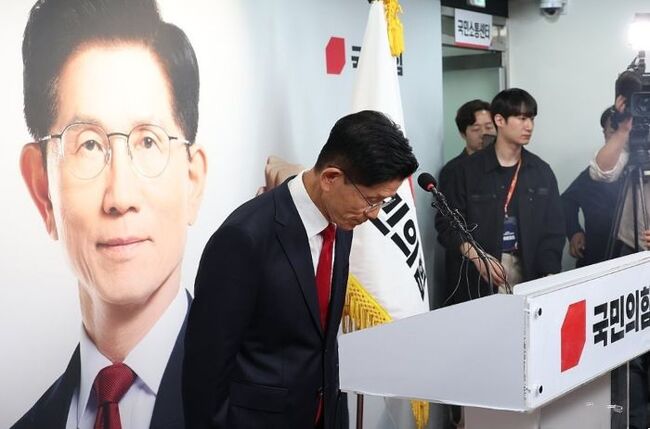 “Too little, too late?…” Kim Moon-soo, who previously conceded his presidential election defeat, now demands a special counsel investigation into ‘allegations of election fraud in the 2025 presidential election’
People Power Party presidential candidate Kim Moon-soo concedes defeat during a press conference at the party headquarters in Yeouido, Seoul, on June 4, 2025. [Joint Press Corps]As allegations emerge
“Too little, too late?…” Kim Moon-soo, who previously conceded his presidential election defeat, now demands a special counsel investigation into ‘allegations of election fraud in the 2025 presidential election’
People Power Party presidential candidate Kim Moon-soo concedes defeat during a press conference at the party headquarters in Yeouido, Seoul, on June 4, 2025. [Joint Press Corps]As allegations emerge
 Stock Market Crash 'Black Tuesday'… KOSPI down 10.8%, KOSDAQ down 7.7%
The KOSPI fell by more than 5% in early trading on the 28th, triggering a sell-side sidecar.On the 28th, the KOSPI plunged by more than 10%.Due to the sharp decline, a sell-side sidecar—a temporary
Stock Market Crash 'Black Tuesday'… KOSPI down 10.8%, KOSDAQ down 7.7%
The KOSPI fell by more than 5% in early trading on the 28th, triggering a sell-side sidecar.On the 28th, the KOSPI plunged by more than 10%.Due to the sharp decline, a sell-side sidecar—a temporary
 [World Heritage Committee] 25 New World Heritage Sites Inscribed in Busan… South Korea Successfully Expands 'Getbol' Listing
The Chairperson of the World Heritage Committee speaks at the plenary session of the 48th session of the World Heritage Committee, held at BEXCO in Busan on the 20th. [Photo: Yonhap News]A total of 25
[World Heritage Committee] 25 New World Heritage Sites Inscribed in Busan… South Korea Successfully Expands 'Getbol' Listing
The Chairperson of the World Heritage Committee speaks at the plenary session of the 48th session of the World Heritage Committee, held at BEXCO in Busan on the 20th. [Photo: Yonhap News]A total of 25
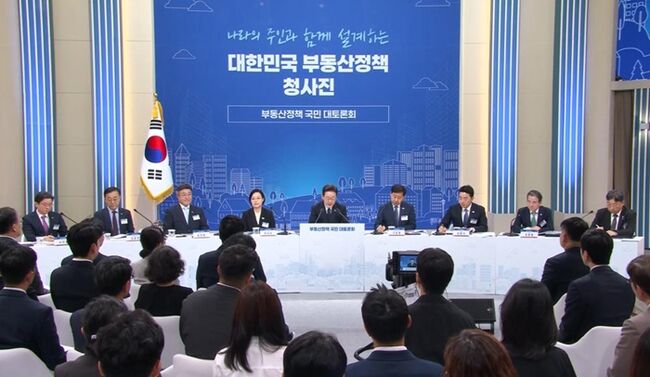 [Liberal Democratic Party Statement] Calling it a Grand Real Estate Debate… It Was Nothing More Than a Private Party Among Themselves
The 'National Grand Debate on Real Estate Policy' held on July 23rd and 27th. [Photo=Yonhap News]The 'National Grand Debate on Real Estate Policy,' hosted by the Lee Jae-myung administration under the
[Liberal Democratic Party Statement] Calling it a Grand Real Estate Debate… It Was Nothing More Than a Private Party Among Themselves
The 'National Grand Debate on Real Estate Policy' held on July 23rd and 27th. [Photo=Yonhap News]The 'National Grand Debate on Real Estate Policy,' hosted by the Lee Jae-myung administration under the
 [Photo] Evidence of Election Fraud Flooding U.S. Media… Trump Had 2.7 Million Votes Stolen
 [Video] U.S. Semiquincentennial Air Show... 'Art in the Sky' streaks across New York
 [Editorial Cartoon] A Draconian Law That Undermines Freedom of Expression

 List
List