U.S. President Trump. Yonhap NewsAfter Strategic Debate, Alliance Management Enters the Accounting Stage
The U.S. security and foreign policy under the second Trump administration is once again being described as having become more aggressive. With explicit demands for cost-sharing in defense, tariff negotiations, and increased contributions and roles from allies, the perception that "Trump-style transactional diplomacy" has been revived is spreading.
However, interpreting this as simply a return to a hardline stance or a matter of personal disposition would be inaccurate. The policy signals from Trump's second term are less about a shift in a new direction and more indicative of a transition to a phase of recouping costs within an already established strategic framework.
△ Signal 1: Defense Cost-Sharing Shifts from "Security Costs" to "Strategic Participation Fees"
The most immediate signal detected in Trump's second term is the change in language regarding defense cost-sharing. While there have been demands for increased contributions in the past, there is a noticeable recent move to redefine these not as mere stationing costs but as a prerequisite for participating in U.S. strategy. Defense costs are increasingly framed not as "payment for being defended by U.S. forces" but closer to "participation fees to be integrated into the order designed by the U.S."
Observing the evolution of Trump's remarks on defense costs, they have shifted from "If they don’t pay, why should we defend them?" to "We are protecting countries that are very rich. Protection is not free." and then to "Pay more or rethink our commitments."
Summarizing this, we see:
"Cost of maintaining alliances (Cold War era ~ Obama) → Commodifying alliance security through cost billing → Conceptualizing security as a 'selective paid service'."
This signifies a transformation of the alliance relationship from one of protection to a kind of partnership. It is a declaration that allies must pay to participate in U.S. strategy. Security and trade have been linked, turning defense costs into participation fees.
△ Signal 2: Combining Tariffs and Security… Securitizing Economic Tools
The second signal is the tendency to directly link tariffs and trade pressure with security. In the second Trump administration, tariffs are utilized not just as a tool of protectionism but as leverage to steer the strategic posture of allies. This is a transactional approach where trade and economic pressure are applied to countries hesitant in security cooperation, while offering incentives such as tariff exemptions or reductions to those who pledge strategic contributions.
This differs from the traditional alliance management approach that separated security and economics. The U.S. no longer permits a structure where "security is shared, but economics are separate" among its allies. The level of security cooperation is directly tied to economic treatment, significantly narrowing the room for negotiation from the allies' perspective.
△ Signal 3: Explicit Demands for Alliance Roles
Another distinct signal emerging in the second Trump administration is the attempt to clearly define the roles of allies. While strategic ambiguity was maintained to some extent in the past, allowing for flexibility in interpreting roles, recent demands are becoming increasingly specific about the missions allies should undertake and their areas of responsibility in particular situations.
This means the U.S. will no longer rely on the autonomous judgment of its allies. Strategic flexibility will be maintained solely as a means to protect U.S. choices, while the independent choices of allies are increasingly curtailed. Consequently, alliances are being reconfigured as functional components that complement U.S. strategy.
△ Signal 4: Reaffirming the Negation of Automatic Intervention Clauses… Protection is a "Choice"
Another core signal repeatedly emphasized in Trump's second term is the firm rejection of the traditional security concept of "automatic intervention in times of crisis." While this had already become strategically entrenched through Trump's first term and the Biden administration, the message has become even more explicit in Trump's second term. The U.S. reiterates its principle of not abandoning alliances but not guaranteeing automatic intervention under any circumstances.
The essence of these signals lies in "management" rather than "deterrence." It is a structure designed to prevent allies from taking U.S. intervention for granted and to compel each nation to bear costs and risks themselves first. In other words, it is closer to a strategy of controlling arising crises in line with U.S. interests rather than deterring them.
△ Signal 5: From "Language of Persuasion" to "Language of Billing"
The most fundamental change in the second Trump administration is the shift in "diplomatic language." The language of values, norms, and shared responsibility, maintained until the Biden era, is rapidly diminishing, replaced by the language of calculation—costs, contributions, and performance. This can be interpreted not as diplomatic rudeness or impulsive expression, but as a strategic judgment that further persuasion is unnecessary within an already institutionalized framework.
From the U.S. perspective, alliances are no longer partners with whom to discuss direction. The direction has already been set, and now it is a matter of confirming who will bear how much of the burden. At this juncture, allies' dissatisfaction or domestic political constraints are no longer considered.
△ What the "Collection Phase" Signifies
The so-called "collection phase" of Trump's second term is not a signal of dismantling alliances. On the contrary, it's quite the opposite. It should be viewed as a strategic step to structurally reduce the U.S. security burden by maintaining the framework of alliances while clearly calculating the associated maintenance costs.
What is important in this phase is the reduced room for negotiation. The stage of discussing strategic direction or principles has passed; only adjustments concerning conditions and costs remain. Therefore, the options for allies are narrowed down to adjustments in the magnitude and method of contributions, rather than a choice between acceptance and rejection.
△ Lingering Questions
U.S. security strategy is now at a stage that prioritizes thorough calculation over debating its direction. It remains uncertain how far this calculation will extend and in which areas its costs will first become visible. The answer to the question, "Will strategy change with a change in administration?" is also still open, though the possibility is very slim.
One thing is clear: the current signals are neither arbitrary nor temporary. They are closer to a warning sound indicating that an already fixed strategic structure has moved to the next stage. The magnitude of the costs that allies will incur can significantly differ depending on how this is interpreted.

 [Statement by the Seo-beo-kka Korea Military Academy Save-the-Nation Comrades Association] ㉛ Recount the Votes Publicly, as the Previous Recount Concealed Election Fraud
Tongyeong Mayoral Election Recount [Photo=Yonhap News]South Korea's liberal democracy is dying. The National Election Commission (NEC) and the judiciary, which have plummeted into criminal syndicates
[Statement by the Seo-beo-kka Korea Military Academy Save-the-Nation Comrades Association] ㉛ Recount the Votes Publicly, as the Previous Recount Concealed Election Fraud
Tongyeong Mayoral Election Recount [Photo=Yonhap News]South Korea's liberal democracy is dying. The National Election Commission (NEC) and the judiciary, which have plummeted into criminal syndicates
 What is the significance of the "Trump 2028" red hats that keep making a comeback?
It is noteworthy that President Donald Trump is "intentionally" fueling controversy over whether he can actually run in the 2028 presidential election, even though it is "highly likely he is seriously
What is the significance of the "Trump 2028" red hats that keep making a comeback?
It is noteworthy that President Donald Trump is "intentionally" fueling controversy over whether he can actually run in the 2028 presidential election, even though it is "highly likely he is seriously
 Jin Cummings: “North Korea says it will increase the number of spies, so what is the government doing?”
U.S. political columnist Gene Cummings has publicly questioned the South Korean government, asking, "North Korea is declaring that it will increase its number of spies, so what is the South Kore
Jin Cummings: “North Korea says it will increase the number of spies, so what is the government doing?”
U.S. political columnist Gene Cummings has publicly questioned the South Korean government, asking, "North Korea is declaring that it will increase its number of spies, so what is the South Kore
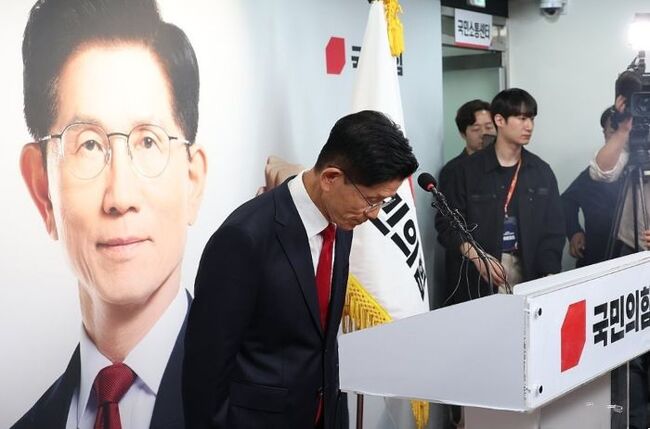 “Too little, too late?…” Kim Moon-soo, who previously conceded his presidential election defeat, now demands a special counsel investigation into ‘allegations of election fraud in the 2025 presidential election’
People Power Party presidential candidate Kim Moon-soo concedes defeat during a press conference at the party headquarters in Yeouido, Seoul, on June 4, 2025. [Joint Press Corps]As allegations emerge
“Too little, too late?…” Kim Moon-soo, who previously conceded his presidential election defeat, now demands a special counsel investigation into ‘allegations of election fraud in the 2025 presidential election’
People Power Party presidential candidate Kim Moon-soo concedes defeat during a press conference at the party headquarters in Yeouido, Seoul, on June 4, 2025. [Joint Press Corps]As allegations emerge
 Stock Market Crash 'Black Tuesday'… KOSPI down 10.8%, KOSDAQ down 7.7%
The KOSPI fell by more than 5% in early trading on the 28th, triggering a sell-side sidecar.On the 28th, the KOSPI plunged by more than 10%.Due to the sharp decline, a sell-side sidecar—a temporary
Stock Market Crash 'Black Tuesday'… KOSPI down 10.8%, KOSDAQ down 7.7%
The KOSPI fell by more than 5% in early trading on the 28th, triggering a sell-side sidecar.On the 28th, the KOSPI plunged by more than 10%.Due to the sharp decline, a sell-side sidecar—a temporary
 [World Heritage Committee] 25 New World Heritage Sites Inscribed in Busan… South Korea Successfully Expands 'Getbol' Listing
The Chairperson of the World Heritage Committee speaks at the plenary session of the 48th session of the World Heritage Committee, held at BEXCO in Busan on the 20th. [Photo: Yonhap News]A total of 25
[World Heritage Committee] 25 New World Heritage Sites Inscribed in Busan… South Korea Successfully Expands 'Getbol' Listing
The Chairperson of the World Heritage Committee speaks at the plenary session of the 48th session of the World Heritage Committee, held at BEXCO in Busan on the 20th. [Photo: Yonhap News]A total of 25
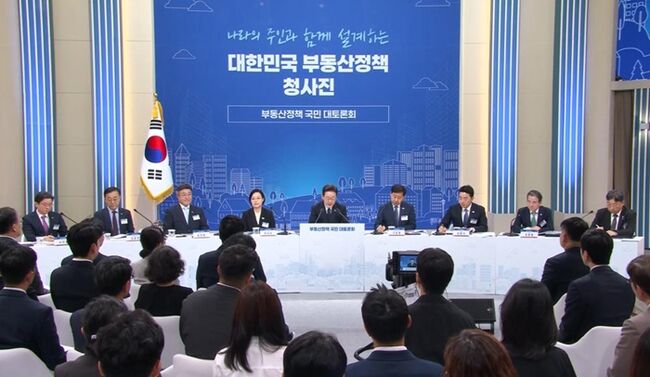 [Liberal Democratic Party Statement] Calling it a Grand Real Estate Debate… It Was Nothing More Than a Private Party Among Themselves
The 'National Grand Debate on Real Estate Policy' held on July 23rd and 27th. [Photo=Yonhap News]The 'National Grand Debate on Real Estate Policy,' hosted by the Lee Jae-myung administration under the
[Liberal Democratic Party Statement] Calling it a Grand Real Estate Debate… It Was Nothing More Than a Private Party Among Themselves
The 'National Grand Debate on Real Estate Policy' held on July 23rd and 27th. [Photo=Yonhap News]The 'National Grand Debate on Real Estate Policy,' hosted by the Lee Jae-myung administration under the
 [Photo] Evidence of Election Fraud Flooding U.S. Media… Trump Had 2.7 Million Votes Stolen
 [Video] U.S. Semiquincentennial Air Show... 'Art in the Sky' streaks across New York
 [Editorial Cartoon] A Draconian Law That Undermines Freedom of Expression

 List
List