U.S. Capitol Building. EPA Yonhap News
A provision in the U.S. National Defense Authorization Act (NDAA) for next year, aimed at preventing the U.S. administration from unilaterally reducing the number of U.S. Forces Korea, was passed by Congress on the 17th (local time).
The Senate passed the NDAA by a vote of 77 in favor and 20 against during a plenary session held that day.
Having passed the House of Representatives on the 10th, the bill will take effect upon President Donald Trump's signature after clearing the Senate hurdle.
The NDAA for next year includes a stipulation that the budget approved through the bill cannot be used to reduce the U.S. troop presence in Korea below the current level of 28,500.
It also states that funds cannot be used to complete the transfer of wartime operational control (OPCON) from the U.S. Forces Korea to a command led by the South Korean military in a manner that deviates from a jointly agreed-upon plan.
However, the bill includes a proviso that the prohibition can be lifted after 60 days if the Secretary of Defense submits to the relevant standing committee confirmation that such a reduction is consistent with U.S. national security interests or that appropriate consultations have been held with allies, including countries that contribute militarily to South Korea, Japan, and the United Nations Command.
The NDAA is an annual bill in which Congress reviews the policies and budget of the Department of Defense (War Department). Such a provision restricting the use of the defense budget for reducing U.S. Forces Korea reappears after five years, during the second term of the Trump administration, having disappeared during the previous Biden administration.
While the NDAA passed during the Biden administration contained the language "maintain approximately 28,500 U.S. service members deployed to South Korea in accordance with the mutual defense treaty," it did not link this to budget usage.
The current NDAA imposes restrictions not only on unilateral reductions of U.S. Forces Korea but also on unilateral reductions of U.S. forces stationed in Europe.
According to The New York Times (NYT), the bill prohibits Secretary of Defense Pete Hegseth from reducing forces stationed or deployed in Europe to below 76,000 for more than 45 days.
Exceptions are made if the Department of Defense consults with North Atlantic Treaty Organization (NATO) allies and demonstrates to Congress that the reduction does not pose a threat to U.S. national security.
Furthermore, the NDAA overcame opposition from far-right Republican lawmakers who have been critical of defense funding from allies, approving an additional $800 million in military aid to Ukraine and hundreds of millions of dollars in additional support to allies and strategic partners such as Israel, Taiwan, and Iraq, according to the NYT.
Notably, amidst a large-scale U.S. military operation against suspected drug trafficking vessels in international waters near Venezuela, controversy has arisen over alleged "war crimes" following a second attack on a vessel on September 2nd, resulting in the killing of survivors. In relation to this, the bill mandates the disclosure of specific orders for attacks and unedited attack footage to Congress.
Failure to comply with this provision will result in a 25% cut in Secretary Hegseth's travel budget.
The defense budget for fiscal year 2026 reflected in this NDAA amounts to $910 billion (approximately 1,330 trillion won), an increase of $8 billion from the administration's initial request.
The bill reflects Congress's bipartisan support for defense spending, including new submarines, fighter jets, and drone technology. It also includes a 3.8% increase in service members' pay.
This NDAA notably repeals the Authorization for Use of Military Force (AUMF), which effectively granted the president the power to declare war during the 1991 Gulf War and the 2002 Iraq War. The AUMF granted the U.S. president the authority to wage war without congressional consent if an imminent attack by an enemy nation against the United States was deemed to be underway.
In addition, the NDAA includes provisions such as the termination of sanctions against Syria, a ban on Diversity, Equity, and Inclusion (DEI) programs, and a reduction in funding for climate-related programs.

 [Statement by the Seo-beo-kka Korea Military Academy Save-the-Nation Comrades Association] ㉛ Recount the Votes Publicly, as the Previous Recount Concealed Election Fraud
Tongyeong Mayoral Election Recount [Photo=Yonhap News]South Korea's liberal democracy is dying. The National Election Commission (NEC) and the judiciary, which have plummeted into criminal syndicates
[Statement by the Seo-beo-kka Korea Military Academy Save-the-Nation Comrades Association] ㉛ Recount the Votes Publicly, as the Previous Recount Concealed Election Fraud
Tongyeong Mayoral Election Recount [Photo=Yonhap News]South Korea's liberal democracy is dying. The National Election Commission (NEC) and the judiciary, which have plummeted into criminal syndicates
 What is the significance of the "Trump 2028" red hats that keep making a comeback?
It is noteworthy that President Donald Trump is "intentionally" fueling controversy over whether he can actually run in the 2028 presidential election, even though it is "highly likely he is seriously
What is the significance of the "Trump 2028" red hats that keep making a comeback?
It is noteworthy that President Donald Trump is "intentionally" fueling controversy over whether he can actually run in the 2028 presidential election, even though it is "highly likely he is seriously
 Jin Cummings: “North Korea says it will increase the number of spies, so what is the government doing?”
U.S. political columnist Gene Cummings has publicly questioned the South Korean government, asking, "North Korea is declaring that it will increase its number of spies, so what is the South Kore
Jin Cummings: “North Korea says it will increase the number of spies, so what is the government doing?”
U.S. political columnist Gene Cummings has publicly questioned the South Korean government, asking, "North Korea is declaring that it will increase its number of spies, so what is the South Kore
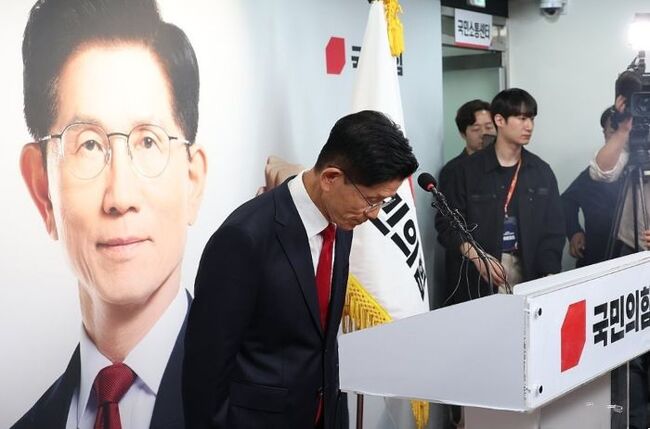 “Too little, too late?…” Kim Moon-soo, who previously conceded his presidential election defeat, now demands a special counsel investigation into ‘allegations of election fraud in the 2025 presidential election’
People Power Party presidential candidate Kim Moon-soo concedes defeat during a press conference at the party headquarters in Yeouido, Seoul, on June 4, 2025. [Joint Press Corps]As allegations emerge
“Too little, too late?…” Kim Moon-soo, who previously conceded his presidential election defeat, now demands a special counsel investigation into ‘allegations of election fraud in the 2025 presidential election’
People Power Party presidential candidate Kim Moon-soo concedes defeat during a press conference at the party headquarters in Yeouido, Seoul, on June 4, 2025. [Joint Press Corps]As allegations emerge
 Stock Market Crash 'Black Tuesday'… KOSPI down 10.8%, KOSDAQ down 7.7%
The KOSPI fell by more than 5% in early trading on the 28th, triggering a sell-side sidecar.On the 28th, the KOSPI plunged by more than 10%.Due to the sharp decline, a sell-side sidecar—a temporary
Stock Market Crash 'Black Tuesday'… KOSPI down 10.8%, KOSDAQ down 7.7%
The KOSPI fell by more than 5% in early trading on the 28th, triggering a sell-side sidecar.On the 28th, the KOSPI plunged by more than 10%.Due to the sharp decline, a sell-side sidecar—a temporary
 [World Heritage Committee] 25 New World Heritage Sites Inscribed in Busan… South Korea Successfully Expands 'Getbol' Listing
The Chairperson of the World Heritage Committee speaks at the plenary session of the 48th session of the World Heritage Committee, held at BEXCO in Busan on the 20th. [Photo: Yonhap News]A total of 25
[World Heritage Committee] 25 New World Heritage Sites Inscribed in Busan… South Korea Successfully Expands 'Getbol' Listing
The Chairperson of the World Heritage Committee speaks at the plenary session of the 48th session of the World Heritage Committee, held at BEXCO in Busan on the 20th. [Photo: Yonhap News]A total of 25
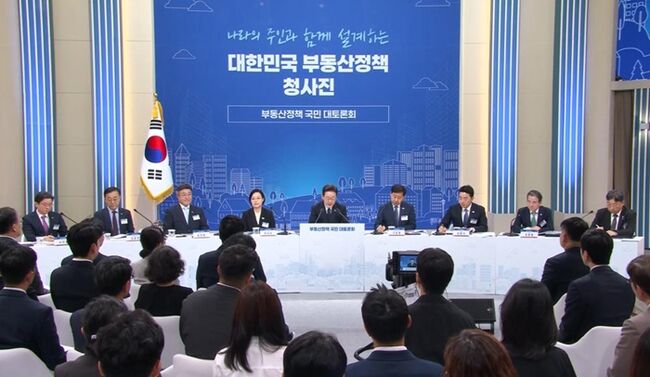 [Liberal Democratic Party Statement] Calling it a Grand Real Estate Debate… It Was Nothing More Than a Private Party Among Themselves
The 'National Grand Debate on Real Estate Policy' held on July 23rd and 27th. [Photo=Yonhap News]The 'National Grand Debate on Real Estate Policy,' hosted by the Lee Jae-myung administration under the
[Liberal Democratic Party Statement] Calling it a Grand Real Estate Debate… It Was Nothing More Than a Private Party Among Themselves
The 'National Grand Debate on Real Estate Policy' held on July 23rd and 27th. [Photo=Yonhap News]The 'National Grand Debate on Real Estate Policy,' hosted by the Lee Jae-myung administration under the
 [Photo] Evidence of Election Fraud Flooding U.S. Media… Trump Had 2.7 Million Votes Stolen
 [Video] U.S. Semiquincentennial Air Show... 'Art in the Sky' streaks across New York
 [Editorial Cartoon] A Draconian Law That Undermines Freedom of Expression

 List
List