Calculate shared costs and responsibilities instead of power expansion to realign order
Alliance Ranking... Crisis Management by Tier Instead of Automatic Intervention
The important thing is where the US will stand in the game it has set up.
이 시리즈는 지난 8년간 발표된 미국 국가안보전략(NSS) 문서를 바탕으로, 미국 안보전략이 어떤 단계적 변화를 거쳐 왔는지를 구조적으로 해설하기 위해 기획됐다. 해법을 제시하기보다, 무엇이 이미 바뀌었는지를 문서와 정책 신호를 통해 정리하는 데 초점을 맞췄다. 판단의 근거가 된 국가안보전략 원문은 독자가 직접 확인할 수 있도록 참조 문서로 함께 제시한다. <편집자 주>
On August 26th, U.S. President Donald Trump shakes hands with President Lee Jae-myung upon his arrival at the White House in Washington D.C. [Photo=Yonhap News]
[Table of Contents]
① Continuity of Trump-Biden-Trump through the NSS
② Policy Signals from Trump's Second Term National Security Strategy
③ Where is the Endpoint of Crisis Management Deterrence Strategy?
④ What Changes if Applied to the Korean Peninsula?
What Remains After the Deal is Done, and the Moment Choice is Forced
The strategy of Trump's second term can be summarized by the term 'cost-charging' allies, meaning 'collecting dues.' However, this is not the end. After shifting strategic direction, institutionalizing it, and passing costs onto allies, U.S. security strategy is now preparing to move to the next stage.
Instead of setting new goals, the U.S. is now focusing on sorting out existing relationships and identifying core partners. It no longer manages all alliances with equal weight and is entering a phase of reclassifying alliances based on roles and responsibilities tied to cost-sharing.
The essence of U.S. strategy after passing costs onto allies is not power expansion. Instead of broadening fronts or increasing interventions, it aims to streamline existing strategic frameworks and maximize efficiency.
This does not signify an abandonment of hegemony, but rather a shift towards maximizing practical benefits by lowering maintenance costs. The U.S. will retain its leadership but will present clear 'deal terms' instead of opaque security promises. It will rebuild the international order by meticulously calculating the roles and responsibilities each country will shoulder, expressed in numbers.
△ Step 1. 'Grading' of Alliances
The first change following the 'dues collection strategy' is the hierarchical ranking of alliances. The single bloc of 'alliance' will break down and be divided into core partners, functional contributors, and temporary cooperation partners.
The criteria for grading will not be democratic values or past history, but rather tangible contributions and actual response capabilities. In this process, some allies will become core members sharing the strategy, while others will be relegated to subcontractor partners performing only specific roles. The level of protection provided by the U.S. will vary according to this grade.
△ Step 2. From Automatic Intervention to Crisis Management
The second characteristic is the change in deterrence methods. The past approach of automatic intervention during crises is no longer the default. The U.S. will now focus on deterrence at a crisis management level. Rather than preempting provocations, the emphasis will be on controlling the spread of crises and reducing costs.
The decision of U.S. intervention will be made conditionally, based on the nature of the incident, the allies' contributions, and U.S. interests. Allies will find themselves in a situation where they must handle the incurred risks themselves, rather than relying on and expecting U.S. protection.
△ Step 3. Integration of Economy, Technology, and Supply Chains is Key
As the U.S. realigns its strategy around national interest, the scope of security will expand comprehensively. Now, not only military and diplomacy, but also the economy, technology, and supply chains themselves are security matters. Tariffs, export controls, and technology standards are no longer secondary tools.
These will become the most powerful tools for aligning allies with U.S. strategy. In the future, the deciding factor between ally and adversary will not be traditional military cooperation. The depth of engagement within the U.S.-led technology and supply chain framework will become the standard for survival.
△ Step 4. 'U.S. Designs, Regions Execute'
The U.S. will focus on designing the overall framework, while the burden of execution will be shifted to regional allies. In the Indo-Pacific, Japan's role will increase, and in Europe, major powers will be mandated to take responsibility for their respective regions.
This solidifies a structure where the U.S. retains leadership from behind, while initial costs and risks are borne by regional nations. This is not about avoiding intervention, but rather about reversing the order of who steps forward first, meaning U.S. intervention becomes the 'last resort'.
△ Step 5. Selective Maintenance of Ambiguity
Interestingly, strategic ambiguity will not disappear entirely. However, this ambiguity will be employed not for the benefit of allies, but to preserve U.S. options.
While the roles allies are expected to play and the costs they must bear will become increasingly clear, when and how the U.S. will intervene will remain shrouded in mystery. This is not to leave room for negotiation, but to assert the U.S.'s exclusive right to judge the situation and make decisions.
△ Questions for South Korea
These steps do not signify the dissolution of alliances. Rather, they represent a process of pragmatically reshaping alliances. However, this change is difficult to reverse.
Once a hierarchy is established and roles are solidified, the level of protection the U.S. will provide in times of crisis will also be determined within that framework. The time to debate the direction of the strategy has passed. What remains is to determine where one will stand within the framework designed by the U.S.
The questions South Korea will face in the future are not simple. It's not just about whether to agree or disagree with the U.S., but about which grade it will be assigned. It will become increasingly clear whether it will remain a core partner, become a contributor for specific tasks, or be classified as a mere management target. This grading will be a harsh report card reflecting the accumulation of past choices.
The U.S. security strategy does not begin with grand new declarations. Quietly but surely, a selection process will be underway to identify who will be considered core partners and who will be excluded.
The reason this process is dangerous is not due to a sudden break in relationships. The real problem is that the changes will occur gradually, as if they are everyday occurrences, leading to costs that are irreversible only when it's too late.
The next phase of U.S. strategy has already begun. The remaining key is when and in what manner its true substance will be fully revealed before our eyes.
It cannot be definitively stated that these prospects will materialize exactly as described. However, in strategic response, proactive analysis that anticipates events is always overwhelmingly more important than post-event interpretation.
In this phase where the U.S. is 'collecting dues' from its allies and prioritizing national interest, understanding the direction of their security strategy will be the starting point for our efforts to survive.

 [Statement by the Seo-beo-kka Korea Military Academy Save-the-Nation Comrades Association] ㉛ Recount the Votes Publicly, as the Previous Recount Concealed Election Fraud
Tongyeong Mayoral Election Recount [Photo=Yonhap News]South Korea's liberal democracy is dying. The National Election Commission (NEC) and the judiciary, which have plummeted into criminal syndicates
[Statement by the Seo-beo-kka Korea Military Academy Save-the-Nation Comrades Association] ㉛ Recount the Votes Publicly, as the Previous Recount Concealed Election Fraud
Tongyeong Mayoral Election Recount [Photo=Yonhap News]South Korea's liberal democracy is dying. The National Election Commission (NEC) and the judiciary, which have plummeted into criminal syndicates
 What is the significance of the "Trump 2028" red hats that keep making a comeback?
It is noteworthy that President Donald Trump is "intentionally" fueling controversy over whether he can actually run in the 2028 presidential election, even though it is "highly likely he is seriously
What is the significance of the "Trump 2028" red hats that keep making a comeback?
It is noteworthy that President Donald Trump is "intentionally" fueling controversy over whether he can actually run in the 2028 presidential election, even though it is "highly likely he is seriously
 Jin Cummings: “North Korea says it will increase the number of spies, so what is the government doing?”
U.S. political columnist Gene Cummings has publicly questioned the South Korean government, asking, "North Korea is declaring that it will increase its number of spies, so what is the South Kore
Jin Cummings: “North Korea says it will increase the number of spies, so what is the government doing?”
U.S. political columnist Gene Cummings has publicly questioned the South Korean government, asking, "North Korea is declaring that it will increase its number of spies, so what is the South Kore
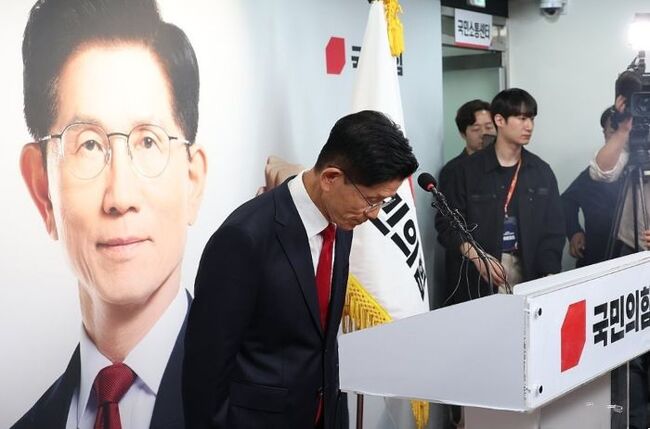 “Too little, too late?…” Kim Moon-soo, who previously conceded his presidential election defeat, now demands a special counsel investigation into ‘allegations of election fraud in the 2025 presidential election’
People Power Party presidential candidate Kim Moon-soo concedes defeat during a press conference at the party headquarters in Yeouido, Seoul, on June 4, 2025. [Joint Press Corps]As allegations emerge
“Too little, too late?…” Kim Moon-soo, who previously conceded his presidential election defeat, now demands a special counsel investigation into ‘allegations of election fraud in the 2025 presidential election’
People Power Party presidential candidate Kim Moon-soo concedes defeat during a press conference at the party headquarters in Yeouido, Seoul, on June 4, 2025. [Joint Press Corps]As allegations emerge
 Stock Market Crash 'Black Tuesday'… KOSPI down 10.8%, KOSDAQ down 7.7%
The KOSPI fell by more than 5% in early trading on the 28th, triggering a sell-side sidecar.On the 28th, the KOSPI plunged by more than 10%.Due to the sharp decline, a sell-side sidecar—a temporary
Stock Market Crash 'Black Tuesday'… KOSPI down 10.8%, KOSDAQ down 7.7%
The KOSPI fell by more than 5% in early trading on the 28th, triggering a sell-side sidecar.On the 28th, the KOSPI plunged by more than 10%.Due to the sharp decline, a sell-side sidecar—a temporary
 [World Heritage Committee] 25 New World Heritage Sites Inscribed in Busan… South Korea Successfully Expands 'Getbol' Listing
The Chairperson of the World Heritage Committee speaks at the plenary session of the 48th session of the World Heritage Committee, held at BEXCO in Busan on the 20th. [Photo: Yonhap News]A total of 25
[World Heritage Committee] 25 New World Heritage Sites Inscribed in Busan… South Korea Successfully Expands 'Getbol' Listing
The Chairperson of the World Heritage Committee speaks at the plenary session of the 48th session of the World Heritage Committee, held at BEXCO in Busan on the 20th. [Photo: Yonhap News]A total of 25
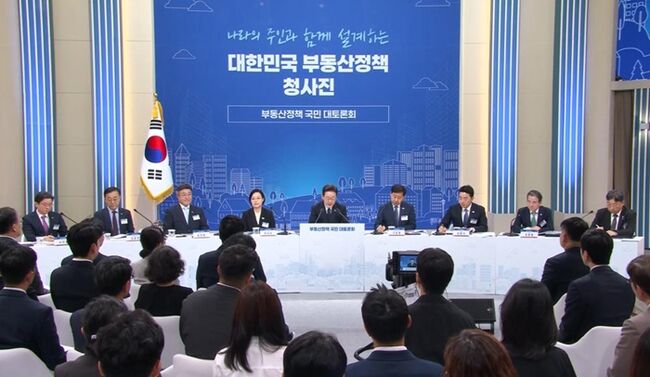 [Liberal Democratic Party Statement] Calling it a Grand Real Estate Debate… It Was Nothing More Than a Private Party Among Themselves
The 'National Grand Debate on Real Estate Policy' held on July 23rd and 27th. [Photo=Yonhap News]The 'National Grand Debate on Real Estate Policy,' hosted by the Lee Jae-myung administration under the
[Liberal Democratic Party Statement] Calling it a Grand Real Estate Debate… It Was Nothing More Than a Private Party Among Themselves
The 'National Grand Debate on Real Estate Policy' held on July 23rd and 27th. [Photo=Yonhap News]The 'National Grand Debate on Real Estate Policy,' hosted by the Lee Jae-myung administration under the
 [Photo] Evidence of Election Fraud Flooding U.S. Media… Trump Had 2.7 Million Votes Stolen
 [Video] U.S. Semiquincentennial Air Show... 'Art in the Sky' streaks across New York
 [Editorial Cartoon] A Draconian Law That Undermines Freedom of Expression

 List
List