- Elevating Civilian Campaign Standards to National Strategy
- Legislation foreshadows debates on power burden and legitimacy
 Prime Minister Kim Boo-kyum is seen conversing with Democratic Party leader Lee Jae-myung and Presidential Chief of Staff Kang Hoon-sik before a meeting at the Prime Minister's official residence in Samcheong-dong, Seoul, on the 21st. [Photo = Yonhap News]
The ruling party, government, and presidential office have decided to promote renewable energy 100% (RE100) industrial complexes as a national strategic task and expedite the enactment of related special legislation. The ruling party, government, and presidential office agreed at a high-level party-government consultation held on the 21st to rapidly proceed with legislation and institutional reforms for the creation of RE100 industrial complexes.
At the consultation, legislative schedules and policy directions for the promotion of RE100 industrial complexes were discussed. It is understood that the party, government, and presidential office reached a consensus on establishing a legal basis for the project through the enactment of a special law and building a national support system including financial aid and special licensing permits. The government plans to simultaneously pursue renewable energy transition and industrial structure reorganization through this initiative.
Kim Yong-beom, Senior Secretary to the President for Economic Affairs, stated in a briefing after the meeting, "RE100 industrial complexes are national strategic tasks that simultaneously pursue energy transition and industrial structure reorganization," and added, "We plan to rapidly proceed with follow-up procedures, including the enactment of a special law."
RE100 is an international campaign for companies to transition to using 100% renewable energy, and it has no legal enforceability. However, as it is used as a supply chain evaluation criterion by global companies and financial markets, there has been increasing pressure on companies, especially exporters, to participate.
Supply chain evaluation criteria refer to internal standards used by finished product companies or global buyers when selecting suppliers, which score factors such as electricity usage, carbon emission levels, and whether renewable energy has been adopted, reflecting these scores in the continuation of transactions and the allocation of volumes. Although these are private standards rather than laws, they operate as de facto transaction conditions, limiting companies' choices.
Upon news of the policy promotion, concerns about electricity cost burdens and supply stability were raised by the industry. While large corporations largely agreed on the necessity of responding to global standards, there were calls for specific measures on how to address the issues of renewable energy unit prices and output volatility. Concerns were also raised that an expansion of renewable energy could lead to increased electricity costs, which in turn could weaken export competitiveness.
Small and medium-sized enterprises (SMEs) and their partners identified the lack of adequate participation conditions as a problem. They pointed out that accessibility to direct renewable energy purchase (PPA) is low, and in a structure where additional costs are difficult to reflect in the supply prices, the burden could effectively be passed on to subcontractors and partners.
The opposition party criticized that there has not been sufficient explanation regarding the background of adopting RE100 industrial complexes as a national strategy and the legitimacy of its standards. Controversy is expected due to the emphasis on legislative speed without clear articulation of the reasons for elevating a private campaign-style standard with no legal enforceability to the level of a national strategy and special law, along with the lack of complementary measures for electricity cost increases, exceptions/buffer regulations for SME participation, and consideration of alternative criteria.
The key issue in the upcoming legislative process is expected to be how to balance industrial competitiveness and cost burdens in the process of elevating a standard that operates as a supply chain transaction condition, though without legal enforceability, to a national strategy and special law.
- 관련기사
-
What do you think of this article?

 [Statement by the Seo-beo-kka Korea Military Academy Save-the-Nation Comrades Association] ㉛ Recount the Votes Publicly, as the Previous Recount Concealed Election Fraud
Tongyeong Mayoral Election Recount [Photo=Yonhap News]South Korea's liberal democracy is dying. The National Election Commission (NEC) and the judiciary, which have plummeted into criminal syndicates
[Statement by the Seo-beo-kka Korea Military Academy Save-the-Nation Comrades Association] ㉛ Recount the Votes Publicly, as the Previous Recount Concealed Election Fraud
Tongyeong Mayoral Election Recount [Photo=Yonhap News]South Korea's liberal democracy is dying. The National Election Commission (NEC) and the judiciary, which have plummeted into criminal syndicates
 What is the significance of the "Trump 2028" red hats that keep making a comeback?
It is noteworthy that President Donald Trump is "intentionally" fueling controversy over whether he can actually run in the 2028 presidential election, even though it is "highly likely he is seriously
What is the significance of the "Trump 2028" red hats that keep making a comeback?
It is noteworthy that President Donald Trump is "intentionally" fueling controversy over whether he can actually run in the 2028 presidential election, even though it is "highly likely he is seriously
 Jin Cummings: “North Korea says it will increase the number of spies, so what is the government doing?”
U.S. political columnist Gene Cummings has publicly questioned the South Korean government, asking, "North Korea is declaring that it will increase its number of spies, so what is the South Kore
Jin Cummings: “North Korea says it will increase the number of spies, so what is the government doing?”
U.S. political columnist Gene Cummings has publicly questioned the South Korean government, asking, "North Korea is declaring that it will increase its number of spies, so what is the South Kore
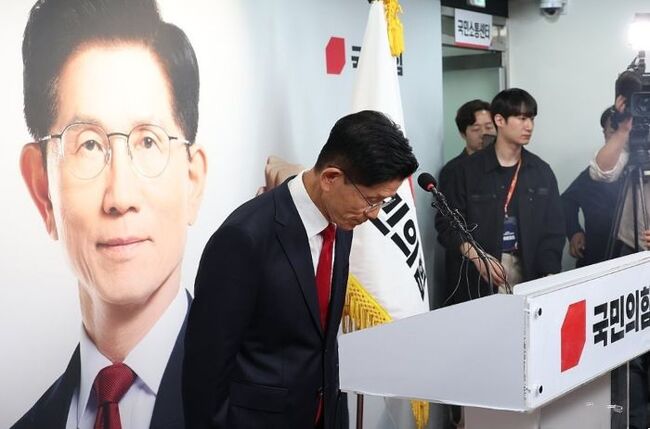 “Too little, too late?…” Kim Moon-soo, who previously conceded his presidential election defeat, now demands a special counsel investigation into ‘allegations of election fraud in the 2025 presidential election’
People Power Party presidential candidate Kim Moon-soo concedes defeat during a press conference at the party headquarters in Yeouido, Seoul, on June 4, 2025. [Joint Press Corps]As allegations emerge
“Too little, too late?…” Kim Moon-soo, who previously conceded his presidential election defeat, now demands a special counsel investigation into ‘allegations of election fraud in the 2025 presidential election’
People Power Party presidential candidate Kim Moon-soo concedes defeat during a press conference at the party headquarters in Yeouido, Seoul, on June 4, 2025. [Joint Press Corps]As allegations emerge
 Stock Market Crash 'Black Tuesday'… KOSPI down 10.8%, KOSDAQ down 7.7%
The KOSPI fell by more than 5% in early trading on the 28th, triggering a sell-side sidecar.On the 28th, the KOSPI plunged by more than 10%.Due to the sharp decline, a sell-side sidecar—a temporary
Stock Market Crash 'Black Tuesday'… KOSPI down 10.8%, KOSDAQ down 7.7%
The KOSPI fell by more than 5% in early trading on the 28th, triggering a sell-side sidecar.On the 28th, the KOSPI plunged by more than 10%.Due to the sharp decline, a sell-side sidecar—a temporary
 [World Heritage Committee] 25 New World Heritage Sites Inscribed in Busan… South Korea Successfully Expands 'Getbol' Listing
The Chairperson of the World Heritage Committee speaks at the plenary session of the 48th session of the World Heritage Committee, held at BEXCO in Busan on the 20th. [Photo: Yonhap News]A total of 25
[World Heritage Committee] 25 New World Heritage Sites Inscribed in Busan… South Korea Successfully Expands 'Getbol' Listing
The Chairperson of the World Heritage Committee speaks at the plenary session of the 48th session of the World Heritage Committee, held at BEXCO in Busan on the 20th. [Photo: Yonhap News]A total of 25
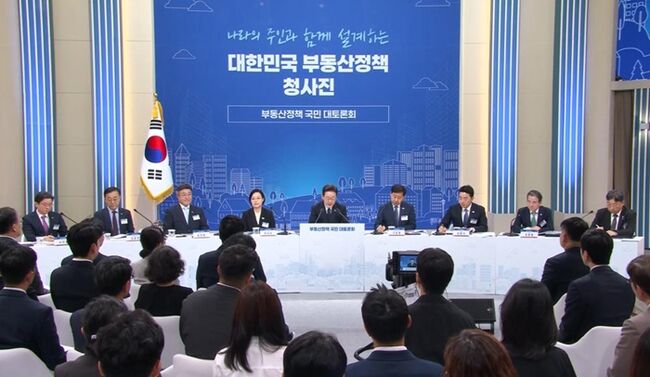 [Liberal Democratic Party Statement] Calling it a Grand Real Estate Debate… It Was Nothing More Than a Private Party Among Themselves
The 'National Grand Debate on Real Estate Policy' held on July 23rd and 27th. [Photo=Yonhap News]The 'National Grand Debate on Real Estate Policy,' hosted by the Lee Jae-myung administration under the
[Liberal Democratic Party Statement] Calling it a Grand Real Estate Debate… It Was Nothing More Than a Private Party Among Themselves
The 'National Grand Debate on Real Estate Policy' held on July 23rd and 27th. [Photo=Yonhap News]The 'National Grand Debate on Real Estate Policy,' hosted by the Lee Jae-myung administration under the
 [Photo] Evidence of Election Fraud Flooding U.S. Media… Trump Had 2.7 Million Votes Stolen
 [Video] U.S. Semiquincentennial Air Show... 'Art in the Sky' streaks across New York
 [Editorial Cartoon] A Draconian Law That Undermines Freedom of Expression

 List
List