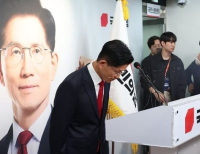
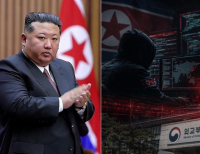
From left, Rep. Scott Fitzgerald (R-Wis.), Joo Byung-ki, Chairman of Korea's Fair Trade Commission, and Rep. Darrell Issa (R-Calif.).Last week, Politico reported, citing three sources, that the U.S. Trade Representative's Office (USTR) canceled its annual meeting with South Korean government officials, citing the South Korean government's pursuit of digital-related measures that the Trump administration views as discriminatory.
The closed-door meeting of the U.S.-Korea Joint Committee, scheduled for Thursday the 18th, was canceled. The committee was established under the 2012 U.S.-Korea Free Trade Agreement (KORUS). Politico noted that this would have been the first Joint Committee meeting since the two countries amended the trade agreement, which reduced U.S. tariffs on South Korean products by 15% in exchange for South Korea's commitment to attract investment and not pursue digital regulations unfavorable to U.S. companies.
Politico stated that this cancellation came "after a controversial National Assembly hearing that targeted Coupang, a major e-commerce company listed on the U.S. stock market that exports U.S. goods to South Korea," and that the U.S. side viewed this as "excessive regulation."
This government decision is drawing attention as it follows warning remarks made by federal lawmakers to South Korea's Fair Trade Commission (KFTC) during a House Judiciary Committee hearing on Tuesday the 16th.
Rep. Darrell Issa (R-Calif.) and Rep. Scott Fitzgerald (R-Wis.) pointed out that South Korea's regulatory stance, particularly the actions of the Fair Trade Commission, have gone beyond the scope of competition policy and devolved into targeted economic pressure against U.S. companies.
Rep. Issa said, "Korea's 'Fair Trade Commission' Chairman Joo Byung-ki is taking America down, and he's taking us down," adding, "He says this: 'So why are so many Americans, especially white working folks in the Rust Belt, so angry?' And I'll tell you why they're angry – because they believe in free and fair trade. The reality is we must now confront the current state of global competitiveness."
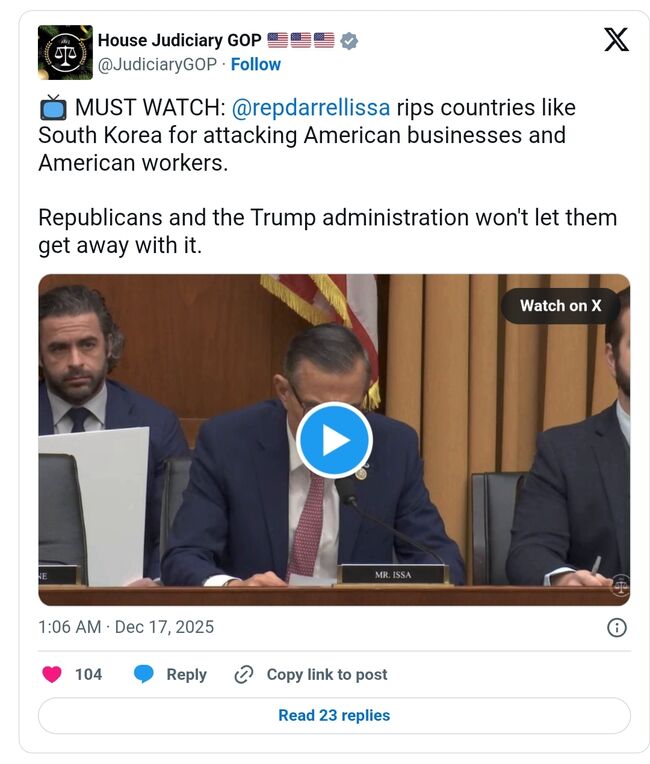
The lawmakers framed the issue not as a technical regulatory dispute but as a matter of fair treatment, reciprocity, and credibility in trade relations.
Rep. Issa criticized Chairman Joo Byung-ki of the Fair Trade Commission for making public remarks that disparaged American workers while pursuing enforcement policies, arguing that such statements and actions reflect a fundamental disregard for the principles underpinning trade relations between the two countries.
Rep. Fitzgerald, who has previously sent warning letters to South Korea's Fair Trade Commission, pointed to economic research indicating that South Korea's approach could result in hundreds of billions of dollars in losses to the U.S. economy, ultimately passing higher costs onto American consumers.
The Republican members of the House Judiciary Committee shared a video of related testimony on X (formerly Twitter), stating, "Progressive countries like South Korea are attacking American businesses to achieve a leftist agenda. President Trump will not let this stand!"
On June 30, approximately 40 Republican lawmakers sent a letter to President Trump urging him to address digital trade barriers with South Korea.
In the letter, the lawmakers urged, "As more comprehensive negotiations with South Korea proceed, we implore the U.S. government to dismantle the remaining barriers that South Korea imposes on American businesses. Doing so will create a fairer competitive environment for American exporters, strengthen supply chains, and ensure continued investment between our countries for the benefit of American industries, consumers, and workers alike."
The lawmakers also noted, "One of the primary obstacles that must be addressed in negotiations is the legislation proposed by the Korea Fair Trade Commission (KFTC) and adopted by the new Lee Jae-myung administration. This bill disproportionately targets American digital companies by strengthening regulatory requirements. Mimicking the EU’s overtly discriminatory Digital Markets Act, this legislation imposes unfair legal and enforcement standards designed to stifle innovative business models and disadvantage successful American companies."
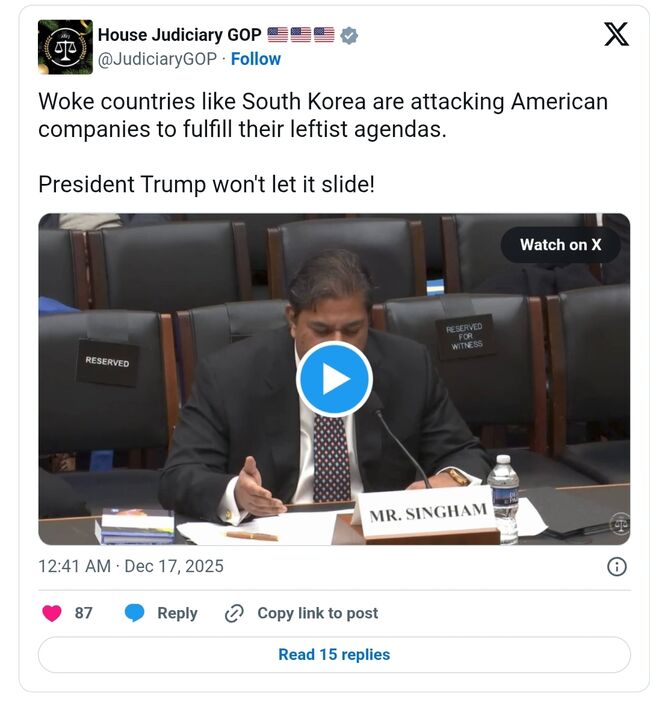
The letter continued, "Furthermore, South Korea has long utilized its competition laws to achieve protectionist ends and foster discriminatory policy outcomes. In recent times, the Korea Fair Trade Commission (KFTC) has been weaponized to achieve these ends. In some instances, this has resulted in unannounced raids on American companies, overly coercive enforcement actions, and threats of criminal prosecution for general industry practices that would not be considered criminal in any other country. Such excessive and arbitrary enforcement of competition law not only leads to unwarranted investigations and unnecessary penalties but also significantly hinders the business operations of American companies in the Korean market."
Major U.S. companies including Google, Apple, Amazon, Meta, Qualcomm, and Tesla have faced repeated sanctions and investigations related to app stores, digital advertising, search rankings, privacy regulations, and platform operations. Industry groups state that South Korea's "network usage fees" and mandatory billing obligations have further exacerbated these imbalances.
Recent moves by the South Korean National Assembly to introduce new digital platform legislation and signals that regulators may continue stringent enforcement were interpreted by U.S. officials as non-compliance rather than negotiation.
The cancellation of the U.S.-Korea Joint Committee meeting was a response to this.
Politico further added that U.S. Trade Representative representative Jamison Greer repeatedly warned South Korean officials that failure to comply with digital trade commitments could lead to investigations under Section 301 of the Trade Act, which could result in new tariffs and retaliatory measures.
It remains to be seen what countermeasures the U.S. will take against South Korea, which, still holding the weapon of tariffs, is seeking to break its promises and regulate American companies.
U.S. NNP=Editor-in-Chief Sung Ku Hong / Special Contribution NNP info@newsandpost.com

 [Statement by the Seo-beo-kka Korea Military Academy Save-the-Nation Comrades Association] ㉛ Recount the Votes Publicly, as the Previous Recount Concealed Election Fraud
Tongyeong Mayoral Election Recount [Photo=Yonhap News]South Korea's liberal democracy is dying. The National Election Commission (NEC) and the judiciary, which have plummeted into criminal syndicates
[Statement by the Seo-beo-kka Korea Military Academy Save-the-Nation Comrades Association] ㉛ Recount the Votes Publicly, as the Previous Recount Concealed Election Fraud
Tongyeong Mayoral Election Recount [Photo=Yonhap News]South Korea's liberal democracy is dying. The National Election Commission (NEC) and the judiciary, which have plummeted into criminal syndicates
 What is the significance of the "Trump 2028" red hats that keep making a comeback?
It is noteworthy that President Donald Trump is "intentionally" fueling controversy over whether he can actually run in the 2028 presidential election, even though it is "highly likely he is seriously
What is the significance of the "Trump 2028" red hats that keep making a comeback?
It is noteworthy that President Donald Trump is "intentionally" fueling controversy over whether he can actually run in the 2028 presidential election, even though it is "highly likely he is seriously
 Jin Cummings: “North Korea says it will increase the number of spies, so what is the government doing?”
U.S. political columnist Gene Cummings has publicly questioned the South Korean government, asking, "North Korea is declaring that it will increase its number of spies, so what is the South Kore
Jin Cummings: “North Korea says it will increase the number of spies, so what is the government doing?”
U.S. political columnist Gene Cummings has publicly questioned the South Korean government, asking, "North Korea is declaring that it will increase its number of spies, so what is the South Kore
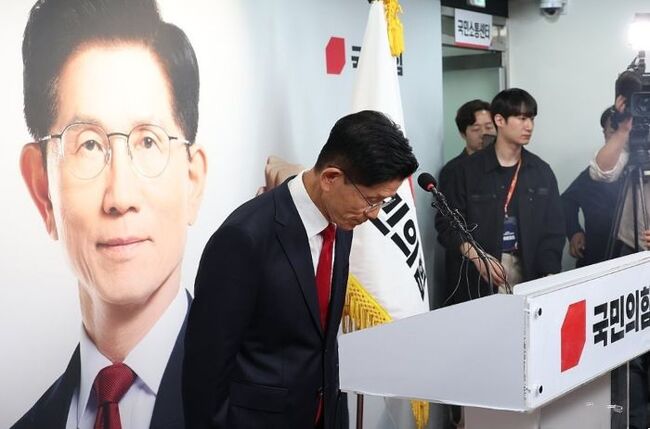 “Too little, too late?…” Kim Moon-soo, who previously conceded his presidential election defeat, now demands a special counsel investigation into ‘allegations of election fraud in the 2025 presidential election’
People Power Party presidential candidate Kim Moon-soo concedes defeat during a press conference at the party headquarters in Yeouido, Seoul, on June 4, 2025. [Joint Press Corps]As allegations emerge
“Too little, too late?…” Kim Moon-soo, who previously conceded his presidential election defeat, now demands a special counsel investigation into ‘allegations of election fraud in the 2025 presidential election’
People Power Party presidential candidate Kim Moon-soo concedes defeat during a press conference at the party headquarters in Yeouido, Seoul, on June 4, 2025. [Joint Press Corps]As allegations emerge
 Stock Market Crash 'Black Tuesday'… KOSPI down 10.8%, KOSDAQ down 7.7%
The KOSPI fell by more than 5% in early trading on the 28th, triggering a sell-side sidecar.On the 28th, the KOSPI plunged by more than 10%.Due to the sharp decline, a sell-side sidecar—a temporary
Stock Market Crash 'Black Tuesday'… KOSPI down 10.8%, KOSDAQ down 7.7%
The KOSPI fell by more than 5% in early trading on the 28th, triggering a sell-side sidecar.On the 28th, the KOSPI plunged by more than 10%.Due to the sharp decline, a sell-side sidecar—a temporary
 [World Heritage Committee] 25 New World Heritage Sites Inscribed in Busan… South Korea Successfully Expands 'Getbol' Listing
The Chairperson of the World Heritage Committee speaks at the plenary session of the 48th session of the World Heritage Committee, held at BEXCO in Busan on the 20th. [Photo: Yonhap News]A total of 25
[World Heritage Committee] 25 New World Heritage Sites Inscribed in Busan… South Korea Successfully Expands 'Getbol' Listing
The Chairperson of the World Heritage Committee speaks at the plenary session of the 48th session of the World Heritage Committee, held at BEXCO in Busan on the 20th. [Photo: Yonhap News]A total of 25
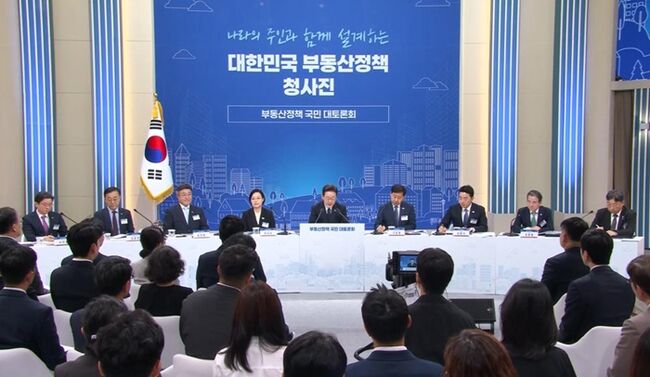 [Liberal Democratic Party Statement] Calling it a Grand Real Estate Debate… It Was Nothing More Than a Private Party Among Themselves
The 'National Grand Debate on Real Estate Policy' held on July 23rd and 27th. [Photo=Yonhap News]The 'National Grand Debate on Real Estate Policy,' hosted by the Lee Jae-myung administration under the
[Liberal Democratic Party Statement] Calling it a Grand Real Estate Debate… It Was Nothing More Than a Private Party Among Themselves
The 'National Grand Debate on Real Estate Policy' held on July 23rd and 27th. [Photo=Yonhap News]The 'National Grand Debate on Real Estate Policy,' hosted by the Lee Jae-myung administration under the
 [Photo] Evidence of Election Fraud Flooding U.S. Media… Trump Had 2.7 Million Votes Stolen
 [Video] U.S. Semiquincentennial Air Show... 'Art in the Sky' streaks across New York
 [Editorial Cartoon] A Draconian Law That Undermines Freedom of Expression

 List
List