President Lee Jae-myung speaking. [Photo=Yonhap News]
The political sphere is abuzz following President Lee Jae-myung's nomination of Lee Hye-hoon as Minister of Planning and Budget on the 28th. This appointment is difficult to explain merely as a gesture of integration or an unconventional personnel choice.
Rather, the interpretation that President Lee's perception of the economy as no longer an asset but a potential political risk, especially in the current situation of overlapping exchange rates, fiscal conditions, and external variables, is the starting point of this nomination is gaining traction.
The reality of the current cabinet and presidential office lacking distinct economic experts also played a role.
In a situation where there is no suitable "economic face" to design policy direction and persuade the market, President Lee's decision to place an external figure in the most sensitive area of budgeting is a choice to diffuse political burden rather than to shoulder the weight of fiscal decisions internally.
The personality of Lee Hye-hoon also aligns with this assessment.
She is neither a core figure in the ruling party nor a close associate of the President. She is a three-term lawmaker from the People Power Party who has emphasized fiscal soundness and budget control.
This point can function as a buffer, allowing the President or the ruling party to avoid direct political responsibility if a "moment to block" arises during future budget formulation processes. This is because they can use "expert judgment" as a shield.
The nomination of Lee Hye-hoon is also a pragmatic card in budget negotiations with the opposition party.
If a member of the ruling party were to lead budget adjustments, it could inevitably devolve into political disputes. However, it is relatively easier for a figure from outside the ruling party to create grounds for compromise. Second, if one considers the second and third supplementary budgets or restructuring phases, this point is not insignificant.
The establishment of relations with the bureaucratic organization is also an important background for this nomination.
By appointing an external figure who is not a bureaucrat to lead the Ministry of Planning and Budget, the presidential office has opted for a strategy of maintaining a certain distance rather than directly controlling the bureaucracy through the ministry. This is a choice that considers both trust and checks and balances, with an underlying calculation to avoid direct confrontation while not fully accepting bureaucratic logic.
A point worth noting is the "possibility of replacement."
The nomination of Lee Hye-hoon is structurally a card that can be replaced at any time. If an economic slowdown or fiscal deterioration becomes more pronounced, a political decision to concentrate responsibility for budget management on a specific individual is also possible.
This again demonstrates that this is a personnel choice made in preparation for uncertainty, rather than during a stable period.
In summary, Lee Hye-hoon's appointment is less a shift in policy direction and more a signal to adjust the operational methods to maintain the current course.
Although the direction has not yet changed, it appears that the administration has reached the conclusion that further acceleration alone is dangerous and that brakes are necessary.
Ultimately, one question remains.
Whether this appointment will be limited to temporary defense or lead to a more comprehensive adjustment of the Lee Jae-myung administration's overall fiscal management.
The choice of Lee Hye-hoon is an appointment that directly poses this question.
By Kim Young

 [Statement by the Seo-beo-kka Korea Military Academy Save-the-Nation Comrades Association] ㉛ Recount the Votes Publicly, as the Previous Recount Concealed Election Fraud
Tongyeong Mayoral Election Recount [Photo=Yonhap News]South Korea's liberal democracy is dying. The National Election Commission (NEC) and the judiciary, which have plummeted into criminal syndicates
[Statement by the Seo-beo-kka Korea Military Academy Save-the-Nation Comrades Association] ㉛ Recount the Votes Publicly, as the Previous Recount Concealed Election Fraud
Tongyeong Mayoral Election Recount [Photo=Yonhap News]South Korea's liberal democracy is dying. The National Election Commission (NEC) and the judiciary, which have plummeted into criminal syndicates
 What is the significance of the "Trump 2028" red hats that keep making a comeback?
It is noteworthy that President Donald Trump is "intentionally" fueling controversy over whether he can actually run in the 2028 presidential election, even though it is "highly likely he is seriously
What is the significance of the "Trump 2028" red hats that keep making a comeback?
It is noteworthy that President Donald Trump is "intentionally" fueling controversy over whether he can actually run in the 2028 presidential election, even though it is "highly likely he is seriously
 Jin Cummings: “North Korea says it will increase the number of spies, so what is the government doing?”
U.S. political columnist Gene Cummings has publicly questioned the South Korean government, asking, "North Korea is declaring that it will increase its number of spies, so what is the South Kore
Jin Cummings: “North Korea says it will increase the number of spies, so what is the government doing?”
U.S. political columnist Gene Cummings has publicly questioned the South Korean government, asking, "North Korea is declaring that it will increase its number of spies, so what is the South Kore
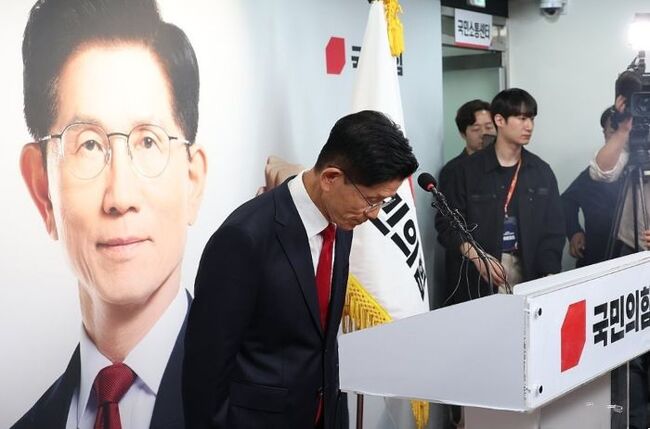 “Too little, too late?…” Kim Moon-soo, who previously conceded his presidential election defeat, now demands a special counsel investigation into ‘allegations of election fraud in the 2025 presidential election’
People Power Party presidential candidate Kim Moon-soo concedes defeat during a press conference at the party headquarters in Yeouido, Seoul, on June 4, 2025. [Joint Press Corps]As allegations emerge
“Too little, too late?…” Kim Moon-soo, who previously conceded his presidential election defeat, now demands a special counsel investigation into ‘allegations of election fraud in the 2025 presidential election’
People Power Party presidential candidate Kim Moon-soo concedes defeat during a press conference at the party headquarters in Yeouido, Seoul, on June 4, 2025. [Joint Press Corps]As allegations emerge
 Stock Market Crash 'Black Tuesday'… KOSPI down 10.8%, KOSDAQ down 7.7%
The KOSPI fell by more than 5% in early trading on the 28th, triggering a sell-side sidecar.On the 28th, the KOSPI plunged by more than 10%.Due to the sharp decline, a sell-side sidecar—a temporary
Stock Market Crash 'Black Tuesday'… KOSPI down 10.8%, KOSDAQ down 7.7%
The KOSPI fell by more than 5% in early trading on the 28th, triggering a sell-side sidecar.On the 28th, the KOSPI plunged by more than 10%.Due to the sharp decline, a sell-side sidecar—a temporary
 [World Heritage Committee] 25 New World Heritage Sites Inscribed in Busan… South Korea Successfully Expands 'Getbol' Listing
The Chairperson of the World Heritage Committee speaks at the plenary session of the 48th session of the World Heritage Committee, held at BEXCO in Busan on the 20th. [Photo: Yonhap News]A total of 25
[World Heritage Committee] 25 New World Heritage Sites Inscribed in Busan… South Korea Successfully Expands 'Getbol' Listing
The Chairperson of the World Heritage Committee speaks at the plenary session of the 48th session of the World Heritage Committee, held at BEXCO in Busan on the 20th. [Photo: Yonhap News]A total of 25
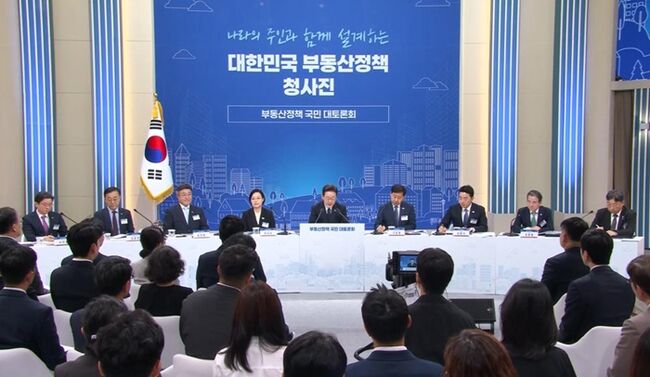 [Liberal Democratic Party Statement] Calling it a Grand Real Estate Debate… It Was Nothing More Than a Private Party Among Themselves
The 'National Grand Debate on Real Estate Policy' held on July 23rd and 27th. [Photo=Yonhap News]The 'National Grand Debate on Real Estate Policy,' hosted by the Lee Jae-myung administration under the
[Liberal Democratic Party Statement] Calling it a Grand Real Estate Debate… It Was Nothing More Than a Private Party Among Themselves
The 'National Grand Debate on Real Estate Policy' held on July 23rd and 27th. [Photo=Yonhap News]The 'National Grand Debate on Real Estate Policy,' hosted by the Lee Jae-myung administration under the
 [Photo] Evidence of Election Fraud Flooding U.S. Media… Trump Had 2.7 Million Votes Stolen
 [Video] U.S. Semiquincentennial Air Show... 'Art in the Sky' streaks across New York
 [Editorial Cartoon] A Draconian Law That Undermines Freedom of Expression

 List
List