High Exchange Rate. Yonhap News
 Editorial Board Member, Class of '80, Korea Military AcademyThe Korean economy is currently caught in a "high exchange rate trap." The exchange rate is not just a number; it's a price tag for national credibility and survival. It's the most rapid indicator of a nation's trustworthiness. When foreign policy, security, and economic policies are out of sync, the market reacts instantly. A high exchange rate is the visible manifestation of a judgment that "this nation finds it difficult to maintain consistent decisions during a crisis." The soaring won-dollar exchange rate is not a simple fluctuation in the foreign exchange market. It is an indicator directly linked to national fiscal stability and existence.
The causes of the high exchange rate are complex. They can be categorized into external factors such as the prolonged high interest rates in the US and a strong dollar, geopolitical instability in the Middle East and Northeast Asia, and increased import costs for energy and raw materials. Internal factors include a decline in national credibility due to heightened security and diplomatic risks and a loss of policy consistency, profligate fiscal management and increasing debt, weakened corporate competitiveness, and a lack of communication with the market.
The problem is that the unusually sensitive reaction of the Korean exchange rate to the same external shocks is difficult to explain by domestic and international environments alone. We cannot escape the diagnosis that the structural fragility of the Korean economy and the decline in government policy credibility have amplified exchange rate volatility.
The high exchange rate is a warning to the current administration. Anti-business regulations such as the Serious Accidents Punishment Act, the Yellow Envelope Act, and amendments to the Commercial Act have increased corporate risk and uncertainty, leading to investment contraction. The government's unpredictable policy stance has encouraged the outflow of foreign capital and the relocation of domestic companies overseas, which has weakened demand for the won. The high exchange rate is a result of the global environment, structural fragility, and security/diplomatic risks arising from the decline in government policy credibility.
A high exchange rate is like "high blood pressure" for the economy. Just as high blood pressure gradually damages organs, a high exchange rate leads the economy into paralysis through a state of chronic fatigue. When the exchange rate rises, import prices increase, and households' real income and purchasing power plummet. If interest rates are raised to control inflation, the economy contracts; if policies are eased to stimulate the economy, the exchange rate becomes unstable again, creating a repeated dilemma. The longer this vicious cycle continues, the more policy consistency wavers, and the market begins to doubt the government's judgment.
While a high exchange rate may offer short-term benefits to exporting companies, it is devastating to domestic demand and import-dependent industries. The rise in energy, food, and raw material prices leads to increased costs for businesses, which in turn translates to higher consumer prices. As households' burden increases due to the high exchange rate, social discontent and conflict also escalate. The majority of the public perceives anti-market economic policies that erode real income and asset values as "economic rebellion."
A high exchange rate is not only detrimental to the economy but also to national security. For Korea, which relies on imports for energy, raw materials, and key components, a rising exchange rate effectively increases the cost of "energy supply in peace and war." Even without a war, the cost of industrial operations and national defense procurement soars, and the real purchasing power of the defense budget significantly weakens. Exchange rate instability reduces the options for monetary policy and limits strategic leverage in diplomatic and security negotiations. Just as high blood pressure can lead to cardiovascular disease, a high exchange rate is a fatal threat that can paralyze industry, consumption, and national security capabilities.
The solution is not short-term measures but rebuilding the economy's fundamental strength through pro-business policies. Just as a fever cannot be cured with antipyretics alone, the root cause must be diagnosed and treated. We must diagnose and eliminate the causes that have brought about the exchange rate crisis.
The high exchange rate is not a temporary market noise. It is a signal that a nation's strength, policy consistency, and crisis response capabilities are all being tested simultaneously. We must pre-emptively assess risks that can arise from the structure of borrowing foreign currency, the timing of repayment, and currency differentials to ensure we can withstand foreign exchange problems safely. We need to regularize and diversify the timing and scale of dollar purchases by institutions and companies, and instead of policies that block the dollar, we must prevent exchange rate쏠림 and rapid fluctuations with safety devices that limit the speed to prevent the exchange rate from running wild.
In the medium to long term, we must increase export capacity by fostering high-value-added industries and technological competitiveness, and accumulate national trust capital through predictable policies. The high exchange rate is not a simple problem to be solved with the antipyretic of foreign exchange market intervention, which is a temporary remedy. It is a warning to simultaneously assess the nation's economic and security capabilities. For issues that cannot be resolved with current capabilities, we must seek international cooperation.
The stage where we could cope with verbal intervention is already past. What is needed now is a shift in perspective to recognize the exchange rate not as a "manageable item" but as a "national system alarm." If, without addressing the root causes, we resort to artificially defending the exchange rate by mobilizing the National Pension Fund, our ultimate future asset, and are then branded as a "currency manipulator," South Korea will descend into a state of anarchy that very day.
We must end the "domestic rebellion" that has plunged the nation into confusion, form a pan-governmental task force to overcome the high exchange rate, and instead of solely blaming external factors, we must inform and seek cooperation from the public, businesses, and the opposition parties regarding the current high exchange rate situation.
If we continue with drastic measures, enacted in secret with next year's local elections in mind, and persist with economic and security policies that run counter to national interests and common sense, not only the current administration but South Korea itself will be in peril.
We urge personnel reshuffling and a comprehensive change in policy direction to accurately diagnose the source of the three-pronged wave (security crisis, high exchange rate, economic slowdown) that is shaking South Korea and the turbulent storms, and to overcome the national crisis and restore government credibility.
Editorial Board Member, Hankyoreh Shinmun

 [Statement by the Seo-beo-kka Korea Military Academy Save-the-Nation Comrades Association] ㉛ Recount the Votes Publicly, as the Previous Recount Concealed Election Fraud
Tongyeong Mayoral Election Recount [Photo=Yonhap News]South Korea's liberal democracy is dying. The National Election Commission (NEC) and the judiciary, which have plummeted into criminal syndicates
[Statement by the Seo-beo-kka Korea Military Academy Save-the-Nation Comrades Association] ㉛ Recount the Votes Publicly, as the Previous Recount Concealed Election Fraud
Tongyeong Mayoral Election Recount [Photo=Yonhap News]South Korea's liberal democracy is dying. The National Election Commission (NEC) and the judiciary, which have plummeted into criminal syndicates
 What is the significance of the "Trump 2028" red hats that keep making a comeback?
It is noteworthy that President Donald Trump is "intentionally" fueling controversy over whether he can actually run in the 2028 presidential election, even though it is "highly likely he is seriously
What is the significance of the "Trump 2028" red hats that keep making a comeback?
It is noteworthy that President Donald Trump is "intentionally" fueling controversy over whether he can actually run in the 2028 presidential election, even though it is "highly likely he is seriously
 Jin Cummings: “North Korea says it will increase the number of spies, so what is the government doing?”
U.S. political columnist Gene Cummings has publicly questioned the South Korean government, asking, "North Korea is declaring that it will increase its number of spies, so what is the South Kore
Jin Cummings: “North Korea says it will increase the number of spies, so what is the government doing?”
U.S. political columnist Gene Cummings has publicly questioned the South Korean government, asking, "North Korea is declaring that it will increase its number of spies, so what is the South Kore
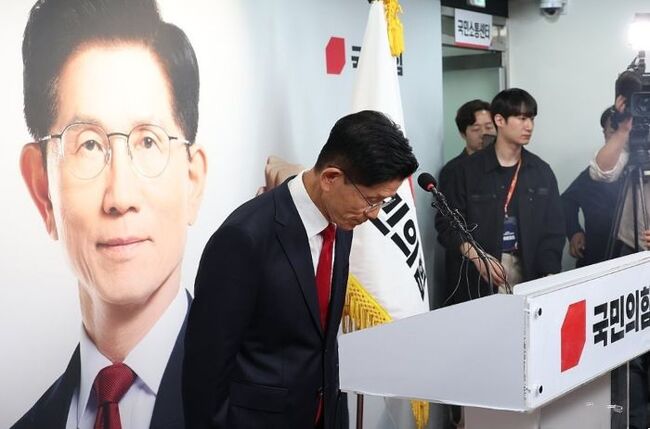 “Too little, too late?…” Kim Moon-soo, who previously conceded his presidential election defeat, now demands a special counsel investigation into ‘allegations of election fraud in the 2025 presidential election’
People Power Party presidential candidate Kim Moon-soo concedes defeat during a press conference at the party headquarters in Yeouido, Seoul, on June 4, 2025. [Joint Press Corps]As allegations emerge
“Too little, too late?…” Kim Moon-soo, who previously conceded his presidential election defeat, now demands a special counsel investigation into ‘allegations of election fraud in the 2025 presidential election’
People Power Party presidential candidate Kim Moon-soo concedes defeat during a press conference at the party headquarters in Yeouido, Seoul, on June 4, 2025. [Joint Press Corps]As allegations emerge
 Stock Market Crash 'Black Tuesday'… KOSPI down 10.8%, KOSDAQ down 7.7%
The KOSPI fell by more than 5% in early trading on the 28th, triggering a sell-side sidecar.On the 28th, the KOSPI plunged by more than 10%.Due to the sharp decline, a sell-side sidecar—a temporary
Stock Market Crash 'Black Tuesday'… KOSPI down 10.8%, KOSDAQ down 7.7%
The KOSPI fell by more than 5% in early trading on the 28th, triggering a sell-side sidecar.On the 28th, the KOSPI plunged by more than 10%.Due to the sharp decline, a sell-side sidecar—a temporary
 [World Heritage Committee] 25 New World Heritage Sites Inscribed in Busan… South Korea Successfully Expands 'Getbol' Listing
The Chairperson of the World Heritage Committee speaks at the plenary session of the 48th session of the World Heritage Committee, held at BEXCO in Busan on the 20th. [Photo: Yonhap News]A total of 25
[World Heritage Committee] 25 New World Heritage Sites Inscribed in Busan… South Korea Successfully Expands 'Getbol' Listing
The Chairperson of the World Heritage Committee speaks at the plenary session of the 48th session of the World Heritage Committee, held at BEXCO in Busan on the 20th. [Photo: Yonhap News]A total of 25
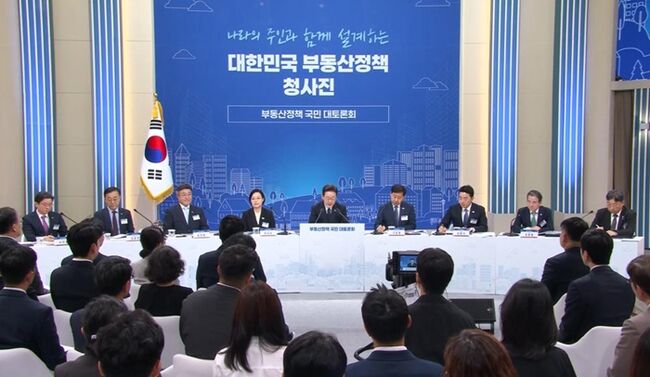 [Liberal Democratic Party Statement] Calling it a Grand Real Estate Debate… It Was Nothing More Than a Private Party Among Themselves
The 'National Grand Debate on Real Estate Policy' held on July 23rd and 27th. [Photo=Yonhap News]The 'National Grand Debate on Real Estate Policy,' hosted by the Lee Jae-myung administration under the
[Liberal Democratic Party Statement] Calling it a Grand Real Estate Debate… It Was Nothing More Than a Private Party Among Themselves
The 'National Grand Debate on Real Estate Policy' held on July 23rd and 27th. [Photo=Yonhap News]The 'National Grand Debate on Real Estate Policy,' hosted by the Lee Jae-myung administration under the
 [Photo] Evidence of Election Fraud Flooding U.S. Media… Trump Had 2.7 Million Votes Stolen
 [Video] U.S. Semiquincentennial Air Show... 'Art in the Sky' streaks across New York
 [Editorial Cartoon] A Draconian Law That Undermines Freedom of Expression

 List
List