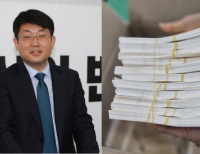
U.S. President Donald Trump released a photo on social media on the 3rd (local time) showing Nicolas Maduro being escorted. Maduro is strongly suspected of involvement in fraudulent elections worldwide, and significant attention is focused on his potential confessions in U.S. courts. [Photo = Trump's Truth Social account]
The Archaic Definition of 'Armed Attack' Revealed by the Venezuela Crisis: A Glimpse into its Flaws
"Who is International Law Truly Protecting?"... We Must Answer This Question Before Placing Blame
The international debate surrounding the U.S. military operation in Venezuela and the arrest of Nicolás Maduro extends beyond a mere diplomatic conflict.
This situation raises a more fundamental question: can international law still adequately explain today's security realities? The question is, "Who is this law truly protecting?"
The international community points to the U.S. actions as "a violation of sovereignty," "lacking justification for the use of force," and "a breach of the UN Charter." However, these criticisms do not address the practical question of the law's purpose of protection.
The concept of an 'armed attack' as defined by the UN Charter was formulated based on the experiences of war in 1945. State-on-state invasions and bombings across national borders were the benchmark.
While this definition served as a minimal safeguard to prevent a repeat of the horrors of World War II, the nature of warfare has fundamentally changed over the past 80 years. Means to collapse nations and societies have emerged without the need for gunfire or bombings, and the scale and persistence of damage are by no means inferior to past total wars.
In the Venezuela crisis, the U.S. justification is drugs. The U.S. has labeled the Maduro regime a "narco-state," claiming that tens of thousands of lives are lost annually in American society through networks protected or abetted by this regime.
The synthetic drug problem, particularly with fentanyl, has moved beyond a public health crisis and is now treated as a national security issue in American politics. Although there are no bombings, if we look solely at the number of deaths, this damage is commensurate with warfare.
However, international law does not recognize this reality as war. This is due to the traditional distinction that drugs are a crime, and crimes are subject to law enforcement, not military response. While this distinction is formally valid, it is gradually losing its persuasiveness when considering the scale and recurrence of the outcomes.
Even if a state does not directly fire a gun, if it facilitates or condones structures that cause persistent mass damage to another society, the question remains whether it is justifiable to define such actions merely as crimes.
The reason international law fails to answer this question is less due to a deficiency in legal doctrine and more due to the United Nations' decision-making process (the Security Council).
If the definition of 'armed attack' in international law were to be expanded to focus on outcomes, the entities most disadvantaged would be those states that have actively utilized hybrid tactics.
Actors who have evaded responsibility through cyberattacks, information warfare, drug and terror networks, and proxy forces are in a more advantageous position the longer current international law is maintained. This is because they can avoid accountability as long as they do not fire a gun, or leave evidence of firing one.
Ironically, the strict formalism of international law has provided more strategic space to states that circumvent rules than to those that diligently adhere to them.
In the era of hybrid warfare, an international order that clings solely to the narrow definition of 'armed attack' effectively legalizes unseen attacks. Damage accumulates, yet any response is invariably criticized as excessive.
At this point, U.S. President Donald Trump's distrust of the UN cannot be seen as a mere deviation.
Rather than outright rejecting the UN, Trump perceived it as a normative system unable to address real-world threats. In his view, the UN was not an organization to prevent war but a structure that blurred responsibility, and a mechanism that protected states circumventing rules while binding those that followed them.
The Venezuela situation exemplifies why Trump's worldview clashes with the UN.
The issue is not whether his choices were correct, but rather that international law's explanatory power has weakened to the point where such choices become possible. When the law fails to keep pace with reality, reality ultimately bypasses the law.
The Venezuela crisis is uncomfortable not because of the roughness of U.S. actions.
It is because, despite international law's inability to explain contemporary threats, it continues to operate as if it were the sole criterion for judgment.
In the era of hybrid warfare, the 1945-style definition of 'armed attack' is being used more often to obscure responsibility than to deter interstate conflict. The logic that no aggression occurs without gunfire, and no attack exists without bombing, ultimately conceals unseen wars.
Five Questions the South Korean President Must Answer
At this juncture, South Korean politics cannot remain aloof. In particular, President Lee Jae-myung must clearly state his position on this situation.
The Venezuela crisis transcends the debate on American unilateralism; it is an event that questions how international law, sovereignty, and the prioritization of citizen protection are being reshaped in the era of hybrid warfare.
This is not merely a diplomatic issue, but a question of the criteria by which a nation will define the lives and safety of its citizens.
President Lee Jae-myung has consistently emphasized the importance of international norms, multilateralism, and the international legal order. If so, we must ask:
△ Will existing international legal frameworks be rigidly adhered to even in situations of mass damage occurring without gunfire?
△ Or will a new security consciousness based on outcomes and responsibilities be considered?
△ To what extent can sovereignty serve as a shield of protection against hybrid threats?
△ When should a nation bear responsibility for intervention?
△ What are South Korea's principles in this regard?
Silence is not neutrality.
In a period of shifting international order, failing to state one's position is not delaying a choice but rather automatically being incorporated into the existing order.
The debate surrounding the Venezuela crisis is not merely a South American issue; it is a test of how South Korea will respond to future threats. This is why President Lee Jae-myung must provide answers.

 [Statement by the Seo-beo-kka Korea Military Academy Save-the-Nation Comrades Association] ㉛ Recount the Votes Publicly, as the Previous Recount Concealed Election Fraud
Tongyeong Mayoral Election Recount [Photo=Yonhap News]South Korea's liberal democracy is dying. The National Election Commission (NEC) and the judiciary, which have plummeted into criminal syndicates
[Statement by the Seo-beo-kka Korea Military Academy Save-the-Nation Comrades Association] ㉛ Recount the Votes Publicly, as the Previous Recount Concealed Election Fraud
Tongyeong Mayoral Election Recount [Photo=Yonhap News]South Korea's liberal democracy is dying. The National Election Commission (NEC) and the judiciary, which have plummeted into criminal syndicates
 What is the significance of the "Trump 2028" red hats that keep making a comeback?
It is noteworthy that President Donald Trump is "intentionally" fueling controversy over whether he can actually run in the 2028 presidential election, even though it is "highly likely he is seriously
What is the significance of the "Trump 2028" red hats that keep making a comeback?
It is noteworthy that President Donald Trump is "intentionally" fueling controversy over whether he can actually run in the 2028 presidential election, even though it is "highly likely he is seriously
 Jin Cummings: "North Korea says it will increase the number of spies, so what is the government doing?"
U.S. political columnist Gene Cummings has publicly questioned the South Korean government, asking, "North Korea is announcing plans to increase its number of spies, yet what is the South Korean
Jin Cummings: "North Korea says it will increase the number of spies, so what is the government doing?"
U.S. political columnist Gene Cummings has publicly questioned the South Korean government, asking, "North Korea is announcing plans to increase its number of spies, yet what is the South Korean
 Attorney Do Tae-woo: “Discrepancies in Voter Count and Improper Sealing Confirmed in Tongyeong Mayoral Recount… Official Request for Additional Verification Submitted to Gyeongnam Election Commission”
A bundle of mail-in early voting ballots captured by lawyer Do Tae-woo at the Tongyeong mayoral election recount site. A clear solid line, raising suspicions of election fraud, is visible on the side
Attorney Do Tae-woo: “Discrepancies in Voter Count and Improper Sealing Confirmed in Tongyeong Mayoral Recount… Official Request for Additional Verification Submitted to Gyeongnam Election Commission”
A bundle of mail-in early voting ballots captured by lawyer Do Tae-woo at the Tongyeong mayoral election recount site. A clear solid line, raising suspicions of election fraud, is visible on the side
 Stock Market Crash 'Black Tuesday'… KOSPI down 10.8%, KOSDAQ down 7.7%
The KOSPI fell by more than 5% in early trading on the 28th, triggering a sell-side sidecar.On the 28th, the KOSPI plunged by more than 10%.Due to the sharp decline, a sell-side sidecar—a temporary
Stock Market Crash 'Black Tuesday'… KOSPI down 10.8%, KOSDAQ down 7.7%
The KOSPI fell by more than 5% in early trading on the 28th, triggering a sell-side sidecar.On the 28th, the KOSPI plunged by more than 10%.Due to the sharp decline, a sell-side sidecar—a temporary
 [World Heritage Committee] 25 New World Heritage Sites Inscribed in Busan… South Korea Successfully Expands 'Getbol' Listing
The Chairperson of the World Heritage Committee speaks at the plenary session of the 48th session of the World Heritage Committee, held at BEXCO in Busan on the 20th. [Photo: Yonhap News]A total of 25
[World Heritage Committee] 25 New World Heritage Sites Inscribed in Busan… South Korea Successfully Expands 'Getbol' Listing
The Chairperson of the World Heritage Committee speaks at the plenary session of the 48th session of the World Heritage Committee, held at BEXCO in Busan on the 20th. [Photo: Yonhap News]A total of 25
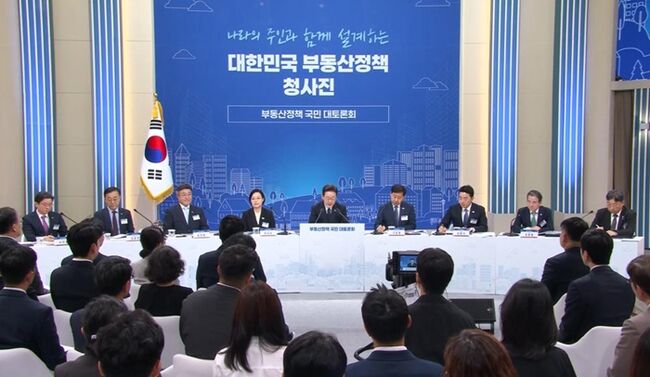 [Liberal Democratic Party Statement] Calling it a Grand Real Estate Debate… It Was Nothing More Than a Private Party Among Themselves
The 'National Grand Debate on Real Estate Policy' held on July 23rd and 27th. [Photo=Yonhap News]The 'National Grand Debate on Real Estate Policy,' hosted by the Lee Jae-myung administration under the
[Liberal Democratic Party Statement] Calling it a Grand Real Estate Debate… It Was Nothing More Than a Private Party Among Themselves
The 'National Grand Debate on Real Estate Policy' held on July 23rd and 27th. [Photo=Yonhap News]The 'National Grand Debate on Real Estate Policy,' hosted by the Lee Jae-myung administration under the
 [Photo] Evidence of Election Fraud Flooding U.S. Media… Trump Had 2.7 Million Votes Stolen
 [Video] U.S. Semiquincentennial Air Show... 'Art in the Sky' streaks across New York
 [Editorial Cartoon] A Draconian Law That Undermines Freedom of Expression

 List
List