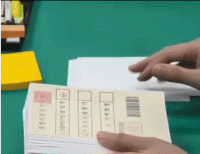
Protesters and police clash in Puerto La Cruz, Venezuela, on July 29, 2024 (local time), opposing the Nicolás Maduro government. [AFP=Yonhap News]
When people talk about why Venezuela collapsed, they usually think of hyperinflation or a dictatorship first. However, the first thing that broke in this country wasn't institutions or numbers. It was the way people perceived time.
When a society functions properly, time flows forward. We believe that working today will make tomorrow slightly better, so we save money, study, and make plans.
People Who Lost Their Tomorrow
The belief that tomorrow will be better than today drives society. However, in Venezuela, this connection has been severed. Today and tomorrow are no longer linked. Society began to function by simply getting through each day.
This phenomenon is not due to poverty. Venezuela was originally a prosperous country. It had abundant oil and a solid middle class. There were schools and hospitals, and urban life was stable. Therefore, the collapse felt less like a slow decline and more like a sudden fall.
The more a society remembers living well in the past, the more painful its current state becomes. While living in the present, people were constantly subjected to comparisons with the past, and these comparisons bred resignation rather than anger.
The first thing to disappear was the habit of thinking about the future. In a normal society, when you receive your salary, you spend some and save some. In Venezuela, this was impossible. On payday, people would immediately withdraw money from the bank and head to the supermarket. This was because prices would rise within a single day.
Leaving money at home meant incurring losses. Saving became a foolish act, and planning became useless. As this repeated, people stopped calculating the future itself. Time shrunk to just "today" and "tomorrow."
The market scene also changed. Some shops in Caracas had no price tags. The prices changed continuously throughout the morning, afternoon, and evening. Before stating the price of an item, the clerk would first check the exchange rate on their mobile phone.
Prices became numbers that were determined only at the moment, not affixed to goods. Grocery shopping became a matter of intuition rather than planning.
"It's the fault of foreign powers, our colonial history, the previous government..."
Unable to properly explain the current problems, the regime constantly brought up the past. Phrases like "foreign intervention," "colonial history," and "previous government's responsibility" were repeated.
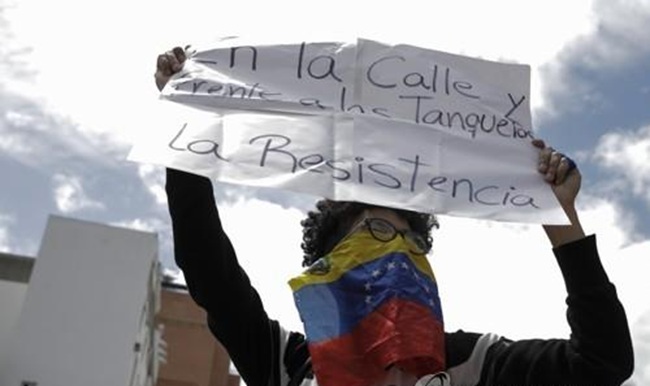 Venezuelan protest against torture in September 2019. [AP=Yonhap News]
The past became a tool to justify the present, rather than something to look back on. People stopped questioning why things had become this way. They simply accepted it with a shrug, saying, "It couldn't be helped." Time ceased to move forward and began to circle in place.
In this process, the meaning of education also crumbled. The structure where those who studied longer lived better lives was broken. Doctors, professors, and engineers drove taxis or sold goods on the street.
This was because street currency exchange or brokerage generated more money than a monthly salary. The problem wasn't the hierarchy of professions, but the disappearance of any reason to prepare for them over the long term. Young people chose jobs that provided immediate cash rather than those that built careers. Society lost its ability to nurture the next generation.
Schools faced a similar situation. The school doors remained open, but teachers were often absent. This was because teachers' salaries were not even enough to cover transportation costs.
Students worried less about absence and more about "whether classes would be held today." Exams were frequently postponed, and graduation timelines became uncertain. Education became a series of stop-and-start activities rather than a continuous accumulation of knowledge.
Life increasingly revolved around the present day. Whether there was food to eat today or medicine to obtain today became the sole focus. Even when doctors were at the hospital, there was no medicine. Antibiotics and chronic disease medications became scarce commodities.
People asked relatives abroad to send medicine. A single bottle of medicine could cost several months' worth of salary. The state failed to fulfill its role, and people relied on their personal connections to survive.
Electricity and water were also frequently cut off. Blackouts and water shortages became the norm, not accidents. People calculated how many hours of electricity they would have today before they worried about what to put in the refrigerator. Laundry and cooking were divided into hourly tasks, not daily schedules. Long-term plans naturally disappeared.
Elections were held, but the results were always the same
The meaning of night also changed. As the sun set, shops closed, and the streets emptied. People debated "which time is most dangerous?" rather than "will tonight be okay?" Safety became a matter of avoidance tactics, not of laws or institutions.
Politics was no different. Elections were held, but the results were always the same. Protests were repeated, but nothing changed. As the experience of time passing without any change accumulated, people disengaged from politics. They may have resented it, but they didn't believe it could be changed. Society moved beyond the stage of fighting to the stage of simply enduring.
Ultimately, the last remaining choice was to leave. The question "When are you leaving?" became a common greeting. Borders became not just geographical boundaries, but lines separating places with a future from those without.
Crossing the border allowed people to make plans again. For those who remained, the country became a space where time stood still. Leaving became a realistic choice, not an act of cowardice.
This impact extended to children. Parents no longer asked their children about their dreams. Instead, they asked, "Where will you go later?" Education became preparation for leaving the country, not for living well within it.
Venezuela's problem is not simply becoming poor. It is becoming unable to think about the future. A society where the belief that efforts will lead to improvement disappears ages first. Fatigue precedes anger, and resignation precedes hope.
A nation is not simply a space with a government. A nation is a mechanism that gives people time to plan for tomorrow. The moment that time is broken, human dignity collapses before money does. What Venezuela has experienced is a clear example of how a society quietly faces defeat.
Poet, Historian & Philosopher, Translator

◆ Songsan
A poet and researcher of history and philosophy, Songsan previously served as the director of the Syngman Rhee Institute and currently works as a research advisor for the Korean Modern and Contemporary History Research Society and the representative of the philosophical forum Lyceum. He has published four poetry collections and co-translated "Hero of Hooko Island." Songsan is a pen name.

 Iranian Foreign Ministry: "Continuing Message Exchanges with the U.S. and Activities of Mediating Countries"
Esmaeil Baghaei, Spokesperson for the Iranian Ministry of Foreign Affairs [Xinhua, Yonhap News file photo]Esmaeil Baghaei, spokesperson for the Iranian Ministry of Foreign Affairs, stated on the 26th
Iranian Foreign Ministry: "Continuing Message Exchanges with the U.S. and Activities of Mediating Countries"
Esmaeil Baghaei, Spokesperson for the Iranian Ministry of Foreign Affairs [Xinhua, Yonhap News file photo]Esmaeil Baghaei, spokesperson for the Iranian Ministry of Foreign Affairs, stated on the 26th
 President Yoon: "Do You Think You Are Safe from the Special Counsel?"... Final Statement Video Released
President Yoon Suk Yeol rebuking the special prosecutor on the 24th. [Court video / @birds_justice X account subtitle GIF] A video of President Yoon Suk Yeol's closing statement at his trial rega
President Yoon: "Do You Think You Are Safe from the Special Counsel?"... Final Statement Video Released
President Yoon Suk Yeol rebuking the special prosecutor on the 24th. [Court video / @birds_justice X account subtitle GIF] A video of President Yoon Suk Yeol's closing statement at his trial rega
 President Yoon, regarding the first-instance ruling on the Public Official Election Act: “An excessive political verdict that distorts the facts… We will appeal immediately.”
The first-instance sentencing hearing for President Yoon Suk Yeol regarding violations of the Public Official Election Act is being broadcast live at Seoul Station on the 27th. [Photo=Yonhap News]Pres
President Yoon, regarding the first-instance ruling on the Public Official Election Act: “An excessive political verdict that distorts the facts… We will appeal immediately.”
The first-instance sentencing hearing for President Yoon Suk Yeol regarding violations of the Public Official Election Act is being broadcast live at Seoul Station on the 27th. [Photo=Yonhap News]Pres
 WSJ: "SK Hynix ADR Premium Is a Sign of AI Trading Overheat"
Advertisement for SK Hynix ADR listing in New York's Times Square [Reuters=Yonhap News file photo]The Wall Street Journal (WSJ) has pointed out that the price of SK Hynix’s American Depositary Recei
WSJ: "SK Hynix ADR Premium Is a Sign of AI Trading Overheat"
Advertisement for SK Hynix ADR listing in New York's Times Square [Reuters=Yonhap News file photo]The Wall Street Journal (WSJ) has pointed out that the price of SK Hynix’s American Depositary Recei
 'Godfather of Japanese Mystery Novels' Keigo Higashino Passes Away After Battle with Cancer at 68
Famous Japanese mystery novelist Keigo Higashino [AFP=Yonhap News]It has been belatedly reported that Keigo Higashino, the "godfather of Japanese mystery novels" and author of bestsellers such as "The
'Godfather of Japanese Mystery Novels' Keigo Higashino Passes Away After Battle with Cancer at 68
Famous Japanese mystery novelist Keigo Higashino [AFP=Yonhap News]It has been belatedly reported that Keigo Higashino, the "godfather of Japanese mystery novels" and author of bestsellers such as "The
 [Park Pil-kyu Security Column] To the Ignorant Trying to Clothe a Beast in Sheep's Clothing
Rep. Kim Byung-joo of the Democratic Party of Korea [Photo=Yonhap News]“The Air Force Academy doesn't teach you how to fly a plane!” “The Army, Navy, and Air Force academies are exactly the
[Park Pil-kyu Security Column] To the Ignorant Trying to Clothe a Beast in Sheep's Clothing
Rep. Kim Byung-joo of the Democratic Party of Korea [Photo=Yonhap News]“The Air Force Academy doesn't teach you how to fly a plane!” “The Army, Navy, and Air Force academies are exactly the
 [Issue Diagnosis] Two Effects of the Election Petition Review
 [Photo] Evidence of Election Fraud Flooding U.S. Media… Trump Had 2.7 Million Votes Stolen
 [Video] U.S. Semiquincentennial Air Show... 'Art in the Sky' streaks across New York
 [Editorial Cartoon] A Draconian Law That Undermines Freedom of Expression

 List
List