The Israeli Arrow-3 missile defense system, adopted by Germany. [AP Yonhap News]
It has been suggested that the reason Israeli Prime Minister Benjamin Netanyahu dissuaded U.S. President Donald Trump from intervening militarily in Iran was due to a vulnerability in Israel's multi-layered air defense network.
On the 18th (local time), the Israeli daily Jerusalem Post pointed out, "Prime Minister Netanyahu pushed President Trump to cancel or postpone an attack on the Iranian regime," and "Iran's inability to prepare for a ballistic missile attack is strongly suggested as a major cause."
As protests against economic hardship, which began on the 28th of last month in Iran, intensified and spread to criticize the theocratic regime, Iranian authorities suppressed them with bloodshed.
This led to speculation that the United States and Israel, seeking to prevent Iran's development of nuclear and ballistic missiles, might oust Iran's Supreme Leader Ayatollah Seyed Ali Khamenei, and President Trump hinted at the possibility of military intervention.
However, Prime Minister Netanyahu adopted a cautious stance.
On the 14th, The New York Times reported that Prime Minister Netanyahu had requested President Trump in a phone call to "delay the plan for a military attack on Iran."
The Jerusalem Post analyzed, "Iran's ballistic missile capabilities have weakened the most in decades," but "Prime Minister Netanyahu felt that the Israeli military had not secured a sufficient quantity of Arrow interceptor missiles to counter the threat."
From a technical standpoint, the Israeli military successfully intercepted approximately 800 Iranian ballistic missiles aimed at Israel in 2024-2025, and Iran's inventory of ballistic missiles and launchers was halved during that period, the Jerusalem Post noted.
However, Israel and the United States spent $1.48 billion to $1.58 billion (approximately 2.2 to 2.3 trillion won) to intercept three airstrikes carried out by Iran during this period with interceptor missiles, and it took time to replenish the stock of interceptor missiles.
The publication suggested that Iran could also rebuild its ballistic missile capabilities during this time, adding, "Netanyahu's thinking would be that Israel could produce Arrow missiles faster than Iran and also secure additional U.S. air defense systems."
The previous day, the U.S. daily Washington Post reported that the dissuasion from regional allies such as Israel, Saudi Arabia, Qatar, and Egypt influenced President Trump's decision to put on hold the option of a military attack on Iran.
What do you think of this article?

 [Statement by the Seo-beo-kka Korea Military Academy Save-the-Nation Comrades Association] ㉛ Recount the Votes Publicly, as the Previous Recount Concealed Election Fraud
Tongyeong Mayoral Election Recount [Photo=Yonhap News]South Korea's liberal democracy is dying. The National Election Commission (NEC) and the judiciary, which have plummeted into criminal syndicates
[Statement by the Seo-beo-kka Korea Military Academy Save-the-Nation Comrades Association] ㉛ Recount the Votes Publicly, as the Previous Recount Concealed Election Fraud
Tongyeong Mayoral Election Recount [Photo=Yonhap News]South Korea's liberal democracy is dying. The National Election Commission (NEC) and the judiciary, which have plummeted into criminal syndicates
 What is the significance of the "Trump 2028" red hats that keep making a comeback?
It is noteworthy that President Donald Trump is "intentionally" fueling controversy over whether he can actually run in the 2028 presidential election, even though it is "highly likely he is seriously
What is the significance of the "Trump 2028" red hats that keep making a comeback?
It is noteworthy that President Donald Trump is "intentionally" fueling controversy over whether he can actually run in the 2028 presidential election, even though it is "highly likely he is seriously
 Jin Cummings: "North Korea says it will increase the number of spies, so what is the government doing?"
U.S. political columnist Gene Cummings has publicly questioned the South Korean government, asking, "North Korea is announcing plans to increase its number of spies, yet what is the South Korean
Jin Cummings: "North Korea says it will increase the number of spies, so what is the government doing?"
U.S. political columnist Gene Cummings has publicly questioned the South Korean government, asking, "North Korea is announcing plans to increase its number of spies, yet what is the South Korean
 Attorney Do Tae-woo: “Discrepancies in Voter Count and Improper Sealing Confirmed in Tongyeong Mayoral Recount… Official Request for Additional Verification Submitted to Gyeongnam Election Commission”
A bundle of mail-in early voting ballots captured by lawyer Do Tae-woo at the Tongyeong mayoral election recount site. A clear solid line, raising suspicions of election fraud, is visible on the side
Attorney Do Tae-woo: “Discrepancies in Voter Count and Improper Sealing Confirmed in Tongyeong Mayoral Recount… Official Request for Additional Verification Submitted to Gyeongnam Election Commission”
A bundle of mail-in early voting ballots captured by lawyer Do Tae-woo at the Tongyeong mayoral election recount site. A clear solid line, raising suspicions of election fraud, is visible on the side
 Stock Market Crash 'Black Tuesday'… KOSPI down 10.8%, KOSDAQ down 7.7%
The KOSPI fell by more than 5% in early trading on the 28th, triggering a sell-side sidecar.On the 28th, the KOSPI plunged by more than 10%.Due to the sharp decline, a sell-side sidecar—a temporary
Stock Market Crash 'Black Tuesday'… KOSPI down 10.8%, KOSDAQ down 7.7%
The KOSPI fell by more than 5% in early trading on the 28th, triggering a sell-side sidecar.On the 28th, the KOSPI plunged by more than 10%.Due to the sharp decline, a sell-side sidecar—a temporary
 [World Heritage Committee] 25 New World Heritage Sites Inscribed in Busan… South Korea Successfully Expands 'Getbol' Listing
The Chairperson of the World Heritage Committee speaks at the plenary session of the 48th session of the World Heritage Committee, held at BEXCO in Busan on the 20th. [Photo: Yonhap News]A total of 25
[World Heritage Committee] 25 New World Heritage Sites Inscribed in Busan… South Korea Successfully Expands 'Getbol' Listing
The Chairperson of the World Heritage Committee speaks at the plenary session of the 48th session of the World Heritage Committee, held at BEXCO in Busan on the 20th. [Photo: Yonhap News]A total of 25
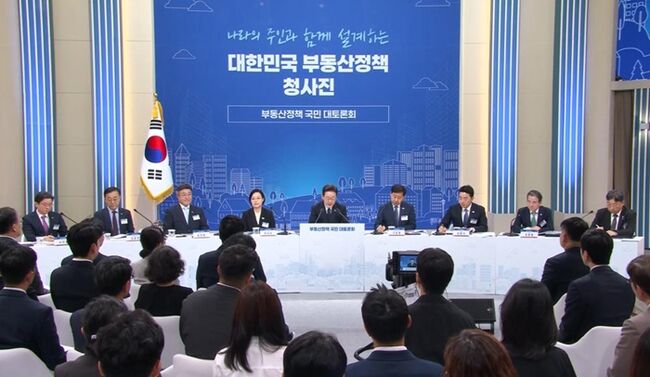 [Liberal Democratic Party Statement] Calling it a Grand Real Estate Debate… It Was Nothing More Than a Private Party Among Themselves
The 'National Grand Debate on Real Estate Policy' held on July 23rd and 27th. [Photo=Yonhap News]The 'National Grand Debate on Real Estate Policy,' hosted by the Lee Jae-myung administration under the
[Liberal Democratic Party Statement] Calling it a Grand Real Estate Debate… It Was Nothing More Than a Private Party Among Themselves
The 'National Grand Debate on Real Estate Policy' held on July 23rd and 27th. [Photo=Yonhap News]The 'National Grand Debate on Real Estate Policy,' hosted by the Lee Jae-myung administration under the
 [Photo] Evidence of Election Fraud Flooding U.S. Media… Trump Had 2.7 Million Votes Stolen
 [Video] U.S. Semiquincentennial Air Show... 'Art in the Sky' streaks across New York
 [Editorial Cartoon] A Draconian Law That Undermines Freedom of Expression

 List
List