 Minister Kim Jeong-kwon (left) and U.S. Secretary of Commerce Howard Lutnick met in August last year. [Photo: Yonhap News]
On the 27th, U.S. President Donald Trump directly mentioned the Korean National Assembly's ratification and referred to a 25% tariff on automobiles.
This led to interpretations in Korea as a "sudden pressure" or a "failure of diplomatic communication."
However, it is clear that this measure is not a new demand or an impromptu response, but one of the actions the U.S. can take after reviewing the implementation of already agreed-upon matters and moving to the execution phase.
Trump's 'Up-Front' Revealed in the Fact Sheet
What is important in understanding this issue is the timeline and the nature of the agreement.
In particular, the core is the "up-front" approach consistently demanded by the Trump administration, which judges relationships based on prior implementation.
Trump-style up-front means determining cooperation and pressure based on whether promises have been fulfilled first, rather than considering political circumstances or phased adjustments after an agreement.
This is clearly revealed in the nature of the ROK-U.S. joint fact sheet, which was released immediately after the agreement between the leaders of the two countries.
This document is not just a joint statement of political declarations or directional guidance, but rather a de facto 'checklist' for the U.S. to review implementation in the future.
Indeed, items such as digital regulations, investment environment, non-discrimination principles, and supply chain cooperation are all structured in a way that allows for implementation to be assessed.
Furthermore, the U.S. warning did not come suddenly as reported by the old media. It proceeded in stages based on the implementation of the fact sheet. We leave it to the reader to judge whether the Korean government ignored it or truly did not know.
Three Warnings from the U.S. Administration
On January 13, U.S. Chargé d'Affaires to Korea, James Heller, sent an official letter to the Korean government urging follow-up implementation of this joint fact sheet.
This was not a diplomatic exchange of opinions, but an official review asking whether the items in the agreement were being translated into actual policies and systems.
Around January 14, U.S. Treasury Secretary Scott Bessent publicly stated that financial and market stability cannot be separated from the implementation of the agreement, citing exchange rate issues.
This was a warning that delays in implementation could spread beyond trade issues to foreign exchange and capital markets.
On January 16, U.S. Secretary of Commerce Howard Lutnick stated, "If you don't invest in America, you have to pay 100% tariffs," explicitly identifying tariffs as an enforcement tool rather than mere negotiation rhetoric.
This statement directly targeted investment issues in strategic industries, including semiconductors. In the context of Trump-style up-front grammar, this was a signal that had already moved beyond the 'stage of words.'
Trump Issues a Fourth Warning... Kim Min-seok Embarrassed by Hotline Remark
After all these warnings were sequentially accumulated, President Trump directly pointed to the Korean National Assembly's failure to ratify and mentioned a 25% tariff on automobiles.
Here too, the core issue was not automobiles. What Trump took issue with was not a specific item, but whether Korea had the institutional will to implement the promises made in the fact sheet.
The focus of responsibility shifted from diplomatic channels to Korea's internal implementation structure.
The reason why Prime Minister Kim Min-seok's remark about "opening a hotline" became controversial in this process is also clear.
This remark was publicized as a diplomatic achievement immediately after meeting with U.S. Vice President J.D. Vance, and the very next day, President Trump directly mentioned ratification and the 25% tariff.
This time gap left the reader with a natural question.
“In a situation where the U.S. is demanding up-front implementation, what kind of hotline is there?”
The problem was not the existence of a hotline, but the use of achievement-oriented language without properly reading the situation.
This is not a cause, but merely evidence of incompetence.
Cheong Wa Dae Substitutes Trump's Ratification Demand with a Special Act
A more fundamental problem is the judgment error by Cheong Wa Dae, which should have coordinated this situation.
The determination of whether to implement ratification, manage the corresponding message to the U.S., and its feasibility are not the responsibilities of individual ministers or the prime minister, but fall within the presidential office's domain.
Nevertheless, Cheong Wa Dae responded to the tariff mention by saying, "We did not fully recognize it."
In addition, the issue of "National Assembly ratification" that President Trump directly raised was substituted with the "special act," which is merely an implementation measure.
This was not managing the issue, but providing a different answer after misunderstanding the question.
Consequently, this was not a diplomatic failure, but an instance that revealed that the ultimate decision-making of state affairs had not functioned.
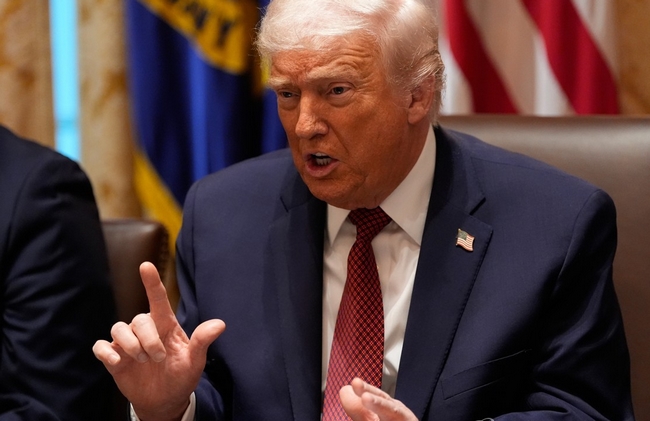 U.S. President Trump. [Photo: Yonhap News]
Trump Wants National Assembly Ratification
What is more noteworthy is the fact that President Trump has repeatedly emphasized that this agreement must last beyond his term.
“This has to last beyond my presidency.”
This suggests that administrative policy measures or temporary legislation are not sufficient, and that political and institutional approval with binding force for the next administration, namely National Assembly ratification, is being considered.
In this context, even if Korea passes a special act, there is still a high possibility that Trump will raise the ratification issue again.
This is because what the U.S. is asking is not the method of implementation, but the more fundamental question of whether Korea is prepared to take responsibility for the agreed-upon matters at the national level.
Questions the Old Media Should Have Asked
Nevertheless, many of Korea's old media outlets still explained this issue as a "failure of diplomatic communication" or a "sudden variable."
Focusing on who met whom and which channels were opened, the essence of the issue – the structure of implementation and execution – was pushed to the backburner.
However, in the Trump-style up-front transaction structure, communication is not a factor that changes the outcome.
A simple formula was at play: if there is no implementation, there will be execution.
The questions the old media should have asked were clear.
"Why does the U.S. prioritize implementation over negotiation?
Why did the fact sheet become an execution standard rather than a declaration?
Why do tariffs, exchange rates, and investments move as a single package?
Why did the government fail to make decisions within that timeline?"
Reporting that omits these questions cannot explain the issue.
This is not only a failure of the government's judgment but also a failure of interpretation by the media, which failed to grasp Trump's transaction grammar and the nature of the fact sheet.
An Incompetent Regime is Irresponsible
What is more important is that this issue is not something that will end with just automobile tariffs.
Items listed in the fact sheet, such as semiconductor investment, supply chain reorganization, exchange rate policy, and digital regulations, still remain. Automobile tariffs are just the beginning.
The fundamental issue is whether Korean society understands the U.S.'s logic of execution, which operates on the premise of up-front implementation.
This tariff statement is not the end, but the beginning.
What the Trump administration is asking is not about automobiles, but whether Korea is prepared to implement already agreed-upon promises.
If, without answering this question, the government only pursues diplomatic events and narratives of communication, it will be a matter of time before we see what becomes the target of the next execution.
At that time, the government may again speak of a 'sudden variable,' but the price of delaying judgment will be borne entirely not by policy officials, but by industries, markets, and the public.
Reporter Kim Young

 Iranian Foreign Ministry: "Continuing Message Exchanges with the U.S. and Activities of Mediating Countries"
Esmaeil Baghaei, Spokesperson for the Iranian Ministry of Foreign Affairs [Xinhua, Yonhap News file photo]Esmaeil Baghaei, spokesperson for the Iranian Ministry of Foreign Affairs, stated on the 26th
Iranian Foreign Ministry: "Continuing Message Exchanges with the U.S. and Activities of Mediating Countries"
Esmaeil Baghaei, Spokesperson for the Iranian Ministry of Foreign Affairs [Xinhua, Yonhap News file photo]Esmaeil Baghaei, spokesperson for the Iranian Ministry of Foreign Affairs, stated on the 26th
 President Yoon: "Do You Think You Are Safe from the Special Counsel?"... Final Statement Video Released
President Yoon Suk Yeol rebuking the special prosecutor on the 24th. [Court video / @birds_justice X account subtitle GIF] A video of President Yoon Suk Yeol's closing statement at his trial rega
President Yoon: "Do You Think You Are Safe from the Special Counsel?"... Final Statement Video Released
President Yoon Suk Yeol rebuking the special prosecutor on the 24th. [Court video / @birds_justice X account subtitle GIF] A video of President Yoon Suk Yeol's closing statement at his trial rega
 President Yoon, regarding the first-instance ruling on the Public Official Election Act: “An excessive political verdict that distorts the facts… We will appeal immediately.”
The first-instance sentencing hearing for President Yoon Suk Yeol regarding violations of the Public Official Election Act is being broadcast live at Seoul Station on the 27th. [Photo=Yonhap News]Pres
President Yoon, regarding the first-instance ruling on the Public Official Election Act: “An excessive political verdict that distorts the facts… We will appeal immediately.”
The first-instance sentencing hearing for President Yoon Suk Yeol regarding violations of the Public Official Election Act is being broadcast live at Seoul Station on the 27th. [Photo=Yonhap News]Pres
 WSJ: "SK Hynix ADR Premium Is a Sign of AI Trading Overheat"
Advertisement for SK Hynix ADR listing in New York's Times Square [Reuters=Yonhap News file photo]The Wall Street Journal (WSJ) has pointed out that the price of SK Hynix’s American Depositary Recei
WSJ: "SK Hynix ADR Premium Is a Sign of AI Trading Overheat"
Advertisement for SK Hynix ADR listing in New York's Times Square [Reuters=Yonhap News file photo]The Wall Street Journal (WSJ) has pointed out that the price of SK Hynix’s American Depositary Recei
 'Godfather of Japanese Mystery Novels' Keigo Higashino Passes Away After Battle with Cancer at 68
Famous Japanese mystery novelist Keigo Higashino [AFP=Yonhap News]It has been belatedly reported that Keigo Higashino, the "godfather of Japanese mystery novels" and author of bestsellers such as "The
'Godfather of Japanese Mystery Novels' Keigo Higashino Passes Away After Battle with Cancer at 68
Famous Japanese mystery novelist Keigo Higashino [AFP=Yonhap News]It has been belatedly reported that Keigo Higashino, the "godfather of Japanese mystery novels" and author of bestsellers such as "The
 [Park Pil-kyu Security Column] To the Ignorant Trying to Clothe a Beast in Sheep's Clothing
Rep. Kim Byung-joo of the Democratic Party of Korea [Photo=Yonhap News]“The Air Force Academy doesn't teach you how to fly a plane!” “The Army, Navy, and Air Force academies are exactly the
[Park Pil-kyu Security Column] To the Ignorant Trying to Clothe a Beast in Sheep's Clothing
Rep. Kim Byung-joo of the Democratic Party of Korea [Photo=Yonhap News]“The Air Force Academy doesn't teach you how to fly a plane!” “The Army, Navy, and Air Force academies are exactly the
 [Issue Diagnosis] Two Effects of the Election Petition Review
 [Photo] Evidence of Election Fraud Flooding U.S. Media… Trump Had 2.7 Million Votes Stolen
 [Video] U.S. Semiquincentennial Air Show... 'Art in the Sky' streaks across New York
 [Editorial Cartoon] A Draconian Law That Undermines Freedom of Expression

 List
List










