① General Discussion
② Identity Verification
③ Computerized Systems
④ Ballot Box Transport and Storage
⑤ Record Retention Authority
Election Fraud Controversy: There's a Way to End It
In June, local elections and by-elections for the National Assembly will be held, serving as a mid-term evaluation of the administration.
Recently, the National Assembly convened the Special Committee on Political Reform to begin discussions on electoral district adjustments and the overall electoral system. While the political sphere's focus is on electoral district demarcation, many citizens are turning their attention to improving the electoral system to resolve the recurring controversies surrounding election fraud.
Considering that public trust in the National Election Commission has been severely shaken since former President Yoon Suk-yeol mentioned "election fraud" while declaring martial law, institutional improvements to structurally resolve these controversies are a task that can no longer be postponed.
Regardless of the truth, the controversy surrounding election fraud in South Korean elections has already become a social cost. The distrust and conflict that repeat after every election undermine the legitimacy of the results and erode the foundation of democracy. The problem is that this controversy stems not from specific claims or groups, but from a system design that has relied solely on the explanations of the managing authorities in the absence of verifiable structures.
What is needed now is not a declaration that "the allegations are false." It is a system that prevents allegations from being raised in the first place.
The Starting Point of One Person, One Vote: Identity Verification
The most fundamental principle of elections is one person, one vote. For this principle to be effectively implemented, it must be confirmed not only "if the person is eligible to vote" but also "if that person is indeed the correct individual."
Currently, identity verification for early voting involves presenting an ID card and verifying it visually. The National Election Commission explains that a device resembling a fingerprint scanner attached to the identity verification machine is not for fingerprint recognition but is a "signature replacement button." In other words, it does not have the function to detect forgery or alteration of the ID card.
The issue is not that this method is incorrect. More robust and universal authentication methods are already commonplace throughout society. Biometric recognition has become basic infrastructure for airport immigration checks, financial transactions, and smartphone security. The resident registration system is also designed with fingerprint information in mind. It is not a problem of lacking technology.
Fingerprint recognition can be designed as a supplementary authentication method, not a mandatory one. If it fails, it can immediately revert to the existing method. This is a way to strengthen the substantive guarantee of one person, one vote without infringing upon the principle of universal suffrage.
As Long As We Use Computers, They Must Be Verified
Early voting utilizes a computerized system for efficiency. The problem is not the use of computers itself, but the fact that the computerized processing cannot be externally verified.
The entire process, from voter roll lookup, vote completion processing, duplicate vote prevention, to closing procedures, must be recorded as an immutable log throughout the entire process of acquisition, storage, and transfer, and this log must be available for post-hoc submission and verification.
What is needed is not an explanation that "there are no problems," but records that can prove there are no problems.
Ballot Box Transport and Storage: A Matter of "Records," Not "Trust"
Out-of-district early voting ballots are sorted and transported by the post office, then stored by the election commission before being moved to the counting stations. Doubts and suspicions have repeatedly arisen regarding the transport and storage during this process.
The solution is not complicated.
It involves recording whether the ballot box has been opened or tampered with using electronic seals, tracking the route and stopping times with GPS, and connecting the handover and receipt process with continuous records of the entire acquisition, storage, and transport process.
This is a method already used in cargo transportation and export logistics. As ballot boxes are physical objects, the same management principles can be applied.
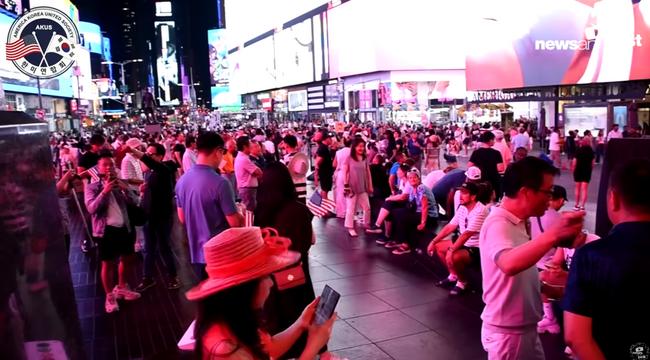 On June 24, 2025 (9 PM EST, 10 AM KST), a 2-minute video claiming election fraud in Korea's snap election on June 3 was repeatedly shown for 30 minutes on a large screen in New York's Times Square.
Key Record Retention by the Board of Audit and Inspection, Data Submission Rights to the National Assembly
Even with all these measures in place, trust will not be established in one scenario: when the agency that creates the records also stores them and explains that everything is fine on its own.
Therefore, immutable copies of key records generated during the election process must be stored separately by the Board of Audit and Inspection. The Board of Audit and Inspection is a constitutional body without investigative or prosecutorial powers, making it a suitable entity for storage and submission rather than judgment.
If an investigation or dispute is necessary, records will be submitted through the Board of Audit and Inspection. And the most certain mechanism to enforce that submission is the National Assembly's right to request data submission. When records are disclosed and verified at the request of the National Assembly, allegations become subject to public review, not conspiracy.
How Much Legislation Needs to Be Amended?
It may seem like extensive legal amendments are required to introduce such a system. However, most of it is possible within the framework of the current Public Official Election Act. To prevent disputes and avoid arguments of refusal, formalizing just one article would suffice.
"Immutable continuous records of the entire process of acquisition, storage, and transfer, generated throughout the entire voting and counting process to ensure election integrity, including ballot box sealing, transport, storage, entry/exit logs, video recordings, and computerized processing records, shall be generated and managed by the National Election Commission, with immutable copies of these records stored separately by the Board of Audit and Inspection. The Board of Audit and Inspection shall submit these records upon lawful request from the National Assembly or a court."
This provision, while maintaining the constitutional independence of the National Election Commission, only separates the path of verification, thus minimizing the risk of constitutional challenges. It is not a provision that creates new powers, but rather a minimal regulation that fixes the accountability path of existing powers.
How to End the Election Fraud Controversy
The election fraud controversy does not end with claims. It does not end with rebuttals either. It persists only when there is no possibility of verification.
Fixing the starting point with fingerprint recognition,
Linking computer systems and physical transport with records,
Having external entities store those records,
And a structure where the National Assembly requests and discloses them.
This system is not a mechanism for a specific faction, but a minimum safeguard to protect the election itself.
Now, National Assembly members from both ruling and opposition parties, and the National Election Commission, must answer this question.
"Is there any reason to refuse even this level of safeguard?"
This method will not solve all election problems. However, given that the current system has a structure that repeatedly breeds distrust, it is undoubtedly a realistic solution that can reduce controversy with minimal supplementation. Therefore, this issue should no longer be discussed as a partisan issue, but as a systemic one.
The next installment (② Identity Verification) will present a solution for identity verification in early voting, the first gateway to election fraud allegations.

 Iranian Foreign Ministry: "Continuing Message Exchanges with the U.S. and Activities of Mediating Countries"
Esmaeil Baghaei, Spokesperson for the Iranian Ministry of Foreign Affairs [Xinhua, Yonhap News file photo]Esmaeil Baghaei, spokesperson for the Iranian Ministry of Foreign Affairs, stated on the 26th
Iranian Foreign Ministry: "Continuing Message Exchanges with the U.S. and Activities of Mediating Countries"
Esmaeil Baghaei, Spokesperson for the Iranian Ministry of Foreign Affairs [Xinhua, Yonhap News file photo]Esmaeil Baghaei, spokesperson for the Iranian Ministry of Foreign Affairs, stated on the 26th
 President Yoon: "Do You Think You Are Safe from the Special Counsel?"... Final Statement Video Released
President Yoon Suk Yeol rebuking the special prosecutor on the 24th. [Court video / @birds_justice X account subtitle GIF] A video of President Yoon Suk Yeol's closing statement at his trial rega
President Yoon: "Do You Think You Are Safe from the Special Counsel?"... Final Statement Video Released
President Yoon Suk Yeol rebuking the special prosecutor on the 24th. [Court video / @birds_justice X account subtitle GIF] A video of President Yoon Suk Yeol's closing statement at his trial rega
 President Yoon, regarding the first-instance ruling on the Public Official Election Act: “An excessive political verdict that distorts the facts… We will appeal immediately.”
The first-instance sentencing hearing for President Yoon Suk Yeol regarding violations of the Public Official Election Act is being broadcast live at Seoul Station on the 27th. [Photo=Yonhap News]Pres
President Yoon, regarding the first-instance ruling on the Public Official Election Act: “An excessive political verdict that distorts the facts… We will appeal immediately.”
The first-instance sentencing hearing for President Yoon Suk Yeol regarding violations of the Public Official Election Act is being broadcast live at Seoul Station on the 27th. [Photo=Yonhap News]Pres
 WSJ: "SK Hynix ADR Premium Is a Sign of AI Trading Overheat"
Advertisement for SK Hynix ADR listing in New York's Times Square [Reuters=Yonhap News file photo]The Wall Street Journal (WSJ) has pointed out that the price of SK Hynix’s American Depositary Recei
WSJ: "SK Hynix ADR Premium Is a Sign of AI Trading Overheat"
Advertisement for SK Hynix ADR listing in New York's Times Square [Reuters=Yonhap News file photo]The Wall Street Journal (WSJ) has pointed out that the price of SK Hynix’s American Depositary Recei
 'Godfather of Japanese Mystery Novels' Keigo Higashino Passes Away After Battle with Cancer at 68
Famous Japanese mystery novelist Keigo Higashino [AFP=Yonhap News]It has been belatedly reported that Keigo Higashino, the "godfather of Japanese mystery novels" and author of bestsellers such as "The
'Godfather of Japanese Mystery Novels' Keigo Higashino Passes Away After Battle with Cancer at 68
Famous Japanese mystery novelist Keigo Higashino [AFP=Yonhap News]It has been belatedly reported that Keigo Higashino, the "godfather of Japanese mystery novels" and author of bestsellers such as "The
 [Park Pil-kyu Security Column] To the Ignorant Trying to Clothe a Beast in Sheep's Clothing
Rep. Kim Byung-joo of the Democratic Party of Korea [Photo=Yonhap News]“The Air Force Academy doesn't teach you how to fly a plane!” “The Army, Navy, and Air Force academies are exactly the
[Park Pil-kyu Security Column] To the Ignorant Trying to Clothe a Beast in Sheep's Clothing
Rep. Kim Byung-joo of the Democratic Party of Korea [Photo=Yonhap News]“The Air Force Academy doesn't teach you how to fly a plane!” “The Army, Navy, and Air Force academies are exactly the
 [Issue Diagnosis] Two Effects of the Election Petition Review
 [Photo] Evidence of Election Fraud Flooding U.S. Media… Trump Had 2.7 Million Votes Stolen
 [Video] U.S. Semiquincentennial Air Show... 'Art in the Sky' streaks across New York
 [Editorial Cartoon] A Draconian Law That Undermines Freedom of Expression

 List
List










