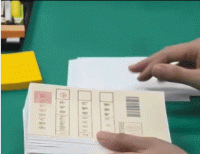
Large tractors are occupying a square around the European Parliament in protest of the push to conclude a Free Trade Agreement (FTA) between the EU and South America's Mercosur. [YTN News Capture]The farmer protests that have shaken Europe are no longer industrial conflicts over subsidies or prices.
The accumulated anger since the end of 2023 exploded with the conclusion of the EU-Mercosur FTA in early 2026, and that energy was immediately absorbed as political momentum for the New Right.
Farmers, once typical beneficiaries of left-wing protectionism, have now transformed into a vanguard pushing most clearly for anti-elite, anti-regulation, and national-first rhetoric.
Farmers are the real people
The core of the shift is not policy, but framing. Brussels' environmental bureaucrats have been redefined as "climate elites out of touch with reality," and farmers as "the real people."
While the Green Deal and the "Farm to Fork" strategy were couched in the language of morality, on the ground they translated into survival costs through regulations on diesel, fertilizers, and nitrogen, as well as mandatory fallow periods.
Regardless of the rightness or wrongness of the goals, environmental policies that ignored speed and method have inevitably led to "Greenlash," and this backlash has precisely aligned with the New Right's message calling for deregulation.
Free trade was also a decisive catalyst. The influx of Ukrainian grain and the opening to South American agricultural products shattered farmers' sense of fairness.
The perception that "we have become expensive by adhering to strict standards, while imports with looser regulations enter duty-free" overpowered the abstract utility of free trade.
As farmers organized their anger by calling this "Cars for Cows," national-first ideology immediately became the language of elections.
Political forces that harvested this anger have rapidly risen. The Farmers-Citizens' Movement (BBB) in the Netherlands, the National Rally (RN) in France, and the Alternative for Germany (AfD) are representative examples.
Farmers are no longer objects of protection but subjects of mobilization, and the New Right has succeeded in translating that anger into institutional politics.
Farmers want respect for the value of their production
This situation offers clear implications for the Korean right.
First, regulations that directly impact daily life must be brought to the forefront of ideological battles. European New Right parties focused on on-the-ground issues like diesel subsidies and fertilizer regulations, rather than grand narratives.
When prices, energy costs, and excessive environmental regulations are redefined as "tyranny by elite power out of touch with reality," a right-wing narrative centered on public welfare can be formed.
Second, while not negating free trade, neo-protectionism must be institutionalized.
Unless explicit compensatory measures such as direct payments, insurance, and conversion investments for affected groups are placed at the center of policy promises, while acknowledging the benefits of openness, FTAs will always become a political backlash. "Korea First" is a matter of design, not just a slogan.
Third, a producer solidarity against political correctness and elites must be built. The European farmers' question was simple: "Why should we sacrifice ourselves for their moral superiority?"
In Korea, a value-based solidarity is needed to connect farmers, manufacturing workers, and self-employed individuals who are tired of excessive environmental fundamentalism and regulations. This is a choice to place producers, not consumers, at the center of politics.
Finally, the center of gravity of organizations must shift. The New Right's victories did not begin in large cities but in the provinces and on the ground where tractors roam. Transforming beyond Seoul-centric discourse to make agricultural fields and provincial industrial complexes permanent bases for organization is what guarantees the sustainability of mobilization.
The lesson from Europe is clear. The destructive power of politics is maximized when groups of producers groaning under regulations coalesce. Remaining a "sophisticated conservative" lacks momentum.
What is needed now is a militant conservatism that converts the anger on the ground into institutional power. The reason farmers, once the protected class of the left, became the engine of the New Right is simple.
They produce, and they demand to be respected for it.
◆ Professor Sim Kyu-jin
Professor of Digital Media at IE University, Spain. He previously served as a policy advisor to the Ministry of National Defense and head of the Data Lab at the Yeouido Research Institute. He also worked as a full-time professor at the University of Melbourne, Australia, and an assistant professor at Singapore Management University. His books include "K-Drama Yoon Suk Yeol" and "Hyper Gender."

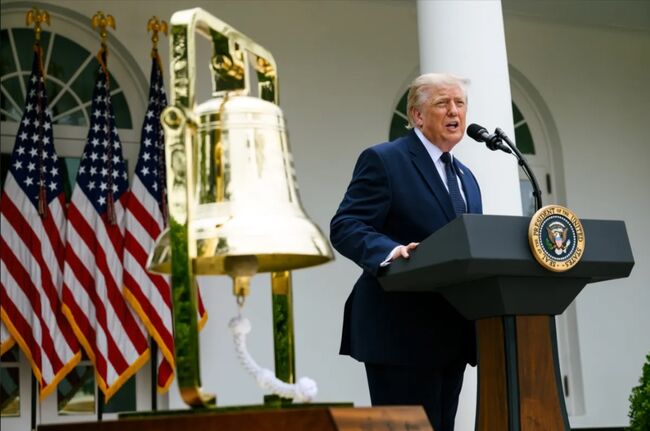 Trump pressures for rate cut again ahead of FOMC... "Should be the lowest in the world"
U.S. President Donald Trump. [Photo = The White House] U.S. President Donald Trump once again pressured the Federal Reserve, the U.S. central bank, to lower interest rates on the 27th (local time
Trump pressures for rate cut again ahead of FOMC... "Should be the lowest in the world"
U.S. President Donald Trump. [Photo = The White House] U.S. President Donald Trump once again pressured the Federal Reserve, the U.S. central bank, to lower interest rates on the 27th (local time
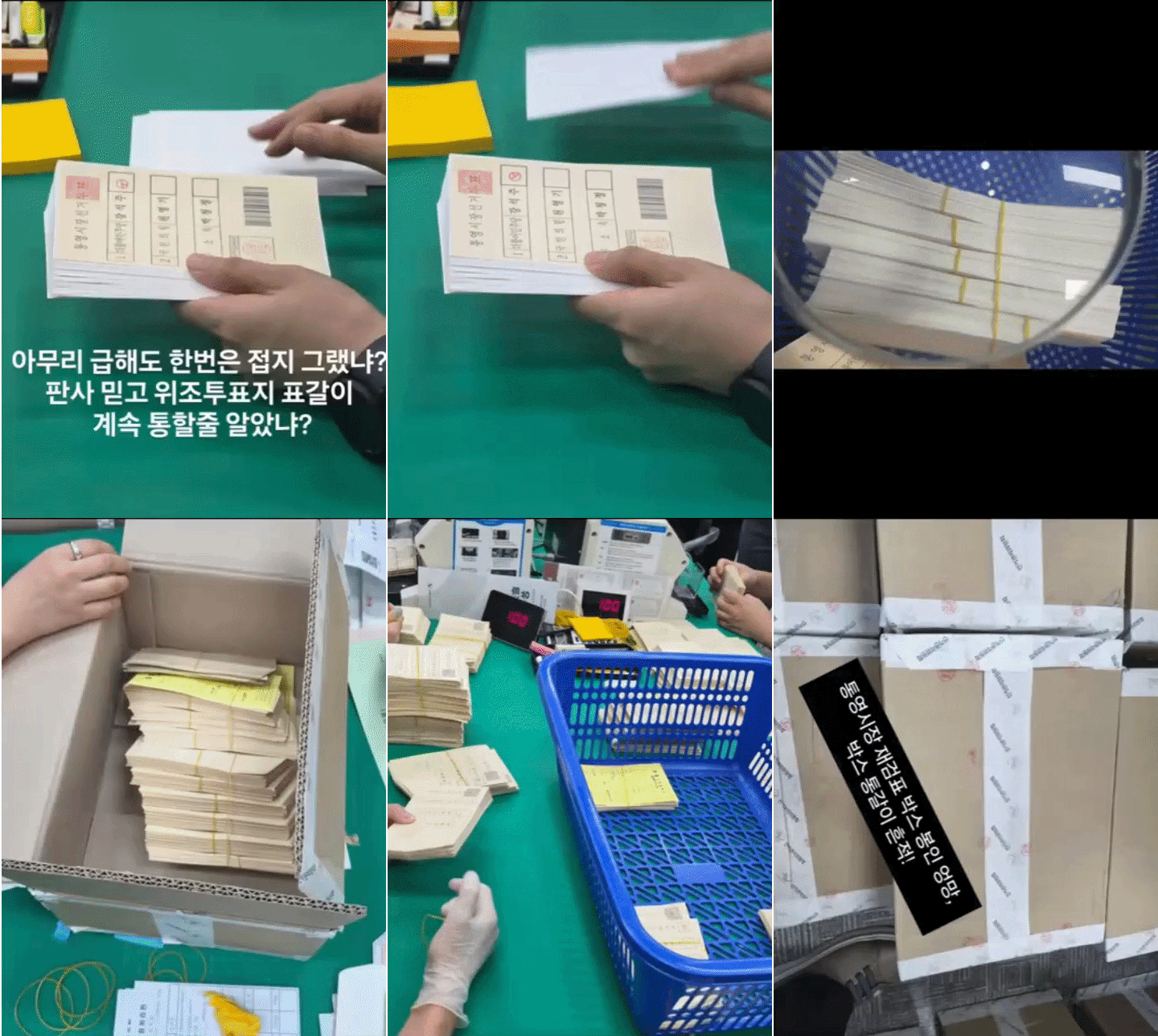 “Ignoring crisp ballots and damaged seals”… Tongyeong mayoral recount concludes with ‘no change in outcome,’ leaving suspicions and public outrage behind
Suspected counterfeit ballots discovered in Tongyeong [GIF from social media of Representative Hwang Kyo-ahn / Attorney Park Joo-hyun]During a recount of the Tongyeong mayoral election in South Gyeong
“Ignoring crisp ballots and damaged seals”… Tongyeong mayoral recount concludes with ‘no change in outcome,’ leaving suspicions and public outrage behind
Suspected counterfeit ballots discovered in Tongyeong [GIF from social media of Representative Hwang Kyo-ahn / Attorney Park Joo-hyun]During a recount of the Tongyeong mayoral election in South Gyeong
 President Yoon, regarding the first-instance ruling on the Public Official Election Act: “An excessive political verdict that distorts the facts… We will appeal immediately.”
The first-instance sentencing hearing for President Yoon Suk Yeol regarding violations of the Public Official Election Act is being broadcast live at Seoul Station on the 27th. [Photo=Yonhap News]Pres
President Yoon, regarding the first-instance ruling on the Public Official Election Act: “An excessive political verdict that distorts the facts… We will appeal immediately.”
The first-instance sentencing hearing for President Yoon Suk Yeol regarding violations of the Public Official Election Act is being broadcast live at Seoul Station on the 27th. [Photo=Yonhap News]Pres
 WSJ: "SK Hynix ADR Premium Is a Sign of AI Trading Overheat"
Advertisement for SK Hynix ADR listing in New York's Times Square [Reuters=Yonhap News file photo]The Wall Street Journal (WSJ) has pointed out that the price of SK Hynix’s American Depositary Recei
WSJ: "SK Hynix ADR Premium Is a Sign of AI Trading Overheat"
Advertisement for SK Hynix ADR listing in New York's Times Square [Reuters=Yonhap News file photo]The Wall Street Journal (WSJ) has pointed out that the price of SK Hynix’s American Depositary Recei
 'Godfather of Japanese Mystery Novels' Keigo Higashino Passes Away After Battle with Cancer at 68
Famous Japanese mystery novelist Keigo Higashino [AFP=Yonhap News]It has been belatedly reported that Keigo Higashino, the "godfather of Japanese mystery novels" and author of bestsellers such as "The
'Godfather of Japanese Mystery Novels' Keigo Higashino Passes Away After Battle with Cancer at 68
Famous Japanese mystery novelist Keigo Higashino [AFP=Yonhap News]It has been belatedly reported that Keigo Higashino, the "godfather of Japanese mystery novels" and author of bestsellers such as "The
 [Park Pil-kyu Security Column] To the Ignorant Trying to Clothe a Beast in Sheep's Clothing
Rep. Kim Byung-joo of the Democratic Party of Korea [Photo=Yonhap News]“The Air Force Academy doesn't teach you how to fly a plane!” “The Army, Navy, and Air Force academies are exactly the
[Park Pil-kyu Security Column] To the Ignorant Trying to Clothe a Beast in Sheep's Clothing
Rep. Kim Byung-joo of the Democratic Party of Korea [Photo=Yonhap News]“The Air Force Academy doesn't teach you how to fly a plane!” “The Army, Navy, and Air Force academies are exactly the
 [Issue Diagnosis] Two Effects of the Election Petition Review
 [Photo] Evidence of Election Fraud Flooding U.S. Media… Trump Had 2.7 Million Votes Stolen
 [Video] U.S. Semiquincentennial Air Show... 'Art in the Sky' streaks across New York
 [Editorial Cartoon] A Draconian Law That Undermines Freedom of Expression

 List
List