각자도생 사회는 혼란의 사회가 아니다. 그것은 공동의 판단과 책임이 사라진 상태다. 본 시리즈는 ‘신뢰 회복’을 말하지 않는다. 불신이 전제가 된 조건에서도 사회가 작동하기 위한 최소한의 구조를 묻는다. 그 조건으로 우리는 판단과 책임의 경로가 남는 구조화된 기록을 제시한다.〈편집자 주〉

The problem with a society of distrust is not that people don't believe. The more fundamental problem is that there are no choices left.
When we can no longer reconstruct what was chosen, what alternatives existed, and why that choice was made, society loses its ability to self-correct.
The "every man for himself" society we have examined so far was not a result of chaos.
The media lost its mediating function, politics failed to record choices, the economy could not manage expectations, and education and labor shifted the risks to individuals.
As a result, individuals acted rationally, but society lost its collective judgment structure.
The common solution proposed at this point is "restoring trust." However, trust is not restored through declarations. Rather, systems designed on the premise of trust do not function in a society of distrust.
Attempts to eliminate distrust mostly fail. Instead, what is needed are the conditions under which society can function even in the presence of distrust.
Those conditions are structured records.
Structured records are not mere documentation. They are records that leave behind the path of judgment, not just the outcomes.
They are records that leave behind in a connected form, what problem perception initiated the process, what options were reviewed, and by what criteria a single choice was adopted.
These records are not a tool for immediate accountability. They do not presuppose punishment or condemnation.
The purpose of structured records is corrigibility. They are the minimum mechanism that allows society to reflect on itself, so that wrong choices are not repeated.
The important point is that these records do not need to be perfect.
Not all judgments can be correct. It is more important that wrong judgments remain.
When the reasons for failure are not recorded, society repeats the same failures under different names. Conversely, when failures remain structurally, society can transform those failures into assets.
Structured records do not idealize democracy. They do not assume that citizens will always be rational.
Instead, they redefine democracy as a learning system. The maturity of democracy is determined by whether wrong choices can be corrected and whether the grounds for those corrections remain.
In the age of AI, these conditions become even more important.
AI can present judgments quickly, but it cannot be socially accountable for the reasons behind those judgments. In a society that does not record its judgments, AI becomes a convenient substitute.
However, in a society that records its judgments, AI is limited to a supplementary tool. It is not a matter of technology, but a matter of records.
This is precisely the fatal weakness of the "every man for himself" society.
Individuals learn, but society cannot. The reason is the absence of collective records. In a society without structured records, democracy quietly loses its function. Votes remain, but corrections do not occur.
Therefore, structured records are not a policy tool but a civilization infrastructure.
This includes everything from how the media writes articles, how politics records decisions, how administration designs policies, to the log structures of AI systems.
What must remain is not what was done, but why it was done.
Trust may not be restored. But choices can be left behind.
A society where the path of judgment is recorded functions even amidst distrust. Only a society that manages distrust, rather than trying to eliminate it, can extend democracy.
Democracy is not sustained by trust. When the path of judgment is recorded, democracy can learn even in the midst of distrust.
Concluding the Series
[The Age of Distrust] did not speak of restoring trust. Instead, it traced how a society accumulating distrust stops functioning and where it can reconnect.
The starting point is always the same.
When records are structured, choices once again belong to society.
Subscribe to Weekly Hankook-Japan-US Report Now
Inquiries: 02-2088-1201

 [Statement by the Seo-beo-kka Korea Military Academy Save-the-Nation Comrades Association] ㉛ Recount the Votes Publicly, as the Previous Recount Concealed Election Fraud
Tongyeong Mayoral Election Recount [Photo=Yonhap News]South Korea's liberal democracy is dying. The National Election Commission (NEC) and the judiciary, which have plummeted into criminal syndicates
[Statement by the Seo-beo-kka Korea Military Academy Save-the-Nation Comrades Association] ㉛ Recount the Votes Publicly, as the Previous Recount Concealed Election Fraud
Tongyeong Mayoral Election Recount [Photo=Yonhap News]South Korea's liberal democracy is dying. The National Election Commission (NEC) and the judiciary, which have plummeted into criminal syndicates
 What is the significance of the "Trump 2028" red hats that keep making a comeback?
It is noteworthy that President Donald Trump is "intentionally" fueling controversy over whether he can actually run in the 2028 presidential election, even though it is "highly likely he is seriously
What is the significance of the "Trump 2028" red hats that keep making a comeback?
It is noteworthy that President Donald Trump is "intentionally" fueling controversy over whether he can actually run in the 2028 presidential election, even though it is "highly likely he is seriously
 Jin Cummings: "North Korea says it will increase the number of spies, so what is the government doing?"
U.S. political columnist Gene Cummings has publicly questioned the South Korean government, asking, "North Korea is announcing plans to increase its number of spies, yet what is the South Korean
Jin Cummings: "North Korea says it will increase the number of spies, so what is the government doing?"
U.S. political columnist Gene Cummings has publicly questioned the South Korean government, asking, "North Korea is announcing plans to increase its number of spies, yet what is the South Korean
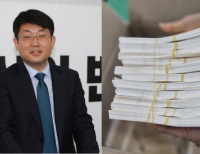
 Attorney Do Tae-woo: “Discrepancies in Voter Count and Improper Sealing Confirmed in Tongyeong Mayoral Recount… Official Request for Further Verification Filed with Gyeongnam Election Commission”
A bundle of out-of-district early voting ballots photographed by attorney Do Tae-woo at the Tongyeong mayoral election recount site. A clear, solid line visible on the side of the ballots raises suspi
Attorney Do Tae-woo: “Discrepancies in Voter Count and Improper Sealing Confirmed in Tongyeong Mayoral Recount… Official Request for Further Verification Filed with Gyeongnam Election Commission”
A bundle of out-of-district early voting ballots photographed by attorney Do Tae-woo at the Tongyeong mayoral election recount site. A clear, solid line visible on the side of the ballots raises suspi
 Stock Market Crash 'Black Tuesday'… KOSPI down 10.8%, KOSDAQ down 7.7%
The KOSPI fell by more than 5% in early trading on the 28th, triggering a sell-side sidecar.On the 28th, the KOSPI plunged by more than 10%.Due to the sharp decline, a sell-side sidecar—a temporary
Stock Market Crash 'Black Tuesday'… KOSPI down 10.8%, KOSDAQ down 7.7%
The KOSPI fell by more than 5% in early trading on the 28th, triggering a sell-side sidecar.On the 28th, the KOSPI plunged by more than 10%.Due to the sharp decline, a sell-side sidecar—a temporary
 [World Heritage Committee] 25 New World Heritage Sites Inscribed in Busan… South Korea Successfully Expands 'Getbol' Listing
The Chairperson of the World Heritage Committee speaks at the plenary session of the 48th session of the World Heritage Committee, held at BEXCO in Busan on the 20th. [Photo: Yonhap News]A total of 25
[World Heritage Committee] 25 New World Heritage Sites Inscribed in Busan… South Korea Successfully Expands 'Getbol' Listing
The Chairperson of the World Heritage Committee speaks at the plenary session of the 48th session of the World Heritage Committee, held at BEXCO in Busan on the 20th. [Photo: Yonhap News]A total of 25
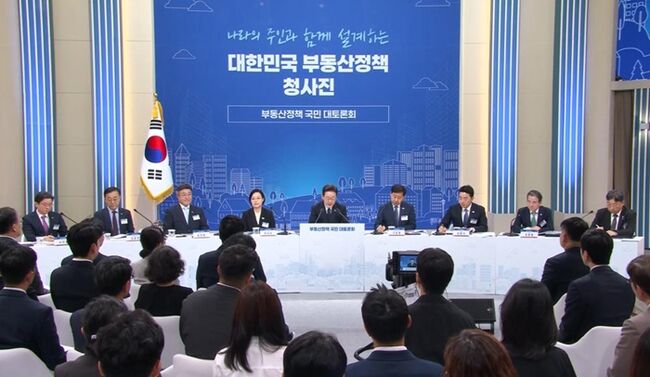 [Liberal Democratic Party Statement] Calling it a Grand Real Estate Debate… It Was Nothing More Than a Private Party Among Themselves
The 'National Grand Debate on Real Estate Policy' held on July 23rd and 27th. [Photo=Yonhap News]The 'National Grand Debate on Real Estate Policy,' hosted by the Lee Jae-myung administration under the
[Liberal Democratic Party Statement] Calling it a Grand Real Estate Debate… It Was Nothing More Than a Private Party Among Themselves
The 'National Grand Debate on Real Estate Policy' held on July 23rd and 27th. [Photo=Yonhap News]The 'National Grand Debate on Real Estate Policy,' hosted by the Lee Jae-myung administration under the
 [Photo] Evidence of Election Fraud Flooding U.S. Media… Trump Had 2.7 Million Votes Stolen
 [Video] U.S. Semiquincentennial Air Show... 'Art in the Sky' streaks across New York
 [Editorial Cartoon] A Draconian Law That Undermines Freedom of Expression

 List
List