U.S. President Donald Trump and Chinese President Xi Jinping are seen leaving the summit venue after concluding their meeting at Narae-Maru within the 5th Air Mobility Wing of the Air Force in Busan on October 30 last year. [Yonhap News]
The Trump administration has put a hold on a series of key technology security measures aimed at curbing China's influence, ahead of the planned U.S.-China summit in Beijing in April, Reuters reported on the 12th (local time).
According to multiple sources, the measures put on hold by the Trump administration include a ban on Chinese telecommunications company China Telecom's operations in the U.S. and restrictions on the sale of Chinese-made equipment for U.S. data centers.
Sources also said that the ban on the sale of TP-Link routers, Chinese-made, in the U.S., restrictions on China Unicom and China Mobile's internet businesses in the U.S., and the ban on the sale of Chinese-made electric trucks and buses in the U.S. have all been suspended.
These decisions are seen as an extension of the recent trend to refrain from strong measures that could provoke China, following the "trade truce" agreed upon by President Trump and Chinese President Xi Jinping in Busan, South Korea, in October last year.
The agreement at the time was also known to include China's promise to postpone export control measures on rare earth minerals, a key material for global technology manufacturing.
The U.S. Department of Commerce offered a general statement regarding the suspension of these technology security measures, stating without specific explanation, "The department is actively utilizing its authorities to address national security risks arising from foreign technology, and will continue to do so."
Some interpret these actions as an effort to ease trade tensions heightened by President Trump's trade war with China.
However, concerns are also being raised that these measures could threaten U.S. security amid a surge in data center construction due to the explosive demand for artificial intelligence (AI).
Matthew Pottinger, former deputy national security advisor in the Trump administration, pointed out, "At a time when we are striving to reduce China's influence in the rare earth supply chain, it is ironic that we are allowing China to exert new influence over the U.S. economy in the areas of telecommunications infrastructure, data centers, AI, and electric vehicles."
David Feith, who served in both the first and second Trump administrations, also warned, "U.S. data centers could become islands controlled remotely by China's 'digital sovereignty.'"
On the other hand, the Chinese Embassy in the U.S. stated its opposition to the politicization of trade and technology issues, expressing hope that this year will be a year of mutual respect and cooperation between the two countries.
TP-Link, which was one of the companies targeted for regulation, retorted, "We are an independent U.S. company spun off from our China headquarters in 2024," and stated, "We adhere to U.S.-managed software and security standards, so the claims of security risks are entirely false."
The measures that have been put on hold were reportedly designed to prevent China from stealing data or disrupting critical infrastructure.
Following the U.S.-China "trade truce" in October last year, U.S. government departments overseeing foreign technology threats were reportedly instructed to "focus on Iran and Russia."
However, Reuters reported that if U.S.-China relations deteriorate after President Trump's visit to China in April, the U.S. may bring back the sanctions it has currently put on hold.

 [Statement by the Seo-beo-kka Korea Military Academy Save-the-Nation Comrades Association] ㉛ Recount the Votes Publicly, as the Previous Recount Concealed Election Fraud
Tongyeong Mayoral Election Recount [Photo=Yonhap News]South Korea's liberal democracy is dying. The National Election Commission (NEC) and the judiciary, which have plummeted into criminal syndicates
[Statement by the Seo-beo-kka Korea Military Academy Save-the-Nation Comrades Association] ㉛ Recount the Votes Publicly, as the Previous Recount Concealed Election Fraud
Tongyeong Mayoral Election Recount [Photo=Yonhap News]South Korea's liberal democracy is dying. The National Election Commission (NEC) and the judiciary, which have plummeted into criminal syndicates
 What is the significance of the "Trump 2028" red hats that keep making a comeback?
It is noteworthy that President Donald Trump is "intentionally" fueling controversy over whether he can actually run in the 2028 presidential election, even though it is "highly likely he is seriously
What is the significance of the "Trump 2028" red hats that keep making a comeback?
It is noteworthy that President Donald Trump is "intentionally" fueling controversy over whether he can actually run in the 2028 presidential election, even though it is "highly likely he is seriously
 Jin Cummings: "North Korea says it will increase the number of spies, so what is the government doing?"
U.S. political columnist Gene Cummings has publicly questioned the South Korean government, asking, "North Korea is announcing plans to increase its number of spies, yet what is the South Korean
Jin Cummings: "North Korea says it will increase the number of spies, so what is the government doing?"
U.S. political columnist Gene Cummings has publicly questioned the South Korean government, asking, "North Korea is announcing plans to increase its number of spies, yet what is the South Korean
 Attorney Do Tae-woo: “Discrepancies in Voter Count and Improper Sealing Confirmed in Tongyeong Mayoral Recount… Official Request for Further Verification Filed with Gyeongnam Election Commission”
A bundle of out-of-district early voting ballots photographed by attorney Do Tae-woo at the Tongyeong mayoral election recount site. A clear, solid line visible on the side of the ballots raises suspi
Attorney Do Tae-woo: “Discrepancies in Voter Count and Improper Sealing Confirmed in Tongyeong Mayoral Recount… Official Request for Further Verification Filed with Gyeongnam Election Commission”
A bundle of out-of-district early voting ballots photographed by attorney Do Tae-woo at the Tongyeong mayoral election recount site. A clear, solid line visible on the side of the ballots raises suspi
 Stock Market Crash 'Black Tuesday'… KOSPI down 10.8%, KOSDAQ down 7.7%
The KOSPI fell by more than 5% in early trading on the 28th, triggering a sell-side sidecar.On the 28th, the KOSPI plunged by more than 10%.Due to the sharp decline, a sell-side sidecar—a temporary
Stock Market Crash 'Black Tuesday'… KOSPI down 10.8%, KOSDAQ down 7.7%
The KOSPI fell by more than 5% in early trading on the 28th, triggering a sell-side sidecar.On the 28th, the KOSPI plunged by more than 10%.Due to the sharp decline, a sell-side sidecar—a temporary
 [World Heritage Committee] 25 New World Heritage Sites Inscribed in Busan… South Korea Successfully Expands 'Getbol' Listing
The Chairperson of the World Heritage Committee speaks at the plenary session of the 48th session of the World Heritage Committee, held at BEXCO in Busan on the 20th. [Photo: Yonhap News]A total of 25
[World Heritage Committee] 25 New World Heritage Sites Inscribed in Busan… South Korea Successfully Expands 'Getbol' Listing
The Chairperson of the World Heritage Committee speaks at the plenary session of the 48th session of the World Heritage Committee, held at BEXCO in Busan on the 20th. [Photo: Yonhap News]A total of 25
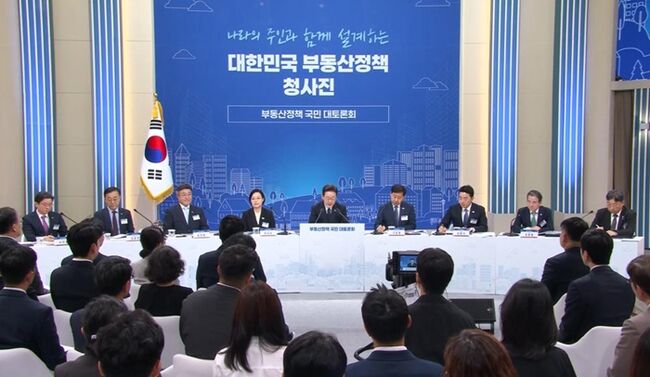 [Liberal Democratic Party Statement] Calling it a Grand Real Estate Debate… It Was Nothing More Than a Private Party Among Themselves
The 'National Grand Debate on Real Estate Policy' held on July 23rd and 27th. [Photo=Yonhap News]The 'National Grand Debate on Real Estate Policy,' hosted by the Lee Jae-myung administration under the
[Liberal Democratic Party Statement] Calling it a Grand Real Estate Debate… It Was Nothing More Than a Private Party Among Themselves
The 'National Grand Debate on Real Estate Policy' held on July 23rd and 27th. [Photo=Yonhap News]The 'National Grand Debate on Real Estate Policy,' hosted by the Lee Jae-myung administration under the
 [Photo] Evidence of Election Fraud Flooding U.S. Media… Trump Had 2.7 Million Votes Stolen
 [Video] U.S. Semiquincentennial Air Show... 'Art in the Sky' streaks across New York
 [Editorial Cartoon] A Draconian Law That Undermines Freedom of Expression

 List
List