On March 9 (local time), foreign media reported that the Iranian Revolutionary Guard Corps, in a statement released immediately after Mojtaba was elected Supreme Leader, pledged their "complete obedience" and stated they were ready to follow the new Supreme Leader's directives. The photo shows Mojtaba, the second son of Khamenei. [Photo = Yonhap News]
Predicting the outcome of a war is always risky.
This is especially true for a war that has not yet lasted a week since its outbreak. While the outcome of a war may seem to be decided on the battlefield, it is often determined by the direction of politics.
However, the initial phase of this war shows clear characteristics.
The airstrikes launched by the US and Israeli allied forces against Iran's theocratic regime are unfolding in a manner that is virtually an unilateral bombardment. It is a typical operation of modern warfare, combining precision strikes, information warfare, and electronic warfare.
It would not be an exaggeration to call it a demonstration of the true essence of American military power.
Iran's current response appears outwardly helpless.
However, the most dangerous moment in war is when the opponent remains silent. Just as embers can reignite at any time, it is difficult to consider the Iranian regime as completely knocked out.
The real problem starts now.
The key variable in this war is not military power, but the political structure.
In particular, the form that the post-Khamenei regime will take is likely to determine the direction of the war. Iran's future could take a completely different path depending on how the power structure is reorganized after the Supreme Leader.
The most important entity in this process is the Revolutionary Guard Corps.
The Revolutionary Guard Corps is not merely a military organization but a central pillar of Iran's political and economic power. The political landscape of Iran could change significantly depending on whether it becomes a shield for regime maintenance or the center of power reorganization.
Another variable is the Iranian people.
It is not yet known whether external military pressure will lead to regime consolidation or demands for internal change. Historically, external wars have often served as catalysts for internal political change.
In addition, the long-standing conflict structure in the Middle East still remains.
If the old frame of sectarian conflict between Sunnis and Shias is revived, this war could escalate into regional tension beyond a simple interstate conflict.
However, viewing this war solely as a Middle Eastern conflict would mean missing a more important trend.
The change in the 21st-century world order has already begun elsewhere.
The starting point was not a military clash, but the US-China trade dispute. The tariff war, triggered by the United States, was not simply a protectionist policy but a competition for leadership in the era of AI capitalism.
The core of this competition is not military power, but currency and financial order.
The foundation of a sovereign nation is not its military, but its currency. The power to determine what the world's central currency is, dictates the international order.
Judging from the trend so far, this competition seems to be settling under American dominance. The dollar remains at the center of global finance, and there is a clear trend of technological hegemony being reorganized around the US.
Therefore, the upcoming US-China summit is important.
This summit is not a mere diplomatic event. It is likely to be a testbed showing what strategies the US and China will choose in the midst of the ongoing reorganization of the world order.
The war in the Middle East is a visible conflict.
However, the real battle unfolding behind it is the hegemonic competition surrounding AI, finance, and monetary order.
While the war began in Iran, the order is likely to be decided between Washington and Beijing.
And its conclusion will probably be recorded like this:
"The war took place in the Middle East, but the world order was rewritten amidst US-China competition."

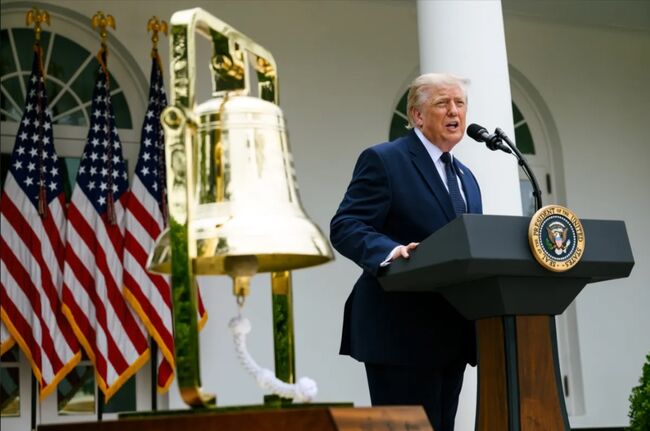 Trump pressures for rate cut again ahead of FOMC... "Should be the lowest in the world"
U.S. President Donald Trump. [Photo = The White House] U.S. President Donald Trump once again pressured the Federal Reserve, the U.S. central bank, to lower interest rates on the 27th (local time
Trump pressures for rate cut again ahead of FOMC... "Should be the lowest in the world"
U.S. President Donald Trump. [Photo = The White House] U.S. President Donald Trump once again pressured the Federal Reserve, the U.S. central bank, to lower interest rates on the 27th (local time
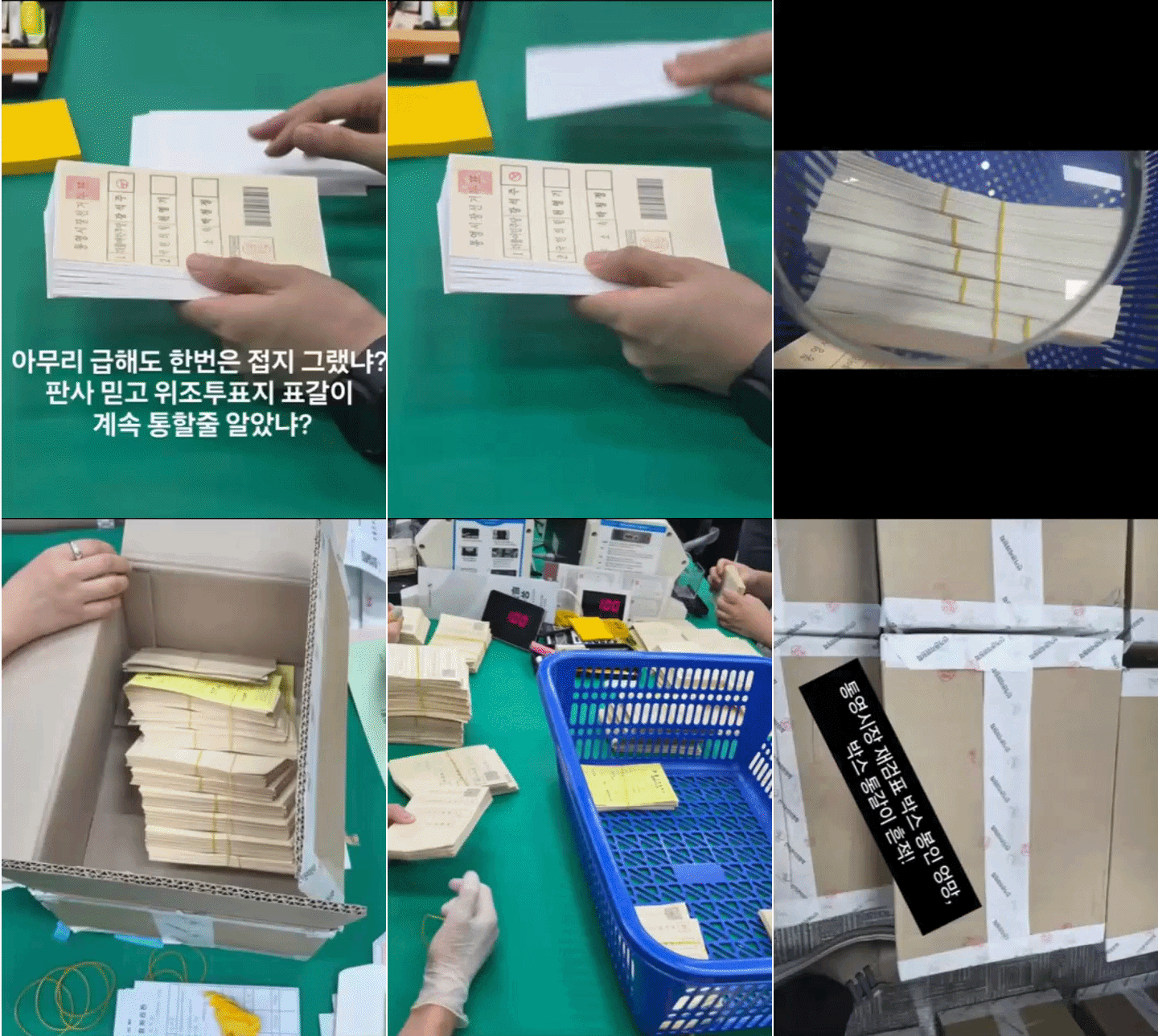 “Ignoring crisp ballots and damaged seals”… Tongyeong mayoral recount concludes with ‘no change in outcome,’ leaving suspicions and public outrage behind
Suspected counterfeit ballots discovered in Tongyeong [GIF from social media of Representative Hwang Kyo-ahn / Attorney Park Joo-hyun]During a recount of the Tongyeong mayoral election in South Gyeong
“Ignoring crisp ballots and damaged seals”… Tongyeong mayoral recount concludes with ‘no change in outcome,’ leaving suspicions and public outrage behind
Suspected counterfeit ballots discovered in Tongyeong [GIF from social media of Representative Hwang Kyo-ahn / Attorney Park Joo-hyun]During a recount of the Tongyeong mayoral election in South Gyeong
 President Yoon, regarding the first-instance ruling on the Public Official Election Act: “An excessive political verdict that distorts the facts… We will appeal immediately.”
The first-instance sentencing hearing for President Yoon Suk Yeol regarding violations of the Public Official Election Act is being broadcast live at Seoul Station on the 27th. [Photo=Yonhap News]Pres
President Yoon, regarding the first-instance ruling on the Public Official Election Act: “An excessive political verdict that distorts the facts… We will appeal immediately.”
The first-instance sentencing hearing for President Yoon Suk Yeol regarding violations of the Public Official Election Act is being broadcast live at Seoul Station on the 27th. [Photo=Yonhap News]Pres
 WSJ: "SK Hynix ADR Premium Is a Sign of AI Trading Overheat"
Advertisement for SK Hynix ADR listing in New York's Times Square [Reuters=Yonhap News file photo]The Wall Street Journal (WSJ) has pointed out that the price of SK Hynix’s American Depositary Recei
WSJ: "SK Hynix ADR Premium Is a Sign of AI Trading Overheat"
Advertisement for SK Hynix ADR listing in New York's Times Square [Reuters=Yonhap News file photo]The Wall Street Journal (WSJ) has pointed out that the price of SK Hynix’s American Depositary Recei
 'Godfather of Japanese Mystery Novels' Keigo Higashino Passes Away After Battle with Cancer at 68
Famous Japanese mystery novelist Keigo Higashino [AFP=Yonhap News]It has been belatedly reported that Keigo Higashino, the "godfather of Japanese mystery novels" and author of bestsellers such as "The
'Godfather of Japanese Mystery Novels' Keigo Higashino Passes Away After Battle with Cancer at 68
Famous Japanese mystery novelist Keigo Higashino [AFP=Yonhap News]It has been belatedly reported that Keigo Higashino, the "godfather of Japanese mystery novels" and author of bestsellers such as "The
 [Park Pil-kyu Security Column] To the Ignorant Trying to Clothe a Beast in Sheep's Clothing
Rep. Kim Byung-joo of the Democratic Party of Korea [Photo=Yonhap News]“The Air Force Academy doesn't teach you how to fly a plane!” “The Army, Navy, and Air Force academies are exactly the
[Park Pil-kyu Security Column] To the Ignorant Trying to Clothe a Beast in Sheep's Clothing
Rep. Kim Byung-joo of the Democratic Party of Korea [Photo=Yonhap News]“The Air Force Academy doesn't teach you how to fly a plane!” “The Army, Navy, and Air Force academies are exactly the
 [Issue Diagnosis] Two Effects of the Election Petition Review
 [Photo] Evidence of Election Fraud Flooding U.S. Media… Trump Had 2.7 Million Votes Stolen
 [Video] U.S. Semiquincentennial Air Show... 'Art in the Sky' streaks across New York
 [Editorial Cartoon] A Draconian Law That Undermines Freedom of Expression

 List
List