President Trump of the United States (left) and Japanese Prime Minister Sanae Takaichi, who held a summit last October. [UPI Yonhap News]
With the imminent departure of THAAD (Terminal High Altitude Area Defense) interceptor missiles for the Middle East from the U.S. Forces Korea, Japanese media reports suggest that this move signifies a shift in the role of U.S. Forces Korea and that Japan cannot escape its influence.
On the 12th, the Nikkei Shimbun, citing South Korean media, reported that THAAD, which was installed at the Seongju base in Gyeongbuk, has been removed and is widely speculated to be moving to the Middle East.
The newspaper expressed concern, stating, "The urgency of the Middle East situation seems to have spilled over into East Asian security. If the chaos in the Middle East prolongs and U.S. forces, including THAAD, remain deployed in the region, a security vacuum could emerge in East Asia."
Recently, THAAD launch vehicles were moved from the Seongju base to the Osan base, and it is widely reported that THAAD interceptor missiles are likely to be loaded onto U.S. military transport aircraft and transported to the Middle East.
On the 9th, The Washington Post (WP) also reported, citing two officials, that "the U.S. Department of Defense is relocating some THAAD systems from South Korea to the Middle East."
Nikkei explained that the Trump administration's decision to remove THAAD from U.S. Forces Korea is a result of 'strategic flexibility' to expand the role of U.S. Forces Korea in response to changes in the strategic environment, and that the redeployment of THAAD to the Middle East clearly expands the mission of U.S. Forces Korea.
Furthermore, it predicted that strong opposition to the removal of THAAD in South Korea could lead to growing calls that 'complete reliance on the U.S. military for security is dangerous.' It also indicated the possibility of accelerating arguments for self-defense and nuclear armament.
Nikkei pointed out that not only North Korea but also China, which has continued retaliatory measures against South Korea due to THAAD deployment, will likely be pleased by the removal of THAAD, and that this is closely related to Japan's security, which is exposed to North Korean and Chinese threats.
Japan's recently pursued enhancement of its defense capabilities is focused on defending the Nansei Islands, an island chain stretching from Kyushu to Okinawa Prefecture, in response to China's military threats in the region.
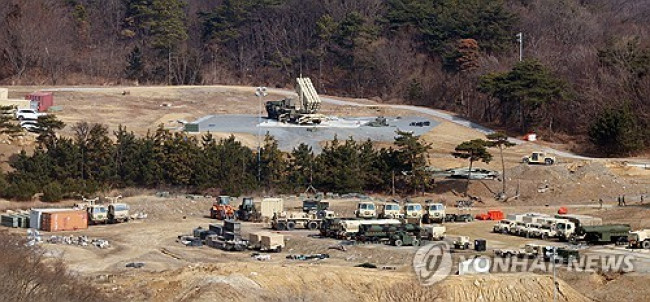 On the 10th, reports emerged that the U.S. Department of Defense was relocating some of the THAAD (Terminal High Altitude Area Defense) systems deployed in South Korea to the Middle East. The photo shows a launcher of air defense missiles at the U.S. THAAD base in Seongju, Gyeongbuk, pointing towards the sky on the 5th. [Yonhap News]
Conversely, it is known that a strategy has been prepared to primarily provide rear support in the event of a contingency on the Korean Peninsula.
Nikkei emphasized the importance of cooperation between South Korea and Japan in response to North Korean and Chinese threats.
The newspaper stated, "It is urgent to maintain security systems such as the South Korea-Japan Mutual Logistics Support Agreement (ACSA) to prevent the U.S. from becoming mired in Middle East conflicts and creating a risk of a security vacuum in Asia."
It also stressed, "As strong opposition to strengthening defense cooperation between South Korea and Japan exists within the left-wing and progressive factions, which are the support base for President Lee Jae-myung, security cooperation between South Korea and Japan depends on President Lee's decision to pursue pragmatic diplomacy."
Japanese media is also paying attention to the possibility of the Self-Defense Forces being dispatched to a war in Iran.
This is because at the U.S.-Japan summit to be held in the United States on the 19th (local time), there is a possibility that the U.S. will request Japan's support for escorting oil tankers in the Strait of Hormuz or clearing mines.
According to Nikkei and the Yomiuri Shimbun, if the Self-Defense Forces are dispatched to the Strait of Hormuz, three grounds are being discussed.
First, it would be when Japan's existence is threatened, even if Japan is not directly attacked, under the exercise of collective self-defense rights.
In 2015, former Japanese Prime Minister Shinzo Abe cited mine clearance in the Strait of Hormuz as an example of a crisis situation threatening Japan's existence.
However, the Japanese government's position is that the current situation does not constitute a threat to Japan's existence.
Chief Cabinet Secretary Hirokazu Matsuno, the government's spokesperson, stated at a press conference the previous day that he does not believe that the mining in the Strait of Hormuz constitutes a threat to Japan's existence.
Second, there is the option of rear support, such as refueling or providing ammunition to U.S. forces or foreign forces, by judging it as a 'situation with significant impact,' which is a stage prior to a crisis threatening existence.
Lastly, under the framework of 'cooperation for international peace and security,' it is mentioned that the Self-Defense Forces would provide rear support as part of cooperative actions in accordance with the purposes of the UN Charter when international peace and security are threatened.
It is also reported that there are suggestions that U.S. compliance with international law should be a prerequisite for the Self-Defense Forces to support the U.S.
However, Nikkei pointed out that it is difficult to definitively conclude whether the U.S. has violated international law by attacking Iran.
Japanese Prime Minister Sanae Takaichi has so far refrained from evaluating the U.S. attack on Iran.
On February 2nd, she stated at a budget committee meeting of the Japanese House of Representatives, "As I do not have detailed information, I will refrain from making a legal assessment" regarding the attacks by the U.S. and Israel on Iran.

 [Statement by the Seo-beo-kka Korea Military Academy Save-the-Nation Comrades Association] ㉛ Recount the Votes Publicly, as the Previous Recount Concealed Election Fraud
Tongyeong Mayoral Election Recount [Photo=Yonhap News]South Korea's liberal democracy is dying. The National Election Commission (NEC) and the judiciary, which have plummeted into criminal syndicates
[Statement by the Seo-beo-kka Korea Military Academy Save-the-Nation Comrades Association] ㉛ Recount the Votes Publicly, as the Previous Recount Concealed Election Fraud
Tongyeong Mayoral Election Recount [Photo=Yonhap News]South Korea's liberal democracy is dying. The National Election Commission (NEC) and the judiciary, which have plummeted into criminal syndicates
 What is the significance of the "Trump 2028" red hats that keep making a comeback?
It is noteworthy that President Donald Trump is "intentionally" fueling controversy over whether he can actually run in the 2028 presidential election, even though it is "highly likely he is seriously
What is the significance of the "Trump 2028" red hats that keep making a comeback?
It is noteworthy that President Donald Trump is "intentionally" fueling controversy over whether he can actually run in the 2028 presidential election, even though it is "highly likely he is seriously
 Jin Cummings: "North Korea says it will increase the number of spies, so what is the government doing?"
U.S. political columnist Gene Cummings has publicly questioned the South Korean government, asking, "North Korea is announcing plans to increase its number of spies, yet what is the South Korean
Jin Cummings: "North Korea says it will increase the number of spies, so what is the government doing?"
U.S. political columnist Gene Cummings has publicly questioned the South Korean government, asking, "North Korea is announcing plans to increase its number of spies, yet what is the South Korean
 Attorney Do Tae-woo: “Discrepancies in Voter Count and Improper Sealing Confirmed in Tongyeong Mayoral Recount… Official Request for Additional Verification Submitted to Gyeongnam Election Commission”
A bundle of mail-in early voting ballots captured by lawyer Do Tae-woo at the Tongyeong mayoral election recount site. A clear solid line, raising suspicions of election fraud, is visible on the side
Attorney Do Tae-woo: “Discrepancies in Voter Count and Improper Sealing Confirmed in Tongyeong Mayoral Recount… Official Request for Additional Verification Submitted to Gyeongnam Election Commission”
A bundle of mail-in early voting ballots captured by lawyer Do Tae-woo at the Tongyeong mayoral election recount site. A clear solid line, raising suspicions of election fraud, is visible on the side
 Stock Market Crash 'Black Tuesday'… KOSPI down 10.8%, KOSDAQ down 7.7%
The KOSPI fell by more than 5% in early trading on the 28th, triggering a sell-side sidecar.On the 28th, the KOSPI plunged by more than 10%.Due to the sharp decline, a sell-side sidecar—a temporary
Stock Market Crash 'Black Tuesday'… KOSPI down 10.8%, KOSDAQ down 7.7%
The KOSPI fell by more than 5% in early trading on the 28th, triggering a sell-side sidecar.On the 28th, the KOSPI plunged by more than 10%.Due to the sharp decline, a sell-side sidecar—a temporary
 [World Heritage Committee] 25 New World Heritage Sites Inscribed in Busan… South Korea Successfully Expands 'Getbol' Listing
The Chairperson of the World Heritage Committee speaks at the plenary session of the 48th session of the World Heritage Committee, held at BEXCO in Busan on the 20th. [Photo: Yonhap News]A total of 25
[World Heritage Committee] 25 New World Heritage Sites Inscribed in Busan… South Korea Successfully Expands 'Getbol' Listing
The Chairperson of the World Heritage Committee speaks at the plenary session of the 48th session of the World Heritage Committee, held at BEXCO in Busan on the 20th. [Photo: Yonhap News]A total of 25
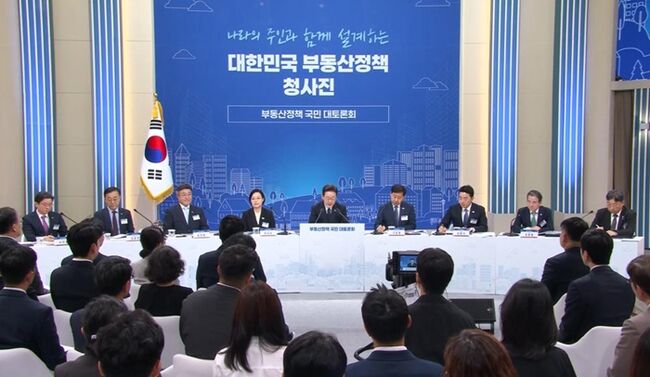 [Liberal Democratic Party Statement] Calling it a Grand Real Estate Debate… It Was Nothing More Than a Private Party Among Themselves
The 'National Grand Debate on Real Estate Policy' held on July 23rd and 27th. [Photo=Yonhap News]The 'National Grand Debate on Real Estate Policy,' hosted by the Lee Jae-myung administration under the
[Liberal Democratic Party Statement] Calling it a Grand Real Estate Debate… It Was Nothing More Than a Private Party Among Themselves
The 'National Grand Debate on Real Estate Policy' held on July 23rd and 27th. [Photo=Yonhap News]The 'National Grand Debate on Real Estate Policy,' hosted by the Lee Jae-myung administration under the
 [Photo] Evidence of Election Fraud Flooding U.S. Media… Trump Had 2.7 Million Votes Stolen
 [Video] U.S. Semiquincentennial Air Show... 'Art in the Sky' streaks across New York
 [Editorial Cartoon] A Draconian Law That Undermines Freedom of Expression

 List
List