US President Donald Trump and Japanese Prime Minister Sanae Takaichi [AP Yonhap News]
Japanese Prime Minister Sanae Takaichi is expected to express her intention to participate in the U.S.'s next-generation aerial missile defense system, "Golden Dawn," during a summit with U.S. President Donald Trump scheduled to be held in the United States on the 19th (local time).
According to the Yomiuri Shimbun on the 13th, the Japanese government is coordinating a plan to convey its intention to participate in Golden Dawn, which the United States plans to operate before January 2029, ahead of the U.S.-Japan summit.
Golden Dawn is a system that detects and intercepts intercontinental ballistic missiles (ICBMs) launched toward the U.S. mainland using satellites and radar. It is a concept designed to protect the U.S. from hypersonic missiles and drones being developed by China and Russia.
Japan appears to be aiming to enhance its deterrence against China and Russia by participating in Golden Dawn through joint development of interceptor missiles and cooperation in building a satellite network.
The U.S. and Japan are already jointly developing a new missile, the "glide phase interceptor missile," to intercept hypersonic glide vehicles (HGVs). The target completion date for development is the 2030s.
In addition, the Japanese government plans to establish a "satellite constellation" system that collects information by operating multiple small satellites by the end of March 2028. To this end, Japan plans to launch satellites in stages starting from April.
It is also known that Japan is considering sharing satellite information with the U.S. in the future.
Regarding Japan's intention to participate in Golden Dawn, the Yomiuri Shimbun reported, "It is an idea to utilize Golden Dawn for its own defense," adding, "It is expected that the two leaders will confirm the steady progress of joint missile development during this summit."
However, there are also skeptical views as to whether the consultation between the two countries will lead to results, as there are opinions that the feasibility of Golden Dawn is somewhat uncertain and its effectiveness is questionable.
Kyodo News reported that President Trump and Prime Minister Takaichi are also expected to discuss increasing missile production, possibly with Patriot missiles in mind, and expanding the sharing of classified information between the U.S. military and the Self-Defense Forces during their meeting.
Prime Minister Takaichi is expected to convey the strength of the U.S.-Japan alliance through these discussions with President Trump, but consultations on the Middle East situation and China issues may encounter difficulties.
Japan, while refraining from directly evaluating the U.S. and Israeli attacks on Iran, has supported the U.S. by criticizing Iran's nuclear development.
Nevertheless, Prime Minister Takaichi has maintained a cautious stance, stating that she is not considering sending Self-Defense Forces to the region for mine clearance in the Strait of Hormuz.
The Sankei Shimbun speculated that Prime Minister Takaichi might be forced into a difficult choice, as "President Trump may request cooperation on clearing mines laid in the Strait of Hormuz."
In contrast, regarding China, it is analyzed that Japan may hope for U.S. support, while the U.S. might take a lukewarm attitude.
Japan has been in sharp confrontation with China since Prime Minister Takaichi hinted at "intervention in case of a Taiwan contingency" in the National Diet last November, but President Trump has shown a conciliatory stance towards China ahead of his visit to China in late March.
The Sankei Shimbun reported, "Prime Minister Takaichi intends to explain China's military threat to President Trump and seek his understanding on the necessity of continued U.S. engagement in the Asia-Pacific region."
Some views suggest that economic security, such as strengthening supply chains for critical minerals, is at the core of this summit. A senior official from the Japanese Ministry of Foreign Affairs told the Sankei Shimbun, "What is important in this summit is economic security," adding, "We must elevate U.S.-Japan cooperation to a higher level."
In this regard, Kyodo News reported that the U.S. and Japanese governments are considering a joint investment in a project to secure rare earth elements from the seabed near Minamitorishima Island in the Pacific Ocean, south of Honshu.
It is likely that an arrangement will be discussed where each country provides funds, and Japan, which has a technological advantage in rare earth mining and processing, will be responsible for those aspects. There is also a possibility of a contract being made for Japan to sell processed rare earth elements to the U.S.
Last month, Japan conducted its first exploratory excavation of mud containing rare earth elements in the deep sea within its exclusive economic zone (EEZ) near Minamitorishima Island and plans to assess its economic viability before March 2028.
Kyodo News explained that the two countries aim to reduce their dependence on China for rare earths by promoting stronger cooperation in resource development, thereby increasing their economic leverage against China.

 [Statement by the Seo-beo-kka Korea Military Academy Save-the-Nation Comrades Association] ㉛ Recount the Votes Publicly, as the Previous Recount Concealed Election Fraud
Tongyeong Mayoral Election Recount [Photo=Yonhap News]South Korea's liberal democracy is dying. The National Election Commission (NEC) and the judiciary, which have plummeted into criminal syndicates
[Statement by the Seo-beo-kka Korea Military Academy Save-the-Nation Comrades Association] ㉛ Recount the Votes Publicly, as the Previous Recount Concealed Election Fraud
Tongyeong Mayoral Election Recount [Photo=Yonhap News]South Korea's liberal democracy is dying. The National Election Commission (NEC) and the judiciary, which have plummeted into criminal syndicates
 What is the significance of the "Trump 2028" red hats that keep making a comeback?
It is noteworthy that President Donald Trump is "intentionally" fueling controversy over whether he can actually run in the 2028 presidential election, even though it is "highly likely he is seriously
What is the significance of the "Trump 2028" red hats that keep making a comeback?
It is noteworthy that President Donald Trump is "intentionally" fueling controversy over whether he can actually run in the 2028 presidential election, even though it is "highly likely he is seriously
 Jin Cummings: "North Korea says it will increase the number of spies, so what is the government doing?"
U.S. political columnist Gene Cummings has publicly questioned the South Korean government, asking, "North Korea is announcing plans to increase its number of spies, yet what is the South Korean
Jin Cummings: "North Korea says it will increase the number of spies, so what is the government doing?"
U.S. political columnist Gene Cummings has publicly questioned the South Korean government, asking, "North Korea is announcing plans to increase its number of spies, yet what is the South Korean
 Attorney Do Tae-woo: “Discrepancies in Voter Count and Improper Sealing Confirmed in Tongyeong Mayoral Recount… Official Request for Additional Verification Submitted to Gyeongnam Election Commission”
A bundle of mail-in early voting ballots captured by lawyer Do Tae-woo at the Tongyeong mayoral election recount site. A clear solid line, raising suspicions of election fraud, is visible on the side
Attorney Do Tae-woo: “Discrepancies in Voter Count and Improper Sealing Confirmed in Tongyeong Mayoral Recount… Official Request for Additional Verification Submitted to Gyeongnam Election Commission”
A bundle of mail-in early voting ballots captured by lawyer Do Tae-woo at the Tongyeong mayoral election recount site. A clear solid line, raising suspicions of election fraud, is visible on the side
 Stock Market Crash 'Black Tuesday'… KOSPI down 10.8%, KOSDAQ down 7.7%
The KOSPI fell by more than 5% in early trading on the 28th, triggering a sell-side sidecar.On the 28th, the KOSPI plunged by more than 10%.Due to the sharp decline, a sell-side sidecar—a temporary
Stock Market Crash 'Black Tuesday'… KOSPI down 10.8%, KOSDAQ down 7.7%
The KOSPI fell by more than 5% in early trading on the 28th, triggering a sell-side sidecar.On the 28th, the KOSPI plunged by more than 10%.Due to the sharp decline, a sell-side sidecar—a temporary
 [World Heritage Committee] 25 New World Heritage Sites Inscribed in Busan… South Korea Successfully Expands 'Getbol' Listing
The Chairperson of the World Heritage Committee speaks at the plenary session of the 48th session of the World Heritage Committee, held at BEXCO in Busan on the 20th. [Photo: Yonhap News]A total of 25
[World Heritage Committee] 25 New World Heritage Sites Inscribed in Busan… South Korea Successfully Expands 'Getbol' Listing
The Chairperson of the World Heritage Committee speaks at the plenary session of the 48th session of the World Heritage Committee, held at BEXCO in Busan on the 20th. [Photo: Yonhap News]A total of 25
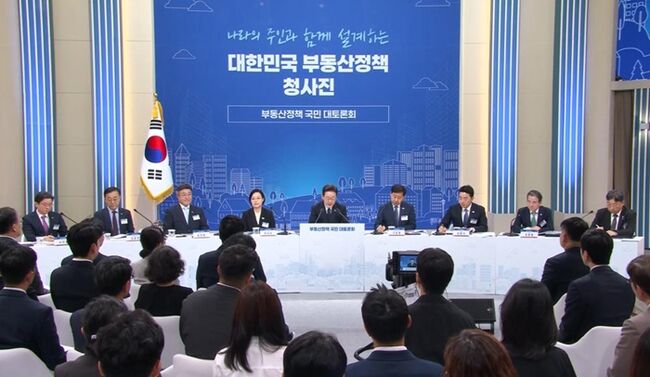 [Liberal Democratic Party Statement] Calling it a Grand Real Estate Debate… It Was Nothing More Than a Private Party Among Themselves
The 'National Grand Debate on Real Estate Policy' held on July 23rd and 27th. [Photo=Yonhap News]The 'National Grand Debate on Real Estate Policy,' hosted by the Lee Jae-myung administration under the
[Liberal Democratic Party Statement] Calling it a Grand Real Estate Debate… It Was Nothing More Than a Private Party Among Themselves
The 'National Grand Debate on Real Estate Policy' held on July 23rd and 27th. [Photo=Yonhap News]The 'National Grand Debate on Real Estate Policy,' hosted by the Lee Jae-myung administration under the
 [Photo] Evidence of Election Fraud Flooding U.S. Media… Trump Had 2.7 Million Votes Stolen
 [Video] U.S. Semiquincentennial Air Show... 'Art in the Sky' streaks across New York
 [Editorial Cartoon] A Draconian Law That Undermines Freedom of Expression

 List
List