Oil tanker passing through the Strait of Hormuz [Reuters=Yonhap News]
As U.S. President Donald Trump calls on major countries to dispatch warships to protect the shipping lanes in the Strait of Hormuz, China's strategic calculations, having been named first, are becoming increasingly complex.
This is because refusing the U.S. request, ahead of U.S.-China summit and high-level talks, could provide leverage in the negotiation process, while complying could create a rift in relations with Iran, a major crude oil importer and an ally.
China has taken the stance that "a cessation of hostile acts is paramount" and is observing the situation.
On the 14th (local time), a spokesperson for the Chinese Embassy in the U.S. stated regarding plans for naval deployment in the Strait of Hormuz that "China calls for an immediate cessation of hostile acts" and "all parties have a responsibility to ensure stable and unimpeded energy supply."
The spokesperson also reiterated China's principled position, previously announced, of strengthening communication with relevant countries, including parties to the conflict, and playing a role in de-escalation as a strategic partner in the Middle East, thus not providing a direct answer.
Chinese state-controlled media outlets have also only reported factual information regarding the request for warship deployment, without offering expert assessments or future outlooks.
From an energy security perspective, China urgently needs stability in the Strait of Hormuz. The strait is not only a critical bottleneck through which approximately 25% of global crude oil and liquefied natural gas (LNG) shipments pass, but China, the world's largest crude oil importer, imports about 45% of its oil through this strait.
This is why President Trump mentioned China, France, Japan, South Korea, and the UK in his Truth Social post, demanding warships from these five countries and referring to them as "countries affected by artificial restrictions (blockade of the Strait of Hormuz)."
Trump's mention of China can be interpreted as pointing out China's heavy reliance on Iranian crude oil imports while simultaneously sending a pressure-inducing message ahead of the U.S.-China summit.
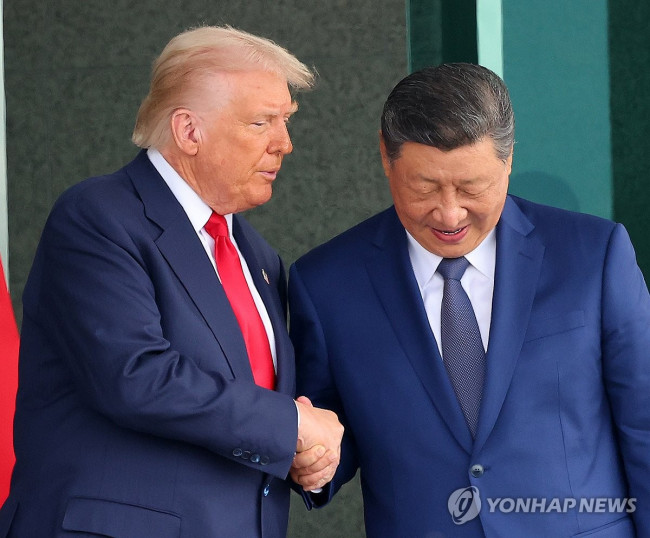 U.S. President Donald Trump and Chinese President Xi Jinping shake hands as they leave the venue after concluding their summit at the Nare-Maru Protocol Room of Gimhae Air Base in Busan on the 30th. [Yonhap News]
The complexity of China's response strategy is growing, as President Trump's demand for troop deployment ahead of the U.S.-China summit and high-level talks could serve as a "lever" in the trade negotiations with the U.S.
U.S. Treasury Secretary Steven Mnuchin and Chinese Vice Premier Hu Chunhua are scheduled to hold high-level economic consultations in Paris, France, on October 15-16 (local time). This is largely a pre-summit agenda coordination ahead of the U.S.-China summit that will take place during President Trump's visit to China at the end of this month.
In particular, discussions are expected to cover key trade negotiation issues between the two countries, including tariffs, rare earth elements, export controls on advanced technologies, and the purchase of U.S. agricultural products.
The U.S. request for China's active involvement in Middle Eastern security, just before major bilateral events, has significant room for interpretation as an attempt to strengthen negotiation leverage by highlighting "accountability" beyond just stabilizing the strait.
China, on the other hand, is refraining from criticizing the U.S. for triggering instability in the Middle East ahead of the summit, while simultaneously boasting about the restoration of relations with North Korea daily and attempting to use its influence over North Korea as a negotiation lever.
On October 12, China resumed passenger train service between Beijing and Pyongyang for the first time in six years since the spread of COVID-19, and starting from October 30, direct flight services from Beijing to Pyongyang will also resume, again for the first time in six years.
There are also analyses suggesting that it is highly unlikely for China to provide military support to the U.S. and target Iran, with whom it has maintained a strategic alliance through long-standing energy cooperation.
Dennis Wilder, former head of CIA's China analysis, told the Financial Times (FT) that "it is highly unlikely that China will send warships to cooperate with the U.S.," adding, "China has already concluded an agreement with Iran regarding the safe passage of Chinese vessels."
Concurrently, China is focusing on indirectly protecting its own vessels by discussing with Iran ways to ensure the safe passage of crude oil destined for China.
According to CNN, Iran is reportedly considering allowing only ships carrying crude oil traded in yuan to pass through the Strait of Hormuz, and AP recently reported that some merchant ships in the Strait of Hormuz and the Persian Gulf are marking themselves as 'China-related vessels' to ensure their safety.

 [Statement by the Seo-beo-kka Korea Military Academy Save-the-Nation Comrades Association] ㉛ Recount the Votes Publicly, as the Previous Recount Concealed Election Fraud
Tongyeong Mayoral Election Recount [Photo=Yonhap News]South Korea's liberal democracy is dying. The National Election Commission (NEC) and the judiciary, which have plummeted into criminal syndicates
[Statement by the Seo-beo-kka Korea Military Academy Save-the-Nation Comrades Association] ㉛ Recount the Votes Publicly, as the Previous Recount Concealed Election Fraud
Tongyeong Mayoral Election Recount [Photo=Yonhap News]South Korea's liberal democracy is dying. The National Election Commission (NEC) and the judiciary, which have plummeted into criminal syndicates
 What is the significance of the "Trump 2028" red hats that keep making a comeback?
It is noteworthy that President Donald Trump is "intentionally" fueling controversy over whether he can actually run in the 2028 presidential election, even though it is "highly likely he is seriously
What is the significance of the "Trump 2028" red hats that keep making a comeback?
It is noteworthy that President Donald Trump is "intentionally" fueling controversy over whether he can actually run in the 2028 presidential election, even though it is "highly likely he is seriously
 Jin Cummings: "North Korea says it will increase the number of spies, so what is the government doing?"
U.S. political columnist Gene Cummings has publicly questioned the South Korean government, asking, "North Korea is announcing plans to increase its number of spies, yet what is the South Korean
Jin Cummings: "North Korea says it will increase the number of spies, so what is the government doing?"
U.S. political columnist Gene Cummings has publicly questioned the South Korean government, asking, "North Korea is announcing plans to increase its number of spies, yet what is the South Korean
 Attorney Do Tae-woo: “Discrepancies in Voter Count and Improper Sealing Confirmed in Tongyeong Mayoral Recount… Official Request for Additional Verification Submitted to Gyeongnam Election Commission”
A bundle of mail-in early voting ballots captured by lawyer Do Tae-woo at the Tongyeong mayoral election recount site. A clear solid line, raising suspicions of election fraud, is visible on the side
Attorney Do Tae-woo: “Discrepancies in Voter Count and Improper Sealing Confirmed in Tongyeong Mayoral Recount… Official Request for Additional Verification Submitted to Gyeongnam Election Commission”
A bundle of mail-in early voting ballots captured by lawyer Do Tae-woo at the Tongyeong mayoral election recount site. A clear solid line, raising suspicions of election fraud, is visible on the side
 Stock Market Crash 'Black Tuesday'… KOSPI down 10.8%, KOSDAQ down 7.7%
The KOSPI fell by more than 5% in early trading on the 28th, triggering a sell-side sidecar.On the 28th, the KOSPI plunged by more than 10%.Due to the sharp decline, a sell-side sidecar—a temporary
Stock Market Crash 'Black Tuesday'… KOSPI down 10.8%, KOSDAQ down 7.7%
The KOSPI fell by more than 5% in early trading on the 28th, triggering a sell-side sidecar.On the 28th, the KOSPI plunged by more than 10%.Due to the sharp decline, a sell-side sidecar—a temporary
 [World Heritage Committee] 25 New World Heritage Sites Inscribed in Busan… South Korea Successfully Expands 'Getbol' Listing
The Chairperson of the World Heritage Committee speaks at the plenary session of the 48th session of the World Heritage Committee, held at BEXCO in Busan on the 20th. [Photo: Yonhap News]A total of 25
[World Heritage Committee] 25 New World Heritage Sites Inscribed in Busan… South Korea Successfully Expands 'Getbol' Listing
The Chairperson of the World Heritage Committee speaks at the plenary session of the 48th session of the World Heritage Committee, held at BEXCO in Busan on the 20th. [Photo: Yonhap News]A total of 25
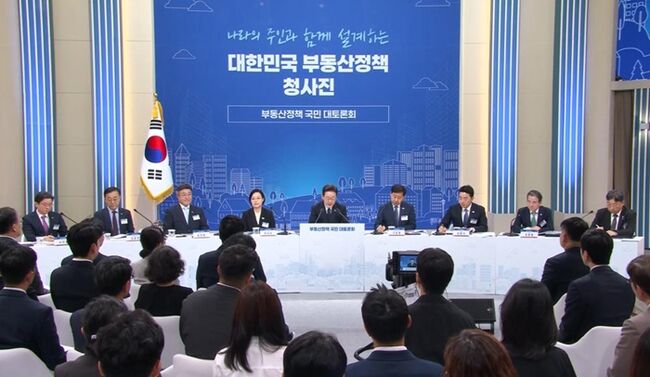 [Liberal Democratic Party Statement] Calling it a Grand Real Estate Debate… It Was Nothing More Than a Private Party Among Themselves
The 'National Grand Debate on Real Estate Policy' held on July 23rd and 27th. [Photo=Yonhap News]The 'National Grand Debate on Real Estate Policy,' hosted by the Lee Jae-myung administration under the
[Liberal Democratic Party Statement] Calling it a Grand Real Estate Debate… It Was Nothing More Than a Private Party Among Themselves
The 'National Grand Debate on Real Estate Policy' held on July 23rd and 27th. [Photo=Yonhap News]The 'National Grand Debate on Real Estate Policy,' hosted by the Lee Jae-myung administration under the
 [Photo] Evidence of Election Fraud Flooding U.S. Media… Trump Had 2.7 Million Votes Stolen
 [Video] U.S. Semiquincentennial Air Show... 'Art in the Sky' streaks across New York
 [Editorial Cartoon] A Draconian Law That Undermines Freedom of Expression

 List
List