 Strait of Hormuz. Five oil fields along the coast of the Persian Gulf in western Iran and an oil pipeline connecting them to the port of Jask [Photo=Wikimedia Commons]
There is a possibility that the ongoing military conflict in the Middle East is entering a new phase.
With U.S. President Donald Trump mentioning the possibility of a "large-scale attack next week," military experts are analyzing the unfolding events, viewing the military actions so far as "Act 1" of a war and hypothesizing a "Act 2" structure.
According to strategic analysis by Hanmiilbo, the military actions to date exhibit characteristics of a typical initial war phase, namely, weakening the enemy's war capabilities.
In particular, the primary targets of the initial attacks were Iran's military production capabilities. Missile and drone production facilities, military factories, and military logistics facilities were major strike targets. These attacks are interpreted not as simple tactical strikes but as a strategic phase aimed at weakening weapon production capabilities in preparation for a prolonged war.
Concurrently, air defense systems, including air defense radars and missile bases, were also primary attack targets. This can be seen as a phase to secure air superiority for subsequent operations.
Due to these operational patterns, an analysis suggests that the military actions so far constitute Act 1 of a war, focused on weakening military production capabilities and air defense systems.
Interestingly, President Trump recently made remarks to the effect that "the war is practically over." This statement is being interpreted not just as political rhetoric but as a potential indication that the war's objectives have already been achieved to a certain extent.
The reason for this is the possibility that the next phase of the war may shift towards a strategic blockade surrounding Iran.
The Strait of Hormuz is undoubtedly a key area. This strait is a crucial artery for global oil transportation, with a significant portion of Middle East energy flows passing through it.
A substantial amount of Iran's oil exports also traverse this strait. Therefore, if this waterway were to be militarily controlled, it could signify more than just a military conflict; it could represent a strategic blockade aimed at pressuring Iran's oil supply routes.
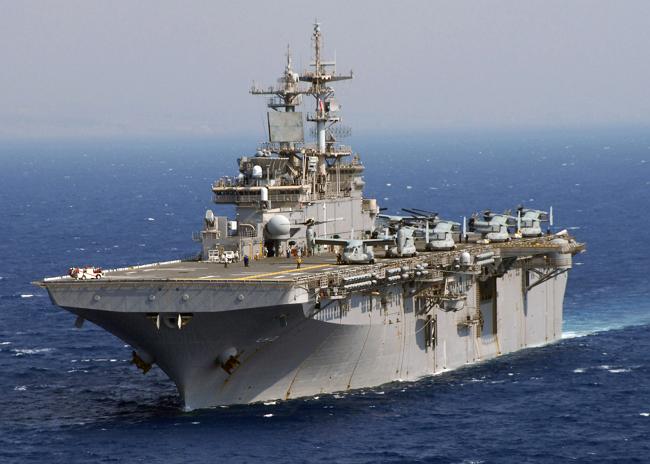 U.S. Marine MV-22 Ospreys are prepared for launch from the deck of the amphibious assault ship USS Wasp in the Gulf of Aqaba. The Wasp was deployed to the Middle East for the first operational deployment of the Osprey. [Photo=U.S. Navy]
The recent movement of U.S. Navy amphibious assault ship forces to the Middle East region is also drawing the attention of military experts.
Amphibious assault ships are not merely air strike assets but are forces used for Marine landings and island control operations. Consequently, among military experts, there is an analysis that if the war progresses to the next stage, the focus of operations might shift to controlling coastlines and straits.
The primary forces threatening the Strait are mostly shore-based. Coastal missile bases, radars, fast attack craft, and mine warfare capabilities are representative examples.
These forces are largely operated from Iran's southern coast and islands at the entrance to the strait.
Notable strategic strongholds include Abu Musa Island, Greater Tunb Island, and Lesser Tunb Island.
These islands are strategically important as they are positioned to monitor the entrance to the Strait of Hormuz and operate missiles. They are known to be major bases for the Navy of the Islamic Revolutionary Guard Corps, equipped with short-range missiles and radar facilities.
As the war progresses to the next phase, there is a possibility of maritime operations-focused military phases unfolding, including the elimination of coastal missile bases, disruption of radar networks, and control of islands around the strait.
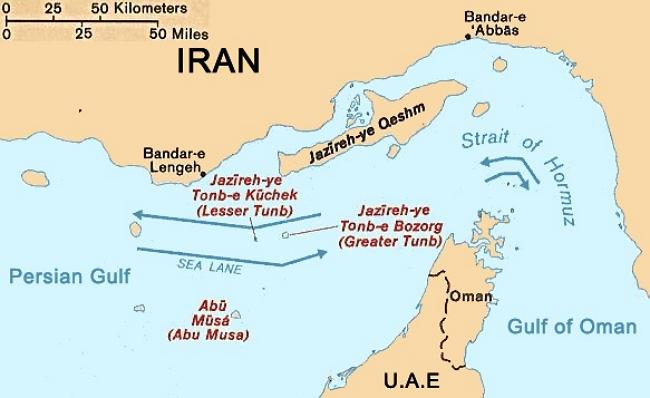 A derivative image based on a public domain work (PD-US-Gov) created by the U.S. Central Intelligence Agency (CIA) in 1980.
Another notable change in this process is the operational structure.
Up to this point, the response has been largely country-specific. However, major allied navies are already deployed in the Middle East waters.
The United Kingdom is traditionally recognized for its superior mine-clearing capabilities. The British Navy's strength in mine countermeasures could play a significant role in a blockade situation in the strait.
France operates a military base in Abu Dhabi near the Persian Gulf, placing it in a position for immediate operational support in the Middle East theater.
South Korea and Japan have experience conducting anti-piracy and maritime safety operations in the Gulf and surrounding waters, suggesting they could play a role if they participate in maritime control operations.
If the allied naval forces already deployed in the Middle East waters are integrated into a unified operational system, the conflict could potentially evolve beyond simple airstrikes into a combined maritime blockade operation surrounding Iran.
Hanmiilbo's strategic analysis views the military actions to date as Act 1, focused on weakening military production capabilities and air defense systems, and the subsequent possibility as Act 2, a phase of maritime blockade centered on the Strait of Hormuz.
In this scenario, the war's objective would extend beyond merely destroying Iran's military capabilities. Strategic blockade, aimed at restricting Iran's oil exports and maritime access, could emerge as the core objective of the war.
Military experts believe that if this phase materializes, the Middle East conflict could transform from a war primarily focused on airstrikes into a strategic blockade war centered on controlling the strait and energy flows.
President Trump's warning on the 9th, "I will prevent Iran from being rebuilt as a nation," suggests the possibility of this conflict escalating to Act 3, targeting the nation's foundations, thus drawing attention to Iran's response.

 Iranian Foreign Ministry: "Continuing Message Exchanges with the U.S. and Activities of Mediating Countries"
Esmaeil Baghaei, Spokesperson for the Iranian Ministry of Foreign Affairs [Xinhua, Yonhap News file photo]Esmaeil Baghaei, spokesperson for the Iranian Ministry of Foreign Affairs, stated on the 26th
Iranian Foreign Ministry: "Continuing Message Exchanges with the U.S. and Activities of Mediating Countries"
Esmaeil Baghaei, Spokesperson for the Iranian Ministry of Foreign Affairs [Xinhua, Yonhap News file photo]Esmaeil Baghaei, spokesperson for the Iranian Ministry of Foreign Affairs, stated on the 26th
 President Yoon: "Do You Think You Are Safe from the Special Counsel?"... Final Statement Video Released
President Yoon Suk Yeol rebuking the special prosecutor on the 24th. [Court video / @birds_justice X account subtitle GIF] A video of President Yoon Suk Yeol's closing statement at his trial rega
President Yoon: "Do You Think You Are Safe from the Special Counsel?"... Final Statement Video Released
President Yoon Suk Yeol rebuking the special prosecutor on the 24th. [Court video / @birds_justice X account subtitle GIF] A video of President Yoon Suk Yeol's closing statement at his trial rega
 President Yoon, regarding the first-instance ruling on the Public Official Election Act: “An excessive political verdict that distorts the facts… We will appeal immediately.”
The first-instance sentencing hearing for President Yoon Suk Yeol regarding violations of the Public Official Election Act is being broadcast live at Seoul Station on the 27th. [Photo=Yonhap News]Pres
President Yoon, regarding the first-instance ruling on the Public Official Election Act: “An excessive political verdict that distorts the facts… We will appeal immediately.”
The first-instance sentencing hearing for President Yoon Suk Yeol regarding violations of the Public Official Election Act is being broadcast live at Seoul Station on the 27th. [Photo=Yonhap News]Pres
 WSJ: "SK Hynix ADR Premium Is a Sign of AI Trading Overheat"
Advertisement for SK Hynix ADR listing in New York's Times Square [Reuters=Yonhap News file photo]The Wall Street Journal (WSJ) has pointed out that the price of SK Hynix’s American Depositary Recei
WSJ: "SK Hynix ADR Premium Is a Sign of AI Trading Overheat"
Advertisement for SK Hynix ADR listing in New York's Times Square [Reuters=Yonhap News file photo]The Wall Street Journal (WSJ) has pointed out that the price of SK Hynix’s American Depositary Recei
 'Godfather of Japanese Mystery Novels' Keigo Higashino Passes Away After Battle with Cancer at 68
Famous Japanese mystery novelist Keigo Higashino [AFP=Yonhap News]It has been belatedly reported that Keigo Higashino, the "godfather of Japanese mystery novels" and author of bestsellers such as "The
'Godfather of Japanese Mystery Novels' Keigo Higashino Passes Away After Battle with Cancer at 68
Famous Japanese mystery novelist Keigo Higashino [AFP=Yonhap News]It has been belatedly reported that Keigo Higashino, the "godfather of Japanese mystery novels" and author of bestsellers such as "The
 [Park Pil-kyu Security Column] To the Ignorant Trying to Clothe a Beast in Sheep's Clothing
Rep. Kim Byung-joo of the Democratic Party of Korea [Photo=Yonhap News]“The Air Force Academy doesn't teach you how to fly a plane!” “The Army, Navy, and Air Force academies are exactly the
[Park Pil-kyu Security Column] To the Ignorant Trying to Clothe a Beast in Sheep's Clothing
Rep. Kim Byung-joo of the Democratic Party of Korea [Photo=Yonhap News]“The Air Force Academy doesn't teach you how to fly a plane!” “The Army, Navy, and Air Force academies are exactly the
 [Issue Diagnosis] Two Effects of the Election Petition Review
 [Photo] Evidence of Election Fraud Flooding U.S. Media… Trump Had 2.7 Million Votes Stolen
 [Video] U.S. Semiquincentennial Air Show... 'Art in the Sky' streaks across New York
 [Editorial Cartoon] A Draconian Law That Undermines Freedom of Expression

 List
List










