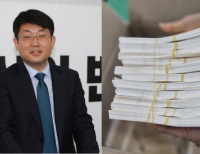
Former Seoul Metropolitan Council member Kim Gyeong (left) and independent lawmaker Kang Seon-woo, arrested on charges of exchanging nomination funds.
The political sphere is once again being shaken by a bribery scandal surrounding nominations for local elections.
Although allegations of money changing hands for nominations have surfaced, the charges applied by the police were violations of the Political Funds Act and breach of trust, not bribery, leading to accusations of a "leniency".
The reason the police could not apply bribery charges is simple. The law views nominations not as public affairs but as internal party activities, or party duties.
Supreme Court precedents also hold the same interpretation. Political parties are considered political associations, not state agencies, and nominations are internal political activities of the party.
Therefore, even if a member of the National Assembly is involved in the nomination process, it is difficult to consider it as performing official duties under criminal law. The logic is that since it is not a public duty, bribery charges are also difficult to establish.
From a legal perspective, this argument seems plausible. However, it is far from reality in politics.
In Korean politics, nominations are not merely internal party appointments. Especially in local elections, a nomination often signifies election itself.
In reality, National Assembly members control regional party chapters, and these chapters influence local election nominations. Candidates who receive nominations become local council members, and these local councils, in turn, form the local political power structure.
Ultimately, this structure means that National Assembly members effectively hold the appointment power for local politics.
In practical politics, nominations are a power that determines entry into public office.
However, the law considers this power to be in the private domain. It's a structure where power performs public functions, but responsibility remains in the private sphere.
This is why, even when nomination-related bribery cases occur, they are usually processed as violations of the Political Funds Act or breach of trust, rather than bribery.
The problem is that as long as this structure persists, nomination corruption cannot be fundamentally curbed.
This is also why bribery scandals surrounding nominations are repeated. It is because, although it is the power to create public office, it is legally not considered a public duty.
It is time to fill this institutional gap. A provision should be newly added to the Public Official Election Act to clearly define as election crimes any instances where money or financial benefits are exchanged during a party's candidate recommendation and nomination process.
This means that the exchange of nomination funds should be defined not merely as a political funding issue, but as a crime that undermines the electoral order.
This is, in a way, a "Kang Seon-woo Prevention Act."
While the autonomy of political parties should be respected, the power to create public office cannot remain entirely in the private domain. Nominations are internal party activities, and at the same time, they are the gateway to public office.
The act of buying and selling nominations is, in essence, no different from buying and selling national representatives. If the power to create public office is not a public duty, then what exactly constitutes a public duty in Korean politics?
This question can no longer be postponed.
We must enact a "Kang Seon-woo Prevention Act" to fill the legal vacuum surrounding the nomination power.

 [Statement by the Seo-beo-kka Korea Military Academy Save-the-Nation Comrades Association] ㉛ Recount the Votes Publicly, as the Previous Recount Concealed Election Fraud
Tongyeong Mayoral Election Recount [Photo=Yonhap News]South Korea's liberal democracy is dying. The National Election Commission (NEC) and the judiciary, which have plummeted into criminal syndicates
[Statement by the Seo-beo-kka Korea Military Academy Save-the-Nation Comrades Association] ㉛ Recount the Votes Publicly, as the Previous Recount Concealed Election Fraud
Tongyeong Mayoral Election Recount [Photo=Yonhap News]South Korea's liberal democracy is dying. The National Election Commission (NEC) and the judiciary, which have plummeted into criminal syndicates
 What is the significance of the "Trump 2028" red hats that keep making a comeback?
It is noteworthy that President Donald Trump is "intentionally" fueling controversy over whether he can actually run in the 2028 presidential election, even though it is "highly likely he is seriously
What is the significance of the "Trump 2028" red hats that keep making a comeback?
It is noteworthy that President Donald Trump is "intentionally" fueling controversy over whether he can actually run in the 2028 presidential election, even though it is "highly likely he is seriously
 Jin Cummings: "North Korea says it will increase the number of spies, so what is the government doing?"
U.S. political columnist Gene Cummings has publicly questioned the South Korean government, asking, "North Korea is announcing plans to increase its number of spies, yet what is the South Korean
Jin Cummings: "North Korea says it will increase the number of spies, so what is the government doing?"
U.S. political columnist Gene Cummings has publicly questioned the South Korean government, asking, "North Korea is announcing plans to increase its number of spies, yet what is the South Korean
 Attorney Do Tae-woo: “Discrepancies in Voter Count and Improper Sealing Confirmed in Tongyeong Mayoral Recount… Official Request for Additional Verification Submitted to Gyeongnam Election Commission”
A bundle of mail-in early voting ballots captured by lawyer Do Tae-woo at the Tongyeong mayoral election recount site. A clear solid line, raising suspicions of election fraud, is visible on the side
Attorney Do Tae-woo: “Discrepancies in Voter Count and Improper Sealing Confirmed in Tongyeong Mayoral Recount… Official Request for Additional Verification Submitted to Gyeongnam Election Commission”
A bundle of mail-in early voting ballots captured by lawyer Do Tae-woo at the Tongyeong mayoral election recount site. A clear solid line, raising suspicions of election fraud, is visible on the side
 Stock Market Crash 'Black Tuesday'… KOSPI down 10.8%, KOSDAQ down 7.7%
The KOSPI fell by more than 5% in early trading on the 28th, triggering a sell-side sidecar.On the 28th, the KOSPI plunged by more than 10%.Due to the sharp decline, a sell-side sidecar—a temporary
Stock Market Crash 'Black Tuesday'… KOSPI down 10.8%, KOSDAQ down 7.7%
The KOSPI fell by more than 5% in early trading on the 28th, triggering a sell-side sidecar.On the 28th, the KOSPI plunged by more than 10%.Due to the sharp decline, a sell-side sidecar—a temporary
 [World Heritage Committee] 25 New World Heritage Sites Inscribed in Busan… South Korea Successfully Expands 'Getbol' Listing
The Chairperson of the World Heritage Committee speaks at the plenary session of the 48th session of the World Heritage Committee, held at BEXCO in Busan on the 20th. [Photo: Yonhap News]A total of 25
[World Heritage Committee] 25 New World Heritage Sites Inscribed in Busan… South Korea Successfully Expands 'Getbol' Listing
The Chairperson of the World Heritage Committee speaks at the plenary session of the 48th session of the World Heritage Committee, held at BEXCO in Busan on the 20th. [Photo: Yonhap News]A total of 25
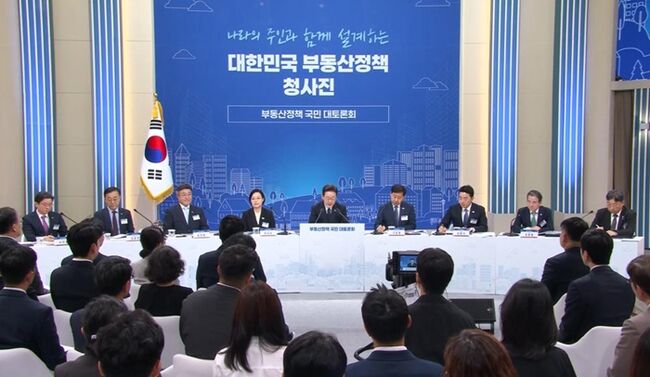 [Liberal Democratic Party Statement] Calling it a Grand Real Estate Debate… It Was Nothing More Than a Private Party Among Themselves
The 'National Grand Debate on Real Estate Policy' held on July 23rd and 27th. [Photo=Yonhap News]The 'National Grand Debate on Real Estate Policy,' hosted by the Lee Jae-myung administration under the
[Liberal Democratic Party Statement] Calling it a Grand Real Estate Debate… It Was Nothing More Than a Private Party Among Themselves
The 'National Grand Debate on Real Estate Policy' held on July 23rd and 27th. [Photo=Yonhap News]The 'National Grand Debate on Real Estate Policy,' hosted by the Lee Jae-myung administration under the
 [Photo] Evidence of Election Fraud Flooding U.S. Media… Trump Had 2.7 Million Votes Stolen
 [Video] U.S. Semiquincentennial Air Show... 'Art in the Sky' streaks across New York
 [Editorial Cartoon] A Draconian Law That Undermines Freedom of Expression

 List
List