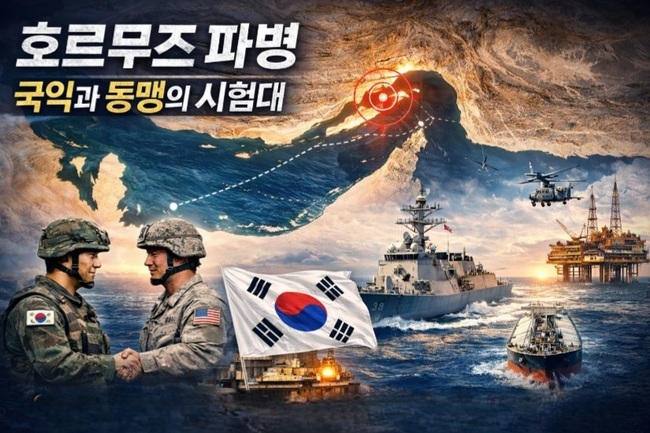
U.S. President Trump's demand for troop deployment in Middle Eastern waters has placed South Korea, Japan, the UK, and China, among other major nations, in a difficult position with varying concerns.
South Korea is already operating the Cheonghae Unit, but faces a challenging decision regarding additional troop deployment due to the high risks in the Strait of Hormuz and domestic political burdens.
Japan, constrained by its pacifist constitution and sensitive public opinion, must approach military deployments cautiously. This complex situation is further complicated by the upcoming U.S.-Japan summit and the need to consider relations with the United States.
The UK is opting for a more flexible approach, exploring various means to ensure maritime security rather than immediately sending troops at the U.S.'s request.
China shares an interest in the stability of the Strait, but accepting the U.S.'s request would significantly increase its strategic burden in the U.S.-China competition. Conversely, refusal would invite criticism for evading international responsibility. Therefore, China is likely to maintain strategic ambiguity, reiterating diplomatic statements.
However, this issue is not merely a matter of diplomatic choice for us. Protecting our oil tankers and maritime industries, fulfilling our role as a middle power, upholding the trust of our blood-allied partners, and generating national interests based on alliances are interconnected issues.
This is a critical strategic issue involving national survival, national interests, alliance trust, and military capability enhancement. We must review the Hormuz deployment not through emotional pro or con arguments or parliamentary approval, but from the perspective of our responsibilities as a nation, objective reality, and national interests.
Participation in International Maritime Security Protects Our Ships, Maritime Industry, and Economy
Since 2020, the Republic of Korea has officially expanded the operational area of the Cheonghae Unit to conduct independent operations in the Strait of Hormuz region. This mission, under the sole command of the South Korean military, involves protecting Korean vessels. Troop deployment is not new to us; we have deployed forces when necessary for our national interests.
The Strait of Hormuz is a vital chokepoint for global energy transportation. A significant portion of South Korea's imported crude oil and gas passes through this narrow waterway. Instability here directly leads to instability in the South Korean economy.
The safe passage of oil tankers is essential for industry to operate and for citizens' livelihoods to be maintained. Therefore, contributing to the security of this region is not about intervening in another country's war. Currently, seven oil tankers are trapped in the Strait of Hormuz, trembling in fear. The Hormuz deployment is about maritime security that protects our ships, our industry, and our economy.
South Korea's Overseas Deployments: A Role as a Middle Power in the International Community
The Republic of Korea has a long history of overseas troop deployments. The participation in the Vietnam War from September 1964 to March 1973 was driven by the pragmatic reasons of contributing to the alliance and securing national interests. Subsequently, through participation in international peacekeeping operations in the Gulf War, Somalia, and Angola, South Korea established itself as a responsible middle power.
In the 2000s, the Zaytun Division in Iraq and the Osino Unit in Afghanistan were responsible for reconstruction and security support, while the Cheonghae Unit has been engaged in anti-piracy and merchant vessel protection missions in the Gulf of Aden since 2009.
Currently, the Republic of Korea continues to contribute to international security in various regions through units such as the Dongmyeong Unit in Lebanon, the Akh Unit in the UAE, the Hanbit Unit in South Sudan, and the Cheonghae Unit in the Gulf of Aden. We are already fulfilling our role as a responsible nation, and the Hormuz deployment should be considered an extension of our international peacekeeping activities.
Hormuz Deployment: Generating National Interests Based on Alliances
From an alliance perspective, the purpose of deployment becomes clear. Alliances are not convenient relationships to be invoked only when needed. The ROK-U.S. alliance is a blood alliance that has protected each other's lives and national interests through war and crisis. Standing with our allies is a path to restoring alliance trust and securing future security.
International politics is pragmatic. To receive help in times of difficulty, contributing when others face hardship is a fundamental principle of alliance. Helping during difficult and necessary times defines a true alliance, and that trust ultimately benefits us. Standing with our allies is about restoring trust and protecting our future.
Deployment in Military Terms is an Investment in Strengthening Our Military's Future Capabilities
Although the Strait of Hormuz is a dangerous region, experience in a high-difficulty operational environment significantly enhances our military's combat readiness. Joint operational experience leads to tangible benefits such as sharing intelligence, reconnaissance, and defense systems. This is also an investment in strengthening our military's future capabilities. What we gain is directly proportional to the risks we undertake.
There is no reason for the military leadership to hesitate in recommending deployment if they first assess the situation on the ground and determine that the gains outweigh the losses. What is needed now is not debate, but a decisive action from the Commander-in-Chief for the sake of national interests and future alliances. The sooner the decision is made, the less division there will be among the public.
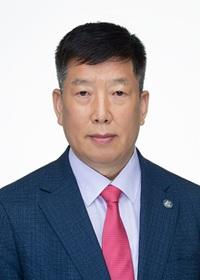
◆ Park Pil-kyu
Editor at Hankook Ilbo
40th graduating class, Korea Military Academy

 [Statement by the Seo-beo-kka Korea Military Academy Save-the-Nation Comrades Association] ㉛ Recount the Votes Publicly, as the Previous Recount Concealed Election Fraud
Tongyeong Mayoral Election Recount [Photo=Yonhap News]South Korea's liberal democracy is dying. The National Election Commission (NEC) and the judiciary, which have plummeted into criminal syndicates
[Statement by the Seo-beo-kka Korea Military Academy Save-the-Nation Comrades Association] ㉛ Recount the Votes Publicly, as the Previous Recount Concealed Election Fraud
Tongyeong Mayoral Election Recount [Photo=Yonhap News]South Korea's liberal democracy is dying. The National Election Commission (NEC) and the judiciary, which have plummeted into criminal syndicates
 What is the significance of the "Trump 2028" red hats that keep making a comeback?
It is noteworthy that President Donald Trump is "intentionally" fueling controversy over whether he can actually run in the 2028 presidential election, even though it is "highly likely he is seriously
What is the significance of the "Trump 2028" red hats that keep making a comeback?
It is noteworthy that President Donald Trump is "intentionally" fueling controversy over whether he can actually run in the 2028 presidential election, even though it is "highly likely he is seriously
 Jin Cummings: "North Korea says it will increase the number of spies, so what is the government doing?"
U.S. political columnist Gene Cummings has publicly questioned the South Korean government, asking, "North Korea is announcing plans to increase its number of spies, yet what is the South Korean
Jin Cummings: "North Korea says it will increase the number of spies, so what is the government doing?"
U.S. political columnist Gene Cummings has publicly questioned the South Korean government, asking, "North Korea is announcing plans to increase its number of spies, yet what is the South Korean
 Attorney Do Tae-woo: “Discrepancies in Voter Count and Improper Sealing Confirmed in Tongyeong Mayoral Recount… Official Request for Additional Verification Submitted to Gyeongnam Election Commission”
A bundle of mail-in early voting ballots captured by lawyer Do Tae-woo at the Tongyeong mayoral election recount site. A clear solid line, raising suspicions of election fraud, is visible on the side
Attorney Do Tae-woo: “Discrepancies in Voter Count and Improper Sealing Confirmed in Tongyeong Mayoral Recount… Official Request for Additional Verification Submitted to Gyeongnam Election Commission”
A bundle of mail-in early voting ballots captured by lawyer Do Tae-woo at the Tongyeong mayoral election recount site. A clear solid line, raising suspicions of election fraud, is visible on the side
 Stock Market Crash 'Black Tuesday'… KOSPI down 10.8%, KOSDAQ down 7.7%
The KOSPI fell by more than 5% in early trading on the 28th, triggering a sell-side sidecar.On the 28th, the KOSPI plunged by more than 10%.Due to the sharp decline, a sell-side sidecar—a temporary
Stock Market Crash 'Black Tuesday'… KOSPI down 10.8%, KOSDAQ down 7.7%
The KOSPI fell by more than 5% in early trading on the 28th, triggering a sell-side sidecar.On the 28th, the KOSPI plunged by more than 10%.Due to the sharp decline, a sell-side sidecar—a temporary
 [World Heritage Committee] 25 New World Heritage Sites Inscribed in Busan… South Korea Successfully Expands 'Getbol' Listing
The Chairperson of the World Heritage Committee speaks at the plenary session of the 48th session of the World Heritage Committee, held at BEXCO in Busan on the 20th. [Photo: Yonhap News]A total of 25
[World Heritage Committee] 25 New World Heritage Sites Inscribed in Busan… South Korea Successfully Expands 'Getbol' Listing
The Chairperson of the World Heritage Committee speaks at the plenary session of the 48th session of the World Heritage Committee, held at BEXCO in Busan on the 20th. [Photo: Yonhap News]A total of 25
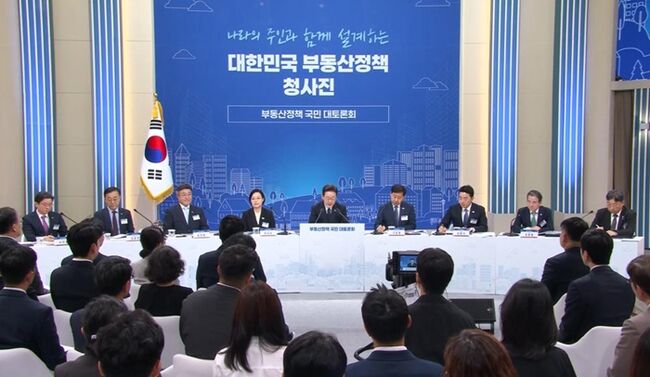 [Liberal Democratic Party Statement] Calling it a Grand Real Estate Debate… It Was Nothing More Than a Private Party Among Themselves
The 'National Grand Debate on Real Estate Policy' held on July 23rd and 27th. [Photo=Yonhap News]The 'National Grand Debate on Real Estate Policy,' hosted by the Lee Jae-myung administration under the
[Liberal Democratic Party Statement] Calling it a Grand Real Estate Debate… It Was Nothing More Than a Private Party Among Themselves
The 'National Grand Debate on Real Estate Policy' held on July 23rd and 27th. [Photo=Yonhap News]The 'National Grand Debate on Real Estate Policy,' hosted by the Lee Jae-myung administration under the
 [Photo] Evidence of Election Fraud Flooding U.S. Media… Trump Had 2.7 Million Votes Stolen
 [Video] U.S. Semiquincentennial Air Show... 'Art in the Sky' streaks across New York
 [Editorial Cartoon] A Draconian Law That Undermines Freedom of Expression

 List
List