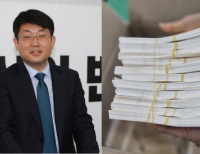
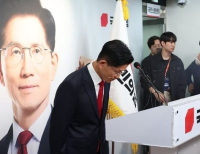
President Lee Jae-myung [Photo: Yonhap News]
President Lee Jae-myung emphasized the importance of cooperation between the party and the government in pursuing reform tasks during a dinner with first-term lawmakers of the Democratic Party of Korea, leading to interpretations in political circles that the president has personally taken charge of managing the ruling party.
The president's direct message, particularly at a time when subtle differences in opinion are emerging within the ruling party regarding prosecutorial reform, is being seen as a signal indicating the direction of the relationship between the party and the Blue House.
President Lee Jae-myung stated on the evening of the 15th, during a dinner with 34 first-term lawmakers of the Democratic Party of Korea at his official residence in Hannam-dong, Seoul, "The party is doing a really good job," and added, "Let's uphold our initial intentions, complete reforms in their true meaning, and engage in politics that is evaluated through them," according to Park Ji-hye, the spokesperson for the Democratic Party of Korea.
Although ostensibly an occasion to encourage ruling party lawmakers, many in political circles are interpreting this dinner not as a mere social gathering but as a political move to reorient the party-government relationship.
The president's direct message is particularly noteworthy given the differing opinions within the ruling party regarding the pace and direction of legislation for the establishment of the new Corruption Investigation Office for High-ranking Officials (CIO) and the Prosecution Office (PO), which the government is pursuing.
According to multiple attendees, President Lee Jae-myung commented on the prosecutorial reform controversy, saying, "Not all prosecutors are bad, are they?" and "It's not logical to say that the prosecution has become stronger," in essence.
He explained that claiming the prosecution's authority has been strengthened is inconsistent with reality, given that its direct investigative powers are effectively being stripped away.
Furthermore, regarding the objection raised by some hardliners to the government's proposal to retain the title of 'Prosecutor General' for the head of the PO, President Lee Jae-myung reportedly remarked, "What is the problem with the title Prosecutor General?"
In political circles, these remarks are being interpreted as an indirect message to temper the hardline faction within the ruling party.
President Lee Jae-myung also reportedly emphasized the need for speed control in the reform process.
He is said to have commented along the lines of, "We must create the changes that the people want," and "It is important to tackle the tasks that the people want one by one, steadily." This is interpreted as a message conveying the recognition that while the direction of reform should be maintained, the method of expanding political conflict is not desirable.
The fact that the president invited first-term lawmakers to his residence for a separate dinner is also seen as politically significant.
This is because first-term lawmakers are highly likely to hold important positions in the future party power structure. Specifically, direct communication with first-term lawmakers during the restructuring of the Democratic Party's internal power dynamics following the launch of the Lee Jae-myung administration could have the effect of strengthening his base within the party.
Meanwhile, on the 16th, Jeong Cheong-rae, the leader of the Democratic Party of Korea, emphasized regarding the legislation for the PO and CIO, "While each article of the law is important, it is also important to adhere to the overarching principle of separating investigation and prosecution."
In political circles, these remarks are being interpreted as a jab at the issue of supplementary investigative powers granted to prosecutors in the PO, given that some hardliners within the party have continuously raised concerns that the principle of separating investigation and prosecution could be effectively undermined if these powers are retained.
Some in political circles argue that the core of the prosecutorial reform debate is not the title of Prosecutor General but rather the supplementary investigative powers.
This is because, even with the separation of investigation and prosecution, if the power to request supplementary investigations remains with the PO prosecutors, substantial investigative control could be maintained.
Notably, Jeong mentioned former President Roh Moo-hyun's death when discussing prosecutorial reform, stating, "When I mention prosecutorial reform, the death of the late President Roh Moo-hyun naturally comes to mind."
Political circles are interpreting these remarks as a message that re-emphasizes prosecutorial reform not as a mere institutional change but as a historical imperative.
Such remarks are also being read as a contrasting message to President Lee Jae-myung's emphasis on pursuing reform centered on the government's proposals during his dinner with first-term lawmakers the previous day.
While the president emphasized cooperation, the signal interpreted by political circles was 'managing the ruling party'.
The question remains whether the horizontal party-government relationship, which the ruling party has spoken of, can be maintained in real politics.
Regarding this dinner, political circles are offering assessments such as, "The president has not managed prosecutorial reform, but has begun to manage the ruling party."

 [Statement by the Seo-beo-kka Korea Military Academy Save-the-Nation Comrades Association] ㉛ Recount the Votes Publicly, as the Previous Recount Concealed Election Fraud
Tongyeong Mayoral Election Recount [Photo=Yonhap News]South Korea's liberal democracy is dying. The National Election Commission (NEC) and the judiciary, which have plummeted into criminal syndicates
[Statement by the Seo-beo-kka Korea Military Academy Save-the-Nation Comrades Association] ㉛ Recount the Votes Publicly, as the Previous Recount Concealed Election Fraud
Tongyeong Mayoral Election Recount [Photo=Yonhap News]South Korea's liberal democracy is dying. The National Election Commission (NEC) and the judiciary, which have plummeted into criminal syndicates
 What is the significance of the "Trump 2028" red hats that keep making a comeback?
It is noteworthy that President Donald Trump is "intentionally" fueling controversy over whether he can actually run in the 2028 presidential election, even though it is "highly likely he is seriously
What is the significance of the "Trump 2028" red hats that keep making a comeback?
It is noteworthy that President Donald Trump is "intentionally" fueling controversy over whether he can actually run in the 2028 presidential election, even though it is "highly likely he is seriously
 Jin Cummings: "North Korea says it will increase the number of spies, so what is the government doing?"
U.S. political columnist Gene Cummings has publicly questioned the South Korean government, asking, "North Korea is announcing plans to increase its number of spies, yet what is the South Korean
Jin Cummings: "North Korea says it will increase the number of spies, so what is the government doing?"
U.S. political columnist Gene Cummings has publicly questioned the South Korean government, asking, "North Korea is announcing plans to increase its number of spies, yet what is the South Korean
 Attorney Do Tae-woo: “Discrepancies in Voter Count and Improper Sealing Confirmed in Tongyeong Mayoral Recount… Official Request for Additional Verification Submitted to Gyeongnam Election Commission”
A bundle of mail-in early voting ballots captured by lawyer Do Tae-woo at the Tongyeong mayoral election recount site. A clear solid line, raising suspicions of election fraud, is visible on the side
Attorney Do Tae-woo: “Discrepancies in Voter Count and Improper Sealing Confirmed in Tongyeong Mayoral Recount… Official Request for Additional Verification Submitted to Gyeongnam Election Commission”
A bundle of mail-in early voting ballots captured by lawyer Do Tae-woo at the Tongyeong mayoral election recount site. A clear solid line, raising suspicions of election fraud, is visible on the side
 Stock Market Crash 'Black Tuesday'… KOSPI down 10.8%, KOSDAQ down 7.7%
The KOSPI fell by more than 5% in early trading on the 28th, triggering a sell-side sidecar.On the 28th, the KOSPI plunged by more than 10%.Due to the sharp decline, a sell-side sidecar—a temporary
Stock Market Crash 'Black Tuesday'… KOSPI down 10.8%, KOSDAQ down 7.7%
The KOSPI fell by more than 5% in early trading on the 28th, triggering a sell-side sidecar.On the 28th, the KOSPI plunged by more than 10%.Due to the sharp decline, a sell-side sidecar—a temporary
 [World Heritage Committee] 25 New World Heritage Sites Inscribed in Busan… South Korea Successfully Expands 'Getbol' Listing
The Chairperson of the World Heritage Committee speaks at the plenary session of the 48th session of the World Heritage Committee, held at BEXCO in Busan on the 20th. [Photo: Yonhap News]A total of 25
[World Heritage Committee] 25 New World Heritage Sites Inscribed in Busan… South Korea Successfully Expands 'Getbol' Listing
The Chairperson of the World Heritage Committee speaks at the plenary session of the 48th session of the World Heritage Committee, held at BEXCO in Busan on the 20th. [Photo: Yonhap News]A total of 25
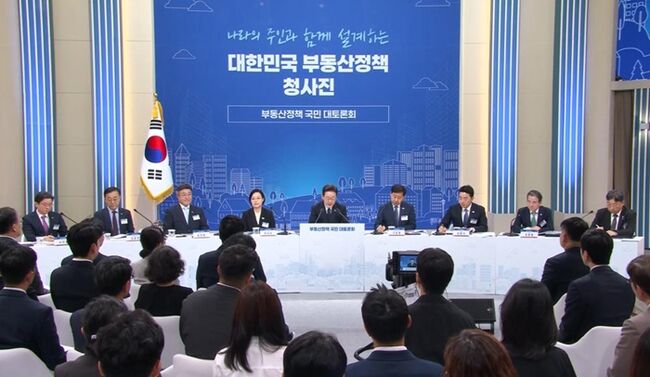 [Liberal Democratic Party Statement] Calling it a Grand Real Estate Debate… It Was Nothing More Than a Private Party Among Themselves
The 'National Grand Debate on Real Estate Policy' held on July 23rd and 27th. [Photo=Yonhap News]The 'National Grand Debate on Real Estate Policy,' hosted by the Lee Jae-myung administration under the
[Liberal Democratic Party Statement] Calling it a Grand Real Estate Debate… It Was Nothing More Than a Private Party Among Themselves
The 'National Grand Debate on Real Estate Policy' held on July 23rd and 27th. [Photo=Yonhap News]The 'National Grand Debate on Real Estate Policy,' hosted by the Lee Jae-myung administration under the
 [Photo] Evidence of Election Fraud Flooding U.S. Media… Trump Had 2.7 Million Votes Stolen
 [Video] U.S. Semiquincentennial Air Show... 'Art in the Sky' streaks across New York
 [Editorial Cartoon] A Draconian Law That Undermines Freedom of Expression

 List
List