U.S. Central Command announced on the 17th (local time) via social media that it had struck an Iranian missile base in the Strait of Hormuz. [Photo=U.S. Central Command]
The U.S. military has struck a missile base on the Iranian coast near the Strait of Hormuz with a bunker buster, also known as a "bunker buster." Amid escalating military tensions surrounding the Strait of Hormuz, a key chokepoint for global oil transport, analyses suggest this attack could go beyond a simple airstrike and lead to the next phase of the war.
U.S. Central Command (CENTCOM) announced on the social media platform X on the 17th (local time), "A few hours ago, U.S. forces employed multiple 5,000-pound penetrating bunker buster munitions against hardened missile sites on the Iranian coast near the Strait of Hormuz."
CENTCOM further explained, "Iran's anti-ship cruise missiles deployed at these sites posed a threat to international shipping traversing the strait."
Penetrating bunker busters are weapons designed to penetrate soil, rock, and concrete structures before exploding internally, and are used to destroy underground facilities or hardened military bases. This attack appears to have directly targeted the missile bases and underground facilities Iran has been building in coastal areas.
Military experts are focusing on the fact that this airstrike is not a mere warning shot but rather an operation aimed at crippling Iran's ability to blockade the strait. Iran has maintained a strategy of threatening maritime traffic routes by establishing anti-ship missile bases along the coasts of the Persian Gulf and the Strait of Hormuz.
The Strait of Hormuz is a critical maritime transport route through which approximately 20% of the world's crude oil passes. Military conflicts in this area could have significant repercussions for the global energy market.
The timing of this attack is particularly noteworthy.
Recently, U.S. President Donald Trump has requested major maritime nations, including South Korea, Japan, the United Kingdom, and France, to dispatch warships to protect the shipping lanes in the Strait of Hormuz. However, the response from allied nations has generally been cautious or passive.
Against this backdrop, the U.S. military's direct strike on Iranian missile bases near the strait is being interpreted not merely as a military action, but as the beginning of an "Iran blockade operation" that preemptively eliminates Iran's ability to blockade the strait and intensifies pressure on the country.
South Korea, the U.S., and Japan had previously analyzed that the next phase of this conflict would likely involve maritime pressure and blockade strategies centered on the Strait of Hormuz. This U.S. bunker buster airstrike is seen as the first instance where this "second act of war" has materialized into actual military operations.
Military experts anticipate that future U.S. strategy may involve the phased elimination of Iranian coastal assets around the strait. In such a scenario, additional targets could include anti-ship missile bases, radar facilities, and mobile launchers, forming part of the coastal defense network.
Furthermore, the possibility of the U.S. Navy and allied navies expanding escort operations for merchant vessels and maritime surveillance in the Persian Gulf and the Arabian Sea, thereby strengthening maritime control, is also being raised.
Ultimately, this airstrike is being evaluated not just as an attack on missile bases, but as an event demonstrating that the focus of the war is shifting from military confrontation to a blockade strategy aimed at pressuring Iran.

 [Statement by the Seo-beo-kka Korea Military Academy Save-the-Nation Comrades Association] ㉛ Recount the Votes Publicly, as the Previous Recount Concealed Election Fraud
Tongyeong Mayoral Election Recount [Photo=Yonhap News]South Korea's liberal democracy is dying. The National Election Commission (NEC) and the judiciary, which have plummeted into criminal syndicates
[Statement by the Seo-beo-kka Korea Military Academy Save-the-Nation Comrades Association] ㉛ Recount the Votes Publicly, as the Previous Recount Concealed Election Fraud
Tongyeong Mayoral Election Recount [Photo=Yonhap News]South Korea's liberal democracy is dying. The National Election Commission (NEC) and the judiciary, which have plummeted into criminal syndicates
 What is the significance of the "Trump 2028" red hats that keep making a comeback?
It is noteworthy that President Donald Trump is "intentionally" fueling controversy over whether he can actually run in the 2028 presidential election, even though it is "highly likely he is seriously
What is the significance of the "Trump 2028" red hats that keep making a comeback?
It is noteworthy that President Donald Trump is "intentionally" fueling controversy over whether he can actually run in the 2028 presidential election, even though it is "highly likely he is seriously
 Jin Cummings: "North Korea says it will increase the number of spies, so what is the government doing?"
U.S. political columnist Gene Cummings has publicly questioned the South Korean government, asking, "North Korea is announcing plans to increase its number of spies, yet what is the South Korean
Jin Cummings: "North Korea says it will increase the number of spies, so what is the government doing?"
U.S. political columnist Gene Cummings has publicly questioned the South Korean government, asking, "North Korea is announcing plans to increase its number of spies, yet what is the South Korean
 Attorney Do Tae-woo: “Discrepancies in Voter Count and Improper Sealing Confirmed in Tongyeong Mayoral Recount… Official Request for Additional Verification Submitted to Gyeongnam Election Commission”
A bundle of mail-in early voting ballots captured by lawyer Do Tae-woo at the Tongyeong mayoral election recount site. A clear solid line, raising suspicions of election fraud, is visible on the side
Attorney Do Tae-woo: “Discrepancies in Voter Count and Improper Sealing Confirmed in Tongyeong Mayoral Recount… Official Request for Additional Verification Submitted to Gyeongnam Election Commission”
A bundle of mail-in early voting ballots captured by lawyer Do Tae-woo at the Tongyeong mayoral election recount site. A clear solid line, raising suspicions of election fraud, is visible on the side
 Stock Market Crash 'Black Tuesday'… KOSPI down 10.8%, KOSDAQ down 7.7%
The KOSPI fell by more than 5% in early trading on the 28th, triggering a sell-side sidecar.On the 28th, the KOSPI plunged by more than 10%.Due to the sharp decline, a sell-side sidecar—a temporary
Stock Market Crash 'Black Tuesday'… KOSPI down 10.8%, KOSDAQ down 7.7%
The KOSPI fell by more than 5% in early trading on the 28th, triggering a sell-side sidecar.On the 28th, the KOSPI plunged by more than 10%.Due to the sharp decline, a sell-side sidecar—a temporary
 [World Heritage Committee] 25 New World Heritage Sites Inscribed in Busan… South Korea Successfully Expands 'Getbol' Listing
The Chairperson of the World Heritage Committee speaks at the plenary session of the 48th session of the World Heritage Committee, held at BEXCO in Busan on the 20th. [Photo: Yonhap News]A total of 25
[World Heritage Committee] 25 New World Heritage Sites Inscribed in Busan… South Korea Successfully Expands 'Getbol' Listing
The Chairperson of the World Heritage Committee speaks at the plenary session of the 48th session of the World Heritage Committee, held at BEXCO in Busan on the 20th. [Photo: Yonhap News]A total of 25
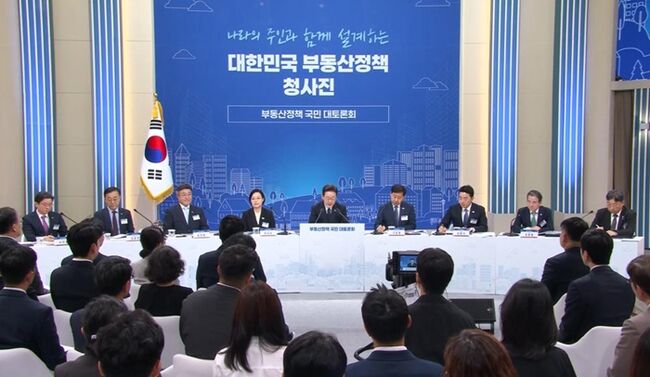 [Liberal Democratic Party Statement] Calling it a Grand Real Estate Debate… It Was Nothing More Than a Private Party Among Themselves
The 'National Grand Debate on Real Estate Policy' held on July 23rd and 27th. [Photo=Yonhap News]The 'National Grand Debate on Real Estate Policy,' hosted by the Lee Jae-myung administration under the
[Liberal Democratic Party Statement] Calling it a Grand Real Estate Debate… It Was Nothing More Than a Private Party Among Themselves
The 'National Grand Debate on Real Estate Policy' held on July 23rd and 27th. [Photo=Yonhap News]The 'National Grand Debate on Real Estate Policy,' hosted by the Lee Jae-myung administration under the
 [Photo] Evidence of Election Fraud Flooding U.S. Media… Trump Had 2.7 Million Votes Stolen
 [Video] U.S. Semiquincentennial Air Show... 'Art in the Sky' streaks across New York
 [Editorial Cartoon] A Draconian Law That Undermines Freedom of Expression

 List
List